The Invisible Editors of AI: Why Dataset Curators, Labelers, and Moderators Deserve Credit
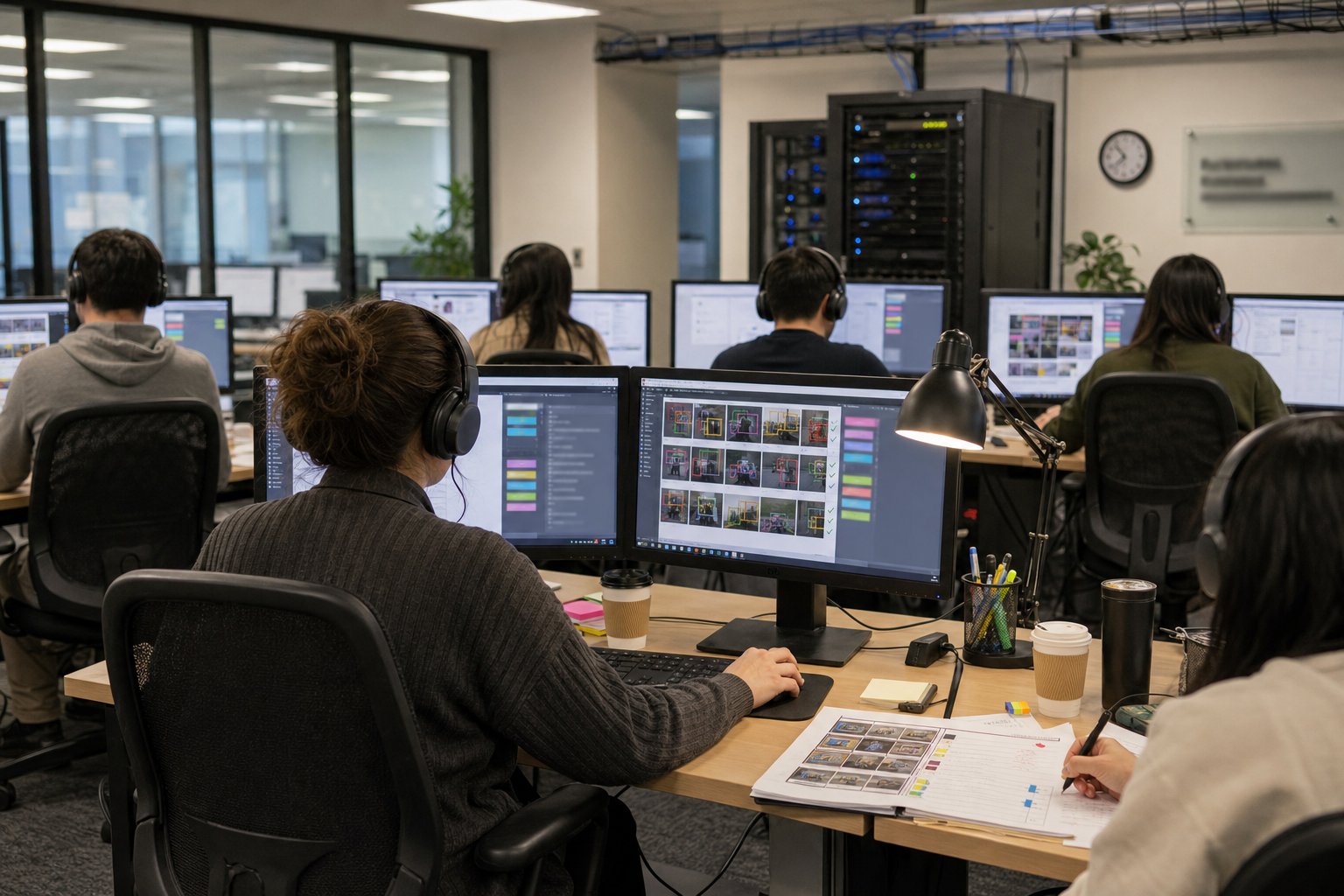
As generative AI moved into search, office software, customer service, and classrooms, most public attention went to model size, computing power, and well-known founders. Much less attention went to the people who selected training data, labeled examples, filtered harmful material, and scored model outputs. That missing part of the story matters because AI systems do not become useful, safe, or reliable through code alone. They are shaped by many human decisions before training, during testing, and after launch.
The debate is not whether engineers and researchers deserve recognition. They do. The real question is whether the public story about AI has become too narrow. If progress is framed mainly as a triumph of machines and a few star companies, the labor that defines quality and safety disappears from view. That makes AI look more autonomous than it really is. It also makes it easier to overlook weak labor protections, hidden bias, and the people who carry much of the system's ethical burden.
Data is not raw material. It is edited material.
One of the biggest myths in AI is that data is simply “collected,” as if it arrives in a clean and neutral form. In practice, datasets are built through selection, exclusion, and judgment. Someone decides which sources are trusted, which languages are included, which duplicates are removed, which low-quality samples are thrown out, and which sensitive material is blocked. Those are editorial choices, even if the job title does not include the word editor.
These choices change what a model can do. A system trained mostly on English and a narrow set of Western sources will perform differently from one built with broader multilingual coverage. A model trained on legal documents, technical manuals, and high-quality reference material will behave differently from one filled with noisy web content. Even basic questions such as what counts as hate speech, harassment, medical misinformation, or spam depend on definitions set by people.
That is why dataset curators deserve more than a passing mention in technical reports. They help determine what enters the system's world and what stays out. When those decisions are invisible, the model's outputs can look like pure computation rather than the result of organized human judgment.
Labeling and evaluation do more than clean up errors
Labelers and evaluators are often treated as support staff at the edge of the AI pipeline. In reality, they help define the model's behavior. When raters compare two answers and mark one as more helpful, safer, or more accurate, they are not just fixing mistakes. They are shaping the standard the system is trained toward.
This is especially clear in instruction tuning and output ranking. A chatbot that gives more cautious answers, refuses some prompts, or follows a preferred tone often reflects thousands or millions of human evaluations. Those evaluators may be following policy rules, common-sense judgments, or domain-specific guidance. In some cases, clinicians, lawyers, teachers, or security experts are brought in to review outputs. Their expertise matters. It is part of the product.
Yet public narratives often skip from “training” to “launch” as if the middle layer hardly exists. That is misleading. A strong model with weak evaluation can still fail in ordinary use. A smaller model with careful evaluation can feel much more reliable. Performance is not just about scale. It is also about the quality of the human feedback built into the system.
Moderation is safety work, and it often comes at a human cost
Content moderators occupy one of the hardest positions in the AI economy. They review material that many people would prefer never to see: abuse, exploitation, threats, graphic violence, self-harm content, scams, and manipulated media. Their work helps keep training sets cleaner, filters outputs, and supports policy enforcement. Without that labor, many AI systems would be far more dangerous to use and much harder to deploy responsibly.
There is a public contradiction here. Companies often market AI safety as a technical achievement, but some of that safety depends on human beings doing repetitive and sometimes distressing review work. In many parts of the industry, this labor is outsourced, fragmented across vendors, or hidden behind broad operational language. That does not make the work less essential. If anything, it makes the industry's dependence on it easier to ignore.
Giving moderators credit is not about sentiment. It is about accuracy. If a system avoids producing certain kinds of harmful content, that result may reflect policy design, classifier engineering, and model tuning. It may also reflect large amounts of human review. The safer outcome is real. So is the labor behind it.
Why credit matters in practical terms
Some people hear calls for credit and assume the issue is symbolic. It is not. Recognition changes incentives. Once data curation, labeling, and moderation are treated as central work rather than invisible support work, it becomes harder for companies to underpay, outsource recklessly, or hide poor conditions behind the glamour of innovation.
Credit also improves accountability. When a model fails, the useful questions are not only about architecture and compute. They are also about dataset choices, annotation guidelines, evaluation design, and moderation rules. If those layers remain vague, outside scrutiny becomes weak. Regulators, clients, and the public cannot assess risks they are not allowed to see clearly.
There is also a public understanding problem. The more AI is described as if it simply learns from the world on its own, the more people overestimate its independence and underestimate the social choices embedded in it. That misunderstanding affects everything from policy debates to workplace adoption. It encourages magical thinking on one side and misplaced blame on the other.
A fair counterpoint
There is a reasonable objection here. Modern AI systems involve huge supply chains. Not every contributor can be individually named in every product launch or media profile. Technical breakthroughs in modeling, systems design, and hardware are real achievements. And in some workflows, automation has reduced the amount of manual labeling needed for certain tasks.
That is all true. The point is not to deny technical progress or pretend every company can list every contractor by name. The point is that the current balance is off. Core engineering is highly visible. Data labor is often barely acknowledged. That imbalance distorts how AI is understood and who gets rewarded.
A second objection is that too much emphasis on hidden labor could make AI seem less impressive than it is. But the opposite is closer to the truth. Serious technologies are rarely the product of one kind of talent. Aviation depends on pilots, mechanics, air traffic control, and safety inspectors. Publishing depends on writers, editors, copy editors, and fact-checkers. AI is not weaker because many people shape it. It is more honestly described.
What better credit would look like
If the industry wants a more truthful account of AI progress, the fix is not complicated. It requires habits, standards, and better disclosure.
- Name the work in public. Product pages, launch notes, and model cards should clearly describe the roles of dataset curators, labelers, evaluators, and moderators.
- Document decision points. Companies should explain, in plain language, how data was selected, what annotation rules were used, and how outputs were tested.
- Treat this labor as skilled work. Pay, training, and career paths should reflect the judgment involved, especially in domain-specific evaluation.
- Protect moderators properly. Mental health support, sensible workload limits, and stronger vendor standards should be normal, not optional.
- Include these workers in governance. Safety reviews and post-launch audits are better when people close to the data and review process are part of the discussion.
None of this requires hero worship. It requires basic honesty about how AI systems are made.
The more powerful AI becomes, the less we should hide the people behind it
AI progress is often presented as a story about models getting smarter. A more accurate version is simpler and more useful: systems improve when people make better decisions about data, quality, risk, and use. Dataset curators, labelers, evaluators, and moderators are not peripheral to that process. They are part of the machinery of trust.
If the industry wants praise for building responsible AI, it should stop treating these workers as backstage labor that only appears when something goes wrong. They deserve credit because they help determine what the system knows, what it refuses, what it gets right, and what harms it avoids. In a field that likes to talk about intelligence, recognizing the human labor inside the system would be a good place to start.