Human Oversight Is Not a Checkbox: How to Tell Whether an AI System Still Has Real Accountability
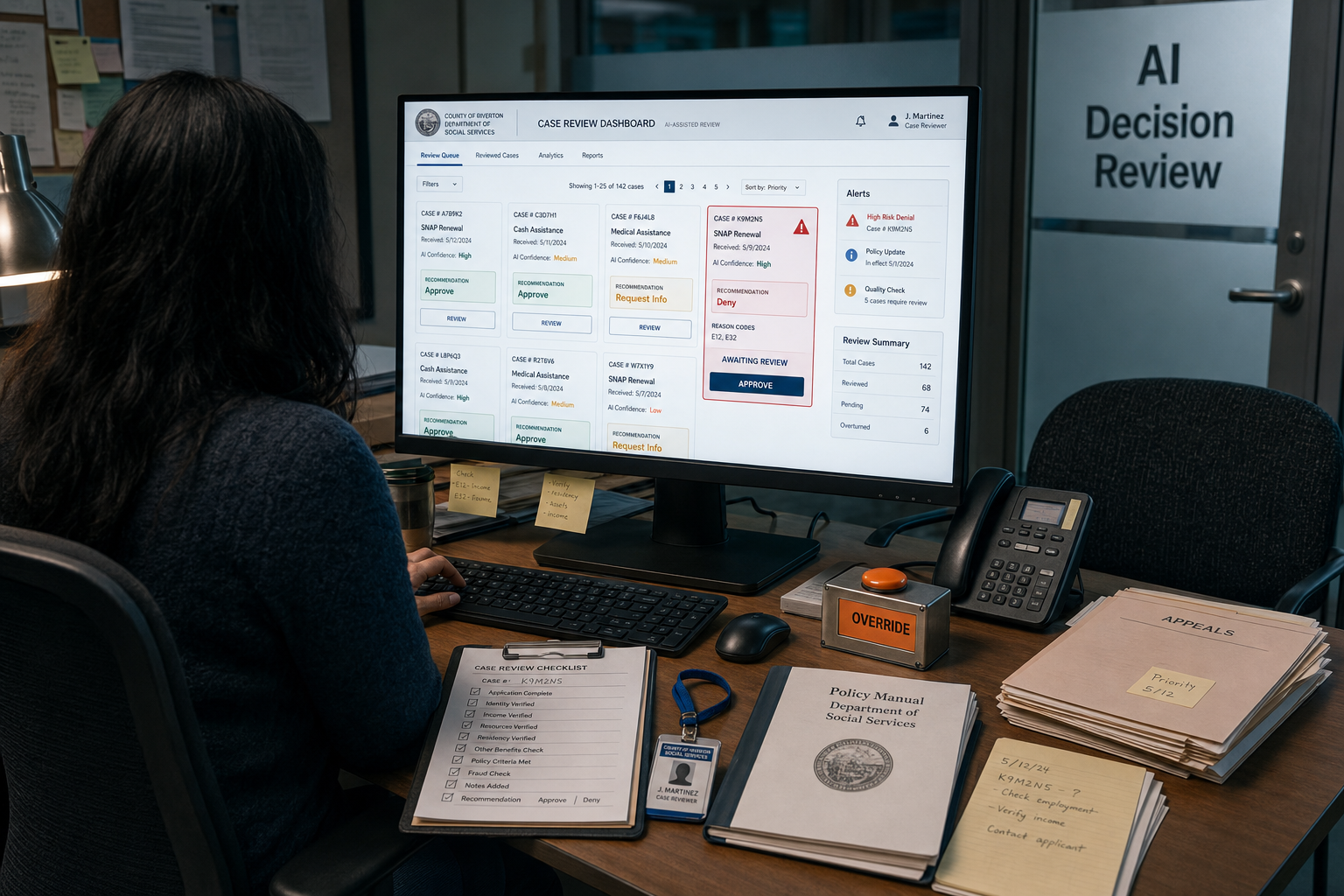
Many institutions now use AI tools with a familiar promise: a human is still “in the loop.” That claim now appears in education, hiring, healthcare, finance, customer service, and public administration. It matters because these systems increasingly shape real outcomes, from which students get flagged for cheating to which job applicants get reviewed first. The central debate is simple: does a person somewhere in the workflow create accountability, or can the human role become little more than a reassuring label?
My position is straightforward. Human oversight is real only when the person reviewing the system has enough time, enough context, and clear authority to stop or change the outcome. Without those conditions, oversight can become symbolic. An organization can say a person checked the result, but that person may have had no meaningful chance to challenge it. That is the difference between responsibility and theater.
A human at the end is not enough
Organizations often describe oversight in the simplest possible way: the AI produces a recommendation, then a human approves it. On paper, that sounds safe. In practice, it can hide three basic problems.
First, the human may be overloaded. A teacher reviewing dozens of plagiarism flags, a recruiter scanning a ranked list, or a manager clearing a queue of automated decisions may not have time to examine each case carefully. When speed is the real goal, “review” can turn into rapid confirmation.
Second, the human may lack the information needed to judge the output. If the system shows only a score, a label, or a red warning without the underlying evidence, the reviewer cannot do much more than trust the tool. Approval still happens, but informed judgment does not.
Third, the human may lack real authority. In some workplaces, overriding an automated recommendation slows the process, triggers extra paperwork, or invites criticism for hurting efficiency. When the cost of disagreement is high, most people learn to click yes.
If the reviewer cannot understand the alert, question the result, or safely say no, the system is not meaningfully supervised.
How symbolic oversight shows up in real life
Education offers a clear example. A school may use an AI tool to flag possible cheating or writing that appears machine-generated. The school can then say no student is punished by automation alone because a teacher makes the final call. That sounds responsible. But if the teacher sees only a risk score, has little training on false positives, and must clear a large list before the end of the day, the safeguard is weak. The teacher is present, but the process is still being driven by the system.
Hiring creates a similar problem. An employer may insist that no applicant is rejected by AI because a recruiter reviews the shortlist. Yet the shortlist itself can shape the whole decision. If the recruiter sees only the top-ranked candidates and never sees who was screened out, the tool has already narrowed the field. The human is steering at the end of a road someone else built.
Healthcare and finance add another layer: urgency. Risk scores, fraud flags, and triage recommendations can be useful because they help staff prioritize limited attention. But urgency also makes rubber-stamping more likely. When a queue is long and the tool appears confident, people tend to trust the alert unless the mistake is obvious.
None of these examples mean AI should be banned from high-stakes settings. They do mean that the phrase “human in the loop” tells us very little by itself. The real question is what the human can actually do.
The questions that reveal real accountability
Before trusting an AI-assisted decision, it helps to ask a few simple questions. If an institution cannot answer them clearly, the oversight is probably weaker than it claims.
- Can the human override the system without punishment? Formal authority is not enough. If staff are penalized for slowing the process or going against the tool, the override is mostly theoretical.
- Does the reviewer see the evidence behind the output? A score alone is not an explanation. Real oversight requires access to the facts, the source material, and the system’s known limits.
- Is there enough time for real review? One person reviewing hundreds of automated flags is not careful oversight. Workload is an accountability issue, not just a staffing issue.
- Does review happen before harm, not only after? An appeal process matters, but it is not a substitute for meaningful review before a student is disciplined, an applicant is dropped, or a payment is frozen.
- Are decisions and overrides recorded? If no one logs why a recommendation was accepted or rejected, it becomes hard to audit patterns, correct mistakes, or assign responsibility later.
- Is there a path for appeal to a real person? People affected by automated systems need a route to challenge the result with someone empowered to reconsider it.
- Is the system tested in the specific context where it is used? A tool that works reasonably well in one setting can fail badly in another. Local testing matters more than broad marketing claims.
These are not technical details for specialists. They are practical tests of whether a human role is substantive or ceremonial.
Why weak oversight keeps spreading
There are understandable reasons organizations fall into symbolic oversight. AI systems promise speed, scale, and lower costs. Leaders want efficiency gains without appearing reckless. Saying a human reviews the results seems to solve both problems at once.
It also distributes blame in a convenient way. If the system performs well, the organization credits automation. If the system fails, it can point to the human reviewer and say the safeguard was there. That structure looks accountable from the outside, even when the reviewer had too little time, too little information, or too little power to make a meaningful difference.
Vendors play a role as well. “Human-in-the-loop” is a reassuring phrase because it sounds familiar and safe. But it often describes a workflow shape, not a quality standard. A person may be present in the process without being able to control it.
The fair counterpoint
Supporters of AI-assisted workflows make a reasonable argument. Full manual review is expensive and slow. In fast-moving settings such as fraud detection, content moderation, or clinical triage, waiting for deep human review on every case can create new harms. Humans are also inconsistent, biased, and tired. A system that helps prioritize attention can improve outcomes.
That is true. The answer is not to force a person to examine every output in the same way. Real accountability can include sampling, threshold-based escalation, second reviews for high-impact cases, and strong appeal channels. A well-designed system may automate low-risk decisions while reserving human judgment for ambiguous or high-stakes cases.
But that only strengthens the main point. Oversight should be designed honestly around the level of risk. It should not be advertised broadly when it exists only in name. If an institution wants the benefits of automation, it should also be clear about where humans genuinely intervene and where they do not.
What institutions should stop doing
They should stop treating a final human click as proof of accountability. They should stop hiding behind vague assurances that “a trained professional reviews every case” when that professional is given seconds, not minutes, and a score, not evidence. They should stop presenting appeals as if they erase the harm of bad initial decisions.
They should also stop assuming that training alone fixes the problem. Training matters, but no amount of training can overcome impossible workloads or missing authority. Accountability is built through process design, staffing, audit trails, and leadership incentives, not through slogans.
Accountability has to be designed
The best test is simple. Ask who can stop the system, on what grounds, with what information, and in what amount of time. Then ask what happens when that person disagrees with the tool. If the answers are vague, the oversight is probably weak.
AI can help people work faster and sometimes better. That is the promise. The risk is that institutions use the language of human judgment to cover decisions that are effectively automated. A person in the loop is not enough. Real accountability requires a person with the power, context, and time to matter.
Before you trust an AI-assisted decision, do not ask only whether a human is involved. Ask whether the human can truly act. That is where accountability starts.