When Governments Blacklist AI Companies: What the Anthropic Ruling Means for Users, Researchers, and Trust
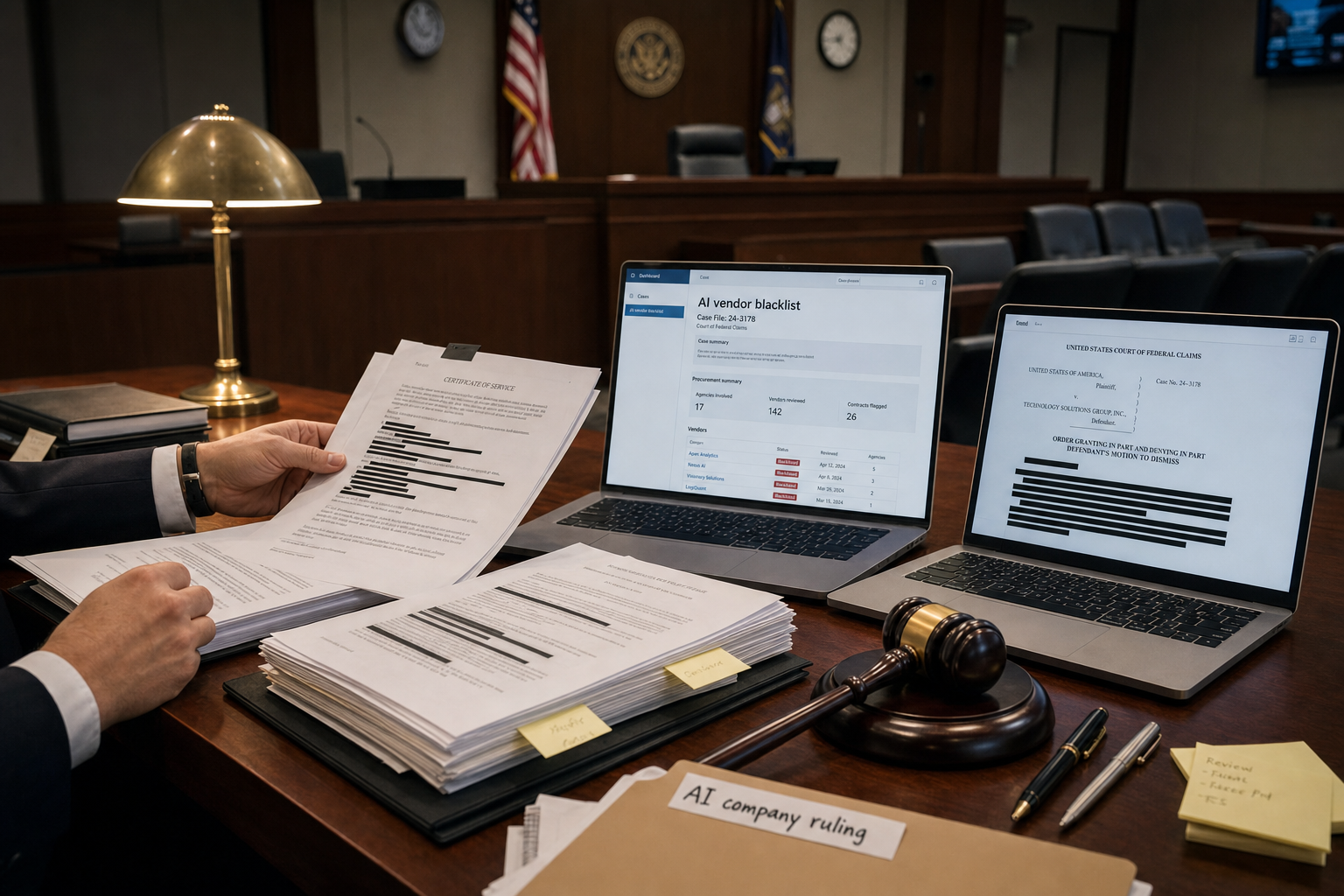
According to early reports, a judge has ruled that a government move to blacklist Anthropic was illegal. If that reporting is accurate, this is not just a legal win for one AI company. It is a warning that governments cannot cut off a major AI provider without clear legal authority, evidence, and a fair process.
That matters because AI companies are no longer a niche part of the tech market. Their tools sit inside research labs, classrooms, software products, and workplace systems. The central debate is straightforward: governments do need the power to restrict risky vendors, but when they use that power loosely, politically, or opaquely, the damage reaches far beyond the targeted company.
Some details of the reported ruling still appear uncertain at the time of writing. Public coverage is thin, and the exact scope matters. “Blacklisting” can mean different things: a procurement ban, a formal debarment, a broader restriction on use, or something in between. The legal reason also matters. A court might object to lack of due process, weak evidence, improper procedure, or political retaliation. Those are different findings. Still, the broader public lesson is already clear enough to discuss.
This is bigger than Anthropic
This should not be read as a sympathy piece for Anthropic. Large AI companies deserve hard scrutiny. They make bold claims, collect influence, and supply systems that can affect jobs, education, privacy, and public services. If a government has credible evidence that one of these companies poses a real legal or security risk, it should act.
But a blacklist is not an ordinary policy tool. It is a blunt one. In practice, it can reshape a market overnight. It can lock researchers out of tools they rely on, force startups into expensive migrations, and push public institutions toward whichever vendors remain politically safe. That is why courts should look closely at these actions. When AI is becoming basic infrastructure, arbitrary exclusion is not a small administrative decision.
Governments should be able to restrict dangerous AI vendors. They should not be able to do it by surprise, with vague claims, and no meaningful path to challenge the decision.
Users are often the first collateral damage
Blacklists are usually described as fights between states and companies. That framing misses the people in the middle.
Consider a few ordinary cases. A university lab may have spent months building experiments around one model API. A sudden government restriction can interrupt the project, break reproducibility, and waste grant money. A startup that uses a model for accessibility tools may have to rebuild core features fast, at higher cost, then pass that cost to schools, nonprofits, or disabled users. A public agency testing AI to summarize long case files may need to pause the whole effort, leaving citizens with slower service again.
None of these people are responsible for the legal dispute. Yet they absorb the disruption first.
This is one reason the Anthropic ruling, if confirmed as reported, matters for more than one brand name. It highlights a basic reality of modern AI markets: users do not just “switch providers” as easily as policymakers sometimes assume. Migrating from one model to another can mean rewriting software, redoing safety checks, retraining staff, revising documentation, and accepting different performance limits. For researchers, it can also mean losing continuity in an ongoing line of work.
Researchers need stability, not policy whiplash
Academic and independent researchers are especially exposed. Much of today’s AI research depends on access to commercial systems. That is already a problem for openness and reproducibility. A poorly handled blacklist makes it worse.
If one provider is suddenly cut off, the research record becomes harder to verify. Benchmarks may no longer be repeatable. Comparative studies may become incomplete. Work that looked neutral can end up skewed toward whichever firms have the strongest political or procurement position rather than the best tools for the question being studied.
There is also a competition issue here. Broad or unstable blacklisting tends to help incumbents with the deepest compliance teams and the safest government relationships. Smaller labs, academic partnerships, and new entrants have fewer buffers. In the name of control, policymakers can accidentally narrow the field even further.
That is bad for science, and it is bad for public accountability. A concentrated AI market is harder to study, harder to challenge, and harder to govern well.
Trust is not built by tough talk alone
Public trust in AI is already thin. Many people suspect the industry overstates benefits and understates risks. Many also suspect governments do not fully understand the systems they are trying to regulate. In that environment, a blacklist can either strengthen trust or weaken it.
It strengthens trust when the state can show a clear reason, a lawful process, and evidence that the restriction is necessary. It weakens trust when the action looks improvised, selective, or political.
That is why due process is not a technical side issue. It is part of AI governance itself. If the public sees regulators making major decisions through opaque power plays, they will not simply lose confidence in one agency. They will start to doubt the credibility of AI oversight as a whole.
The same is true on the company side. An AI firm cannot demand public trust while resisting scrutiny. If Anthropic, or any company like it, wants to be treated as infrastructure, it should expect deeper review. But review is different from arbitrary punishment. One is governance. The other is noise with legal force.
The counterargument is real
The strongest argument for blacklisting power is easy to understand. Governments sometimes need to move fast. An AI vendor could mishandle sensitive data, violate export rules, misrepresent security standards, or create dependencies that later become a national security problem. In those cases, delay has costs. Waiting for a long perfect process may expose the public to more harm.
That concern is serious, and any honest editorial should admit it. Not every restriction can wait for months of public hearings. Some actions do need to be immediate.
But that does not justify broad, indefinite, or weakly explained blacklists. The better answer is a layered one: emergency restrictions when necessary, followed quickly by review, explanation, and a real chance to challenge the decision. Urgency can justify speed. It does not justify carelessness.
What smarter AI blacklisting would look like
If governments are going to keep blacklisting or debarment tools in the AI sector, they need clearer rules than many appear to have now.
- Define the trigger. Is the action based on security failures, fraud, sanctions risk, procurement violations, data misuse, or something else? The ground should be specific.
- Match the remedy to the risk. A problem in one contract should not automatically become a system-wide ban if a narrower fix would work.
- Explain as much as possible. Some evidence may need to stay confidential, but the public basis for the action should not be a mystery.
- Provide a fast appeal path. Companies should be able to contest errors, and users should not be trapped in a long limbo created by bad process.
- Protect continuity for researchers and public-interest users. Transitional access, carve-outs, or migration windows can reduce collateral damage.
- Use sunset reviews. Restrictions should not run forever by default. If the risk changes, the policy should too.
These are not pro-corporate ideas. They are pro-governance ideas. They protect the public from risky vendors, and they protect the public from sloppy state action at the same time.
Why the ruling matters even if you never use Anthropic
Most people do not care much about the internal politics of AI firms, and they should not have to. What they should care about is whether critical technology policy is being made in a lawful, legible way.
If a government can blacklist one major AI provider without meeting basic legal standards, that precedent will not stay limited to one company. It will shape who researchers can study, which tools schools can adopt, what startups can build on, and how much confidence the public has in official claims about AI safety.
That is the real significance of the reported Anthropic ruling. It is less about Anthropic itself than about whether AI governance will be built on rules or on sudden force.
If the court did indeed find the blacklist illegal, that should be seen as a healthy correction, not a regulatory failure. Governments need strong powers in the AI era. They also need limits. Without those limits, users lose stability, researchers lose access, and everyone loses trust.
The practical lesson is simple: in AI policy, rule of law is part of safety. A blacklist may sometimes be necessary. But if it cannot survive basic legal scrutiny, it is not building trust. It is burning it.