From Blank Page to Better Draft: A Human-Centered Workflow for Writing with AI Without Losing Your Voice
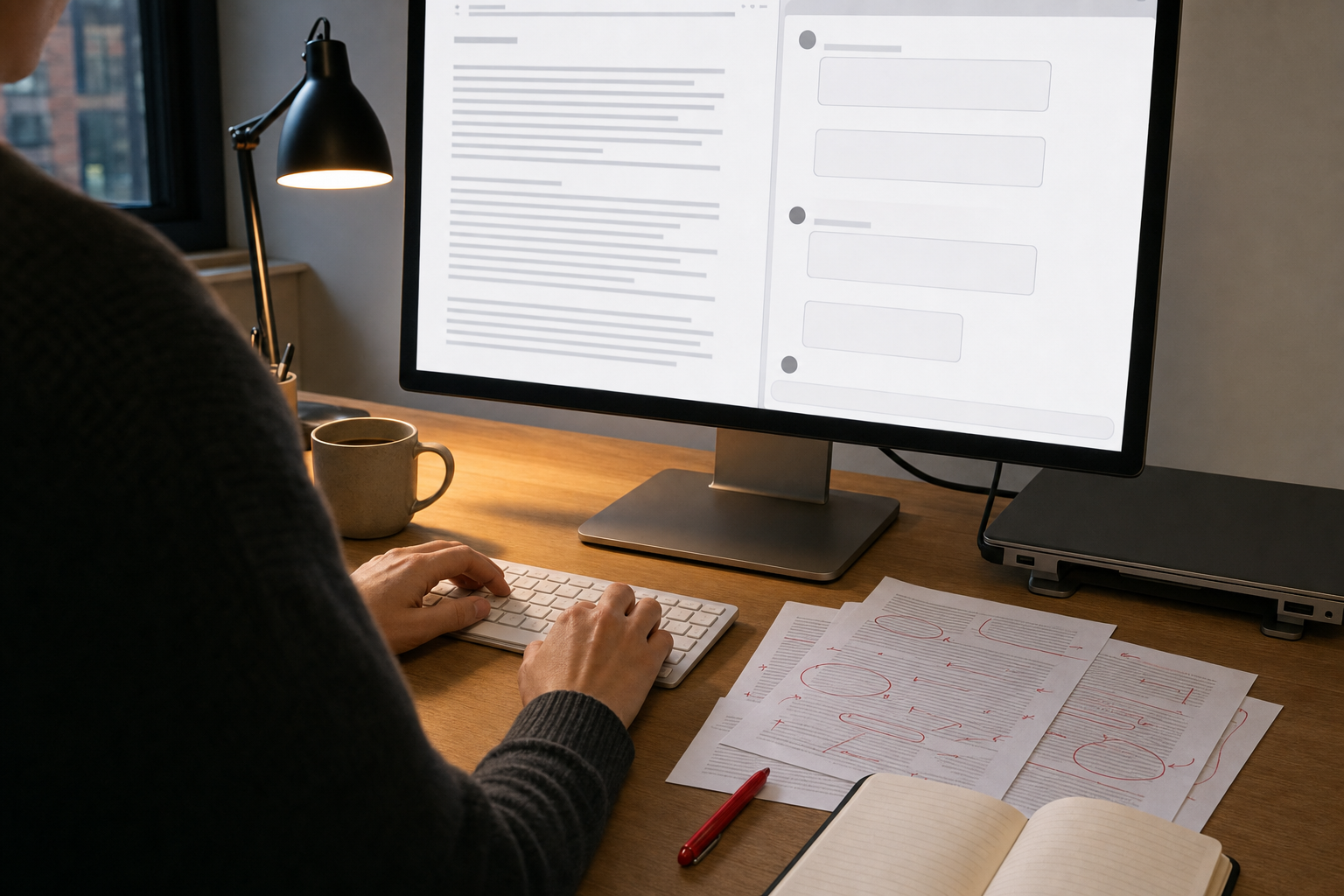
AI writing tools have moved quickly from novelty to routine. Students use them to start essays. Marketers use them to draft campaigns. Professionals use them to summarize notes, build outlines, and clean up awkward sentences. That shift matters because writing is not only a way to publish ideas. It is also how people think, argue, and present themselves. The central tension is simple: can writers use AI to save time without ending up with prose that sounds smooth, generic, and strangely impersonal?
My view is yes, but only with a clear boundary. AI is most useful when it handles narrow tasks such as brainstorming, structure checks, and revision passes. It is least useful when it is asked to produce the whole piece and the writer tries to “personalize” it afterward. That usually leads to bland copy with a few human edits on top. If you want to keep your voice, the human job is not just final approval. It is choosing the point, the examples, the rhythm, and the standard.
The fear is real, and it is not irrational
Writers are right to be cautious. Most AI systems are trained to produce plausible, average prose. That makes them helpful in one sense: they can turn scattered notes into readable sentences very quickly. But it also creates a problem. Average prose is often what people mean when they say something “sounds like AI.” It is grammatically clean, but the edges are gone.
The deeper risk is not just style. It is thinking. If a system gives you an outline, your examples, your transitions, and your conclusion, you may publish something competent without ever doing the harder work of deciding what you actually believe. That is efficient, but it is not a good bargain for anyone whose writing is meant to carry judgment, expertise, or personality.
Still, the counterpoint deserves respect. For many people, especially non-native English writers, early-career professionals, or anyone facing a deadline, AI can reduce real friction. It can help organize a messy argument. It can suggest cleaner phrasing. It can make the blank page less intimidating. The answer is not to reject the tool. It is to use it in a way that protects the parts of writing that matter most.
Start with your own material, not a request for a full article
The biggest mistake is also the most common: “Write me an 800-word article about X in a friendly tone.” That prompt invites the tool to fill the page with default language. A better starting point is your own raw material.
Before you open the AI tool, write down a few basics:
- What is the one point you want to make?
- Who is the audience?
- What do you want them to understand, question, or do?
- What examples, stories, or facts do you already have?
- What tone fits the piece: direct, skeptical, practical, warm?
This does not need to be elegant. Bullets are enough. The point is to give the process a human center before the machine starts predicting text.
For example, if you are writing about remote work, your notes might include: one claim, one personal observation from your team, one statistic you plan to verify, one counterargument, and one sentence about what you do not want the piece to sound like. That last part matters. Style is often easier to protect when you define what to avoid.
Ask the AI to question you before it drafts anything
A simple way to keep your voice is to make the tool pull more material out of you first. Instead of asking for a draft, ask for questions.
You can ask it to do things like:
- Identify gaps in your argument
- Ask ten specific questions that would sharpen your point
- Challenge your assumptions from a skeptical reader’s perspective
- Suggest what evidence or examples are missing
This step is underrated. Good writing often depends less on better wording than on better noticing. A question such as “What would a reader misunderstand here?” or “What is the strongest objection to this claim?” can improve a piece more than a full AI draft ever will.
It also helps non-native English writers in a useful way. Instead of copying a generic paragraph and trying to adapt it, they can answer focused questions in their own words and then shape those answers into prose. That keeps the thinking personal, even if the language support comes later.
Use AI to test structure, not to decide meaning
Once you have notes and answers, AI can be very good at outlining. It can offer three or four ways to organize the same material: problem first, example first, counterargument first, or practical guide first. That is helpful because structure is often where writers get stuck.
But this is the point where human judgment has to stay firm. Do not just select the neatest outline and move on. Compare the options. Then rewrite the outline yourself. Cut sections you do not need. Add the example you know belongs near the top. Change the order if the logic feels wrong.
The outline should serve your argument, not replace it. AI can show possible routes. You still need to choose the destination and decide what matters most.
Write the parts with the most voice yourself
If you want the final piece to sound like you, write the parts where voice carries the most weight before you ask for help on the rest.
That usually means:
- The opening paragraph
- The main claim or thesis
- Any personal story or specific example
- The section where you make your strongest judgment
- The conclusion
These are the places where readers decide whether they trust the writer. They are also the places where AI-generated prose is most likely to feel secondhand.
There is nothing wrong with using AI to build supporting paragraphs around these sections. But when the central argument arrives in borrowed language, the whole piece tends to wobble. It may still read well. It just will not carry much authority.
Use AI for narrow drafting tasks, not full substitution
After you have a structure and some anchor paragraphs, AI can help with specific jobs that are genuinely useful.
- Turn scattered bullet points into a rough paragraph you will later rewrite
- Generate possible subheadings
- Suggest transitions between two sections
- Condense a long passage without losing the core meaning
- Offer alternative phrasings for a sentence that feels flat or repetitive
- Summarize a counterargument fairly so you can respond to it
The key is scope. “Help me tighten this paragraph” is different from “Write this article.” One protects authorship. The other outsources it.
A practical test helps here: if you could paste the AI output directly into publication with only minor edits, you have probably given the tool too much of the writing job. Useful AI output should usually feel provisional. It should save time, not end the thinking.
Run separate revision passes instead of one vague request
Many writers use AI poorly at the editing stage too. They paste a full draft and ask, “Can you improve this?” That often produces a smoother version with less character. A better method is to ask for one kind of edit at a time.
Useful revision passes include:
- Clarity: Which sentences are hard to follow?
- Structure: Where does the argument jump too quickly?
- Evidence: Which claims need support or sourcing?
- Redundancy: What repeats the same point?
- Tone: Where does the piece sound stiff, vague, or too promotional?
- Readability: Which long sentences could be shortened?
This is where AI can act more like a fast editorial assistant than a ghostwriter. It can spot patterns you no longer see because you are too close to the draft. That is a real advantage.
But do not confuse useful criticism with reliable judgment. AI can recommend removing the sentence that gives the piece its distinctive edge because that sentence breaks a pattern. Sometimes that is exactly why it should stay.
Do a final human-only pass to restore voice
Even a careful AI-assisted draft needs one stage with no machine input at all. Read the piece aloud. Mark the lines that sound unlike you. Replace broad words with specific ones. Put back the detail you cut too early. Check whether the rhythm feels natural or overly polished.
This is also the moment to ask a blunt question: would a reader who knows my work recognize this as mine?
If the answer is no, look for the common signs of generic prose:
- Openings that could fit almost any article
- Abstract nouns instead of concrete examples
- Balanced but empty phrasing that avoids taking a clear position
- Transitions that sound professional but add no meaning
- Conclusions that summarize without leaving a real point behind
Voice is not decoration added at the end. It comes from choices: what you notice, what you ignore, what you are willing to state plainly, and what examples you trust enough to include. That is why the final pass has to be human.
Do not ignore the practical risks
There are also basic editorial risks that have nothing to do with style. AI systems can invent facts, misstate sources, and flatten nuance. If you ask for examples, quotes, studies, or historical references, you need to verify every one of them. That is non-negotiable.
Privacy matters too. Do not paste confidential interviews, unpublished reporting, client documents, or sensitive internal material into a public AI tool unless you know the terms and have permission. Writers sometimes focus so much on voice that they forget the larger professional obligations.
And context matters. In journalism, academic work, and many workplaces, disclosure rules may apply. A workflow that is acceptable for polishing a newsletter may not be acceptable for a reported article or a university submission. The tool may be the same. The standards are not.
The best use of AI is modest and disciplined
There is no prize for writing every sentence the hard way if a tool can help you think more clearly or revise more efficiently. But there is also no value in publishing words that are technically clean and personally empty. The most effective writers will likely be the ones who treat AI neither as a threat to avoid nor as an author to trust.
The better model is simpler: use AI to create options, surface gaps, and reduce friction. Keep the decisions that shape meaning, taste, and tone in human hands. If you do that, AI can help you get from blank page to better draft. If you do not, you may finish faster, but you will sound more like the tool than yourself.
A useful rule to remember: let AI help with the work around your voice, not the work instead of your voice.