Community Rules for AI Use: Let the People Affected Help Write Them
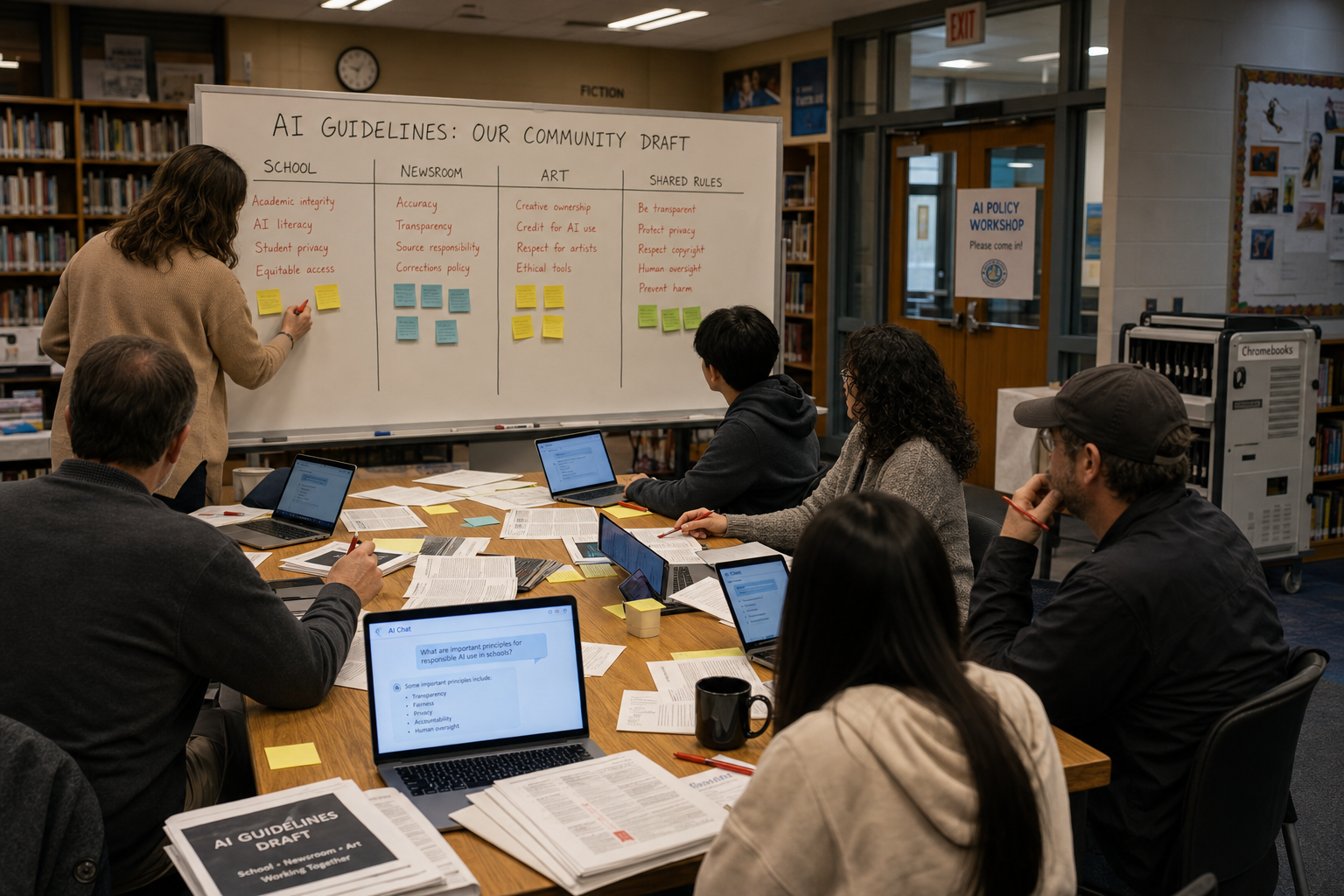
Schools are issuing AI policies. Newsrooms are adding disclosure rules. Creative groups are arguing over whether AI-assisted work belongs in contests, pitches, or shared projects at all. The immediate reason is simple: generative tools are now cheap, easy to access, and hard to police. What used to be a fringe question is now part of daily work.
This matters because communities are not just deciding what AI can do. They are deciding what kind of standards they want to live with. The main debate is no longer whether rules are needed. They are. The real tension is whether those rules should come from the top down, or whether teachers, editors, students, artists, and contributors should help shape them. My view is clear: leaders should set basic guardrails, but communities should help write the working rules. That is the best way to get policies people understand, trust, and actually follow.
Why top-down rules are not enough
Top-down rules have one obvious advantage: speed. A school can send a memo. An editor can update a handbook. A platform can add labels and terms of service. In some cases, that is necessary. If privacy is at risk, if students are submitting fully generated work as their own, or if a newsroom faces legal exposure, waiting months for consensus is not realistic.
But speed often creates weak policy. Broad bans are easy to announce and hard to enforce. Vague permissions create confusion. Rules written only by managers or lawyers tend to miss the real situations people face every day. A teacher may allow AI for brainstorming but not for final writing. A reporter may use transcription software but not AI-written quotes or summaries without checking the source material. A design collective may accept AI for mockups but reject it in final submissions. These are practical distinctions. A one-line policy rarely covers them.
There is another problem. People are more likely to resist rules they see as imposed, inconsistent, or technically naive. That resistance does not always look like open rebellion. Often it looks like quiet workarounds, selective disclosure, and growing mistrust. In a classroom, that can undermine learning. In a newsroom, it can damage credibility. In a creative group, it can poison collaboration.
The promise of shared rule-making is not harmony. It is legitimacy. If people understand why a rule exists, where it applies, and how it was decided, compliance becomes much more likely.
Start with the work, not the technology
Many AI policies fail because they start by asking, “Do we allow AI?” That is too blunt. Communities should start with a different question: “What are we trying to protect or produce here?”
In a classroom, the answer may be learning, original thinking, and fair assessment. In a newsroom, it is accuracy, accountability, and public trust. In a creative group, it may be authorship, consent, artistic standards, and economic fairness. Once that purpose is clear, the role of AI becomes easier to define.
This shift matters because the same tool can be harmless in one context and damaging in another. Spellcheck is not the same as ghostwriting. Audio cleanup is not the same as inventing a quote. Generating rough visual ideas is not the same as submitting machine-made work in a competition built around human craft. Good policy separates these cases instead of collapsing them into a single yes-or-no answer.
The five decisions every community should make
Most groups do not need a grand theory of AI. They need a short, usable agreement. That agreement should answer five questions.
- What uses are allowed? Be specific. Research help? Outlining? Translation? Transcription? Image cleanup? Administrative drafting? Say what is clearly acceptable.
- What uses are restricted or prohibited? This should cover the high-risk areas: fake citations, fabricated quotes, undisclosed ghostwriting, use of confidential data, impersonation, and submission of generated work where original work is required.
- When is disclosure required? Not every use needs a flashing label. But communities should define when disclosure matters. If AI changed the substance of the work, supported reporting, shaped a final product, or replaced labor that readers or reviewers would reasonably expect a human to do, disclosure should be on the table.
- What review process applies? Someone must be responsible for checking facts, sources, rights, and quality. AI use does not remove human accountability. It often increases the need for it.
- How will the rules be revised? Tools change quickly. Policies should not be treated as permanent. Set a review date and update based on actual use, not panic.
Those five questions force clarity. They also make disagreement productive. People may not agree on every detail, but they can argue about concrete choices instead of abstract fear.
What participation should look like in practice
“Decide together” does not mean endless meetings. It means structured input before the rules are finalized. A workable process is usually simpler than people think.
- Map the real use cases. Ask members how AI is already being used, quietly or openly. The answers are often more revealing than official policy drafts.
- Identify the red lines. Leaders should define the non-negotiables first: privacy breaches, fabricated evidence, plagiarism, undisclosed synthetic sources, and any use that breaks law or professional ethics.
- Draft examples, not just principles. People understand scenarios better than slogans. “You may use AI to summarize your own interview notes, but you may not publish that summary without checking against the recording.” That kind of sentence works.
- Invite feedback from the people who will live with the rule. Students, teachers, desk editors, freelancers, contributors, and moderators will spot problems faster than a policy committee acting alone.
- Publish a short version and a detailed version. Most people need the practical rules first. The reasoning can sit behind them.
- Review after a fixed period. Ninety days is often enough to see where the confusion lies.
This is not bureaucracy for its own sake. It is a way to avoid rules that look firm and fail on contact with real work.
How it works in classrooms
Schools often swing between two weak positions: total bans or vague permission. Neither serves students well. A better approach is to distinguish between learning support and outsourced thinking.
For example, a department might allow AI for grammar feedback, study questions, translation support, or brainstorming. It might ban AI-generated final essays in courses designed to assess writing ability. It might require students to note when they used AI to develop an outline or revise a draft. That is not perfect, but it is clear.
Students should be part of this discussion, not because they should set the standards alone, but because they know where the pressure points are. They know when rules are unrealistic. They also know how quickly classmates find loopholes. Bringing them into the process can improve both honesty and design.
The risk, of course, is that some students will push for looser rules mainly for convenience. That is real. But that is not an argument against participation. It is an argument for participation with adult judgment and clear educational goals.
How it works in newsrooms
Newsrooms face a sharper trust problem. Readers already worry about what is real, what is verified, and what is being passed off as original reporting. For journalism, a weak AI policy is not just an internal issue. It can become a public credibility issue fast.
Here the core principle should be simple: efficiency tools may assist the process, but they cannot replace verification, editorial responsibility, or transparent sourcing. A newsroom might allow AI for transcription, translation checks, headline options, or document sorting. It should be much stricter about summaries of source material, generated analyses, image creation, or any output that could be mistaken for reported fact.
Editors, reporters, visual teams, and standards staff should help shape these rules together. Otherwise, one desk may quietly use tools another desk considers unacceptable. That inconsistency is where trust breaks down.
Some people argue that full disclosure of any AI use will overwhelm readers and turn minor assistance into a scandal. That concern is fair. Disclosure should not become noise. But the answer is not silence. It is better standards about material use. If AI materially shaped reporting, generated a publishable element, or touched sensitive evidence, readers deserve to know.
How it works in creative groups
Creative communities often face the hardest arguments because the disagreement is not only technical. It is also economic and cultural. Members may ask whether AI-assisted work borrows unfairly from other creators, lowers the value of skilled labor, or changes the meaning of originality itself. These are serious concerns, and many of the legal questions around training data and copyright remain unsettled.
That uncertainty is exactly why creative groups need clear local rules. A writing collective, festival, gallery, or online art forum should not wait for courts or platforms to settle every issue. It can define its own standards now.
Those standards might include categories such as:
- Human-made only for juried competitions or showcases built around craft.
- AI-assisted with disclosure for experimental work, concept development, or hybrid forms.
- Restricted source material rules where contributors must confirm they did not use private, confidential, or clearly unauthorized material.
This approach does not solve every dispute. But it gives members a fair basis for participation and enforcement. It also avoids a common mistake: pretending all creative communities value the same thing. They do not. A commercial design team, a poetry workshop, and a fan art forum may reach different conclusions, and that is acceptable as long as the rules are clear.
The counterargument: participation can be slow and messy
It can. Shared governance takes time. Strong personalities may dominate. Some members may know far more about the tools than others. And in high-risk settings, leaders may need to act before a broad consultation is possible.
That is why the best model is not pure consensus. It is participatory rule-making with accountable leadership. Leaders should set legal, ethical, and safety boundaries. The community should help define the workable standards inside those boundaries.
In other words, not every rule needs a vote. But every durable rule needs informed input.
What good AI policy looks like
Good policy is not long. It is not full of slogans. It does not treat every use case as equal. It gives examples. It names prohibited behavior. It explains when disclosure matters. It makes one person or role responsible for final review. And it includes a date for revision.
Most of all, good policy reflects the values of the group using it. A classroom should sound like a classroom. A newsroom should sound like a newsroom. A creative collective should sound like a creative collective. When communities borrow generic policy language without adapting it, they often import confusion along with it.
The goal is not to write the perfect AI rule. It is to write rules that people can understand, trust, and use under pressure.
AI policy is now part of ordinary governance. The question is not whether communities will make these decisions. They already are. The question is whether they will do it in a way that builds trust instead of draining it. The practical answer is straightforward: set firm red lines, involve the people affected, use concrete examples, and revise early. Communities do not need total agreement. They need rules that match the work, the risks, and the values of the people in the room.