Claude Opus 4.8 and the Work Humans Still Own: Judgment, Taste, and Responsibility
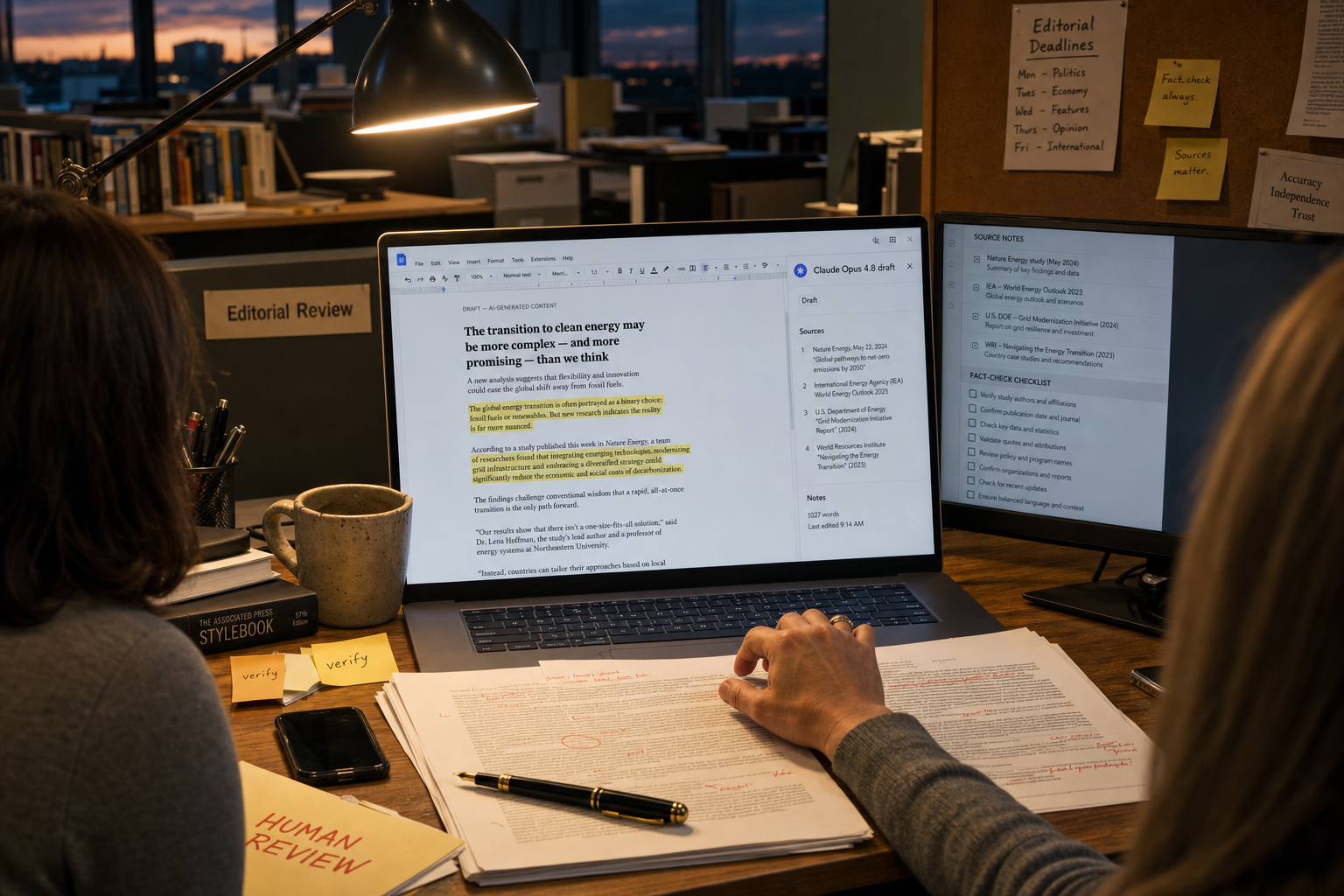
Anthropic’s Claude Opus 4.8 is already being discussed as another jump in model capability, especially in writing, analysis, and knowledge work. Some of that conversation still rests on launch claims and early user reports, so independent testing matters. But the practical point is clear enough now: when a model gets better at producing plausible, polished output, the human role does not disappear. It changes.
That matters because many people are asking the wrong question. The question is not whether AI can help write, summarize, explain, or draft. It can, and each new release makes that harder to deny. The real debate is whether stronger output also replaces human judgment. My view is no. Claude Opus 4.8 may take over more routine production, but writers, educators, editors, and small teams still own three things that matter most: what deserves to be said, what counts as good, and who answers when the result is wrong.
A stronger model mainly changes the first pass
The biggest effect of models like Claude Opus 4.8 is not mystical. It is operational. A stronger system can turn messy notes into a readable draft, compare several arguments, rewrite for a different audience, suggest examples, or produce a working structure in minutes. For a small team, that is real leverage. For a solo writer or editor, it can remove a lot of friction.
That promise is easy to see. A nonprofit can turn meeting notes into a donor update. A teacher can generate alternate explanations for the same concept. An editor can get a fast summary of a long report before deciding what to read closely. A small business can draft customer replies in a more consistent tone.
But better first passes also create a new risk: people start treating a fluent draft as a finished thought. That is where the trouble begins. When the language is clean, the weak logic, missing evidence, and bad prioritization become harder to spot. In other words, better models raise the value of human review precisely because they make mediocre output look finished.
Judgment is still a human task
Judgment is not just producing a likely answer. It is deciding among tradeoffs under real constraints. That includes deciding what facts matter, what uncertainty needs to be disclosed, what risk is acceptable, and when a useful answer is still not good enough.
A model can help compare options. It can summarize the upside and downside of each. It can even imitate the language of careful thinking. But it does not bear the consequence of the choice.
Take a writer working on a piece about a controversial study. The model can draft a balanced summary. It cannot decide whether the evidence is strong enough to feature the claim at all. That decision requires context about audience, editorial standards, and the cost of giving weak research more attention than it deserves.
Or take a school deciding how students may use AI. A model can propose policy language. It cannot decide what the school believes students should actually learn through writing, nor how much assistance changes an assignment from support into substitution.
Small teams face the same issue. AI can draft product copy, customer responses, or hiring messages. But a human still needs to decide whether a faster reply is worth the risk of sounding careless, whether a claim is too aggressive, or whether a policy exception should be made for a specific customer.
This is why “the model got smarter” is not the same as “the decision can be automated.” Better systems can reduce the labor around a choice. They do not remove the need to make one.
Taste is not fluff. It is selection.
Taste is often dismissed because it sounds subjective. In practice, it is highly concrete. It is the ability to tell the difference between clear and merely smooth, between distinctive and generic, between persuasive and pushy, between useful detail and clutter.
Claude Opus 4.8 may be better than earlier models at producing polished prose. That is useful. But polished prose is not the same as good prose. A publication, a classroom, and a small brand each have a voice, an audience, and a standard. Someone has to decide whether a draft fits those things or quietly erodes them.
Editors know this problem well. Many AI drafts are not bad. They are worse than bad in a subtler way: they are acceptable. They sound informed. They move cleanly from point to point. They also flatten surprise, over-explain familiar ideas, and drift toward the average style of the internet. If nobody with taste intervenes, a team can publish more while saying less.
Writers face a similar temptation. If a model can generate ten headlines, twenty hooks, and a workable structure, it becomes easy to confuse abundance with quality. But good writing is not the maximum number of options. It is the discipline of choosing the right one and cutting the rest.
For educators, taste matters too. A strong explanation is not just technically correct. It meets students where they are. It uses the right example. It leaves enough difficulty in place for learning to happen. That kind of calibration is closer to editorial judgment than to autocomplete.
Responsibility is the line that matters most
Responsibility is the clearest human boundary because it does not disappear when the tool improves. If an AI-generated grant proposal misstates facts, the nonprofit owns that error. If an AI-assisted article repeats a false claim, the publication owns it. If a school deploys AI feedback in a way that disadvantages certain students, the school owns that decision.
This sounds obvious, but it is the point many organizations still try to skip. They focus on speed, volume, and labor savings while treating accountability as a later problem. That is backwards. The more capable the model, the easier it becomes to scale mistakes, bias, weak sourcing, or careless tone.
The right question is not “Can Claude Opus 4.8 do this task?” It is “Who checks the result, under what standard, and who signs off?” Once you ask that, the workflow becomes clearer.
- Low-risk tasks such as internal brainstorming, rough summaries, or early outline generation can be lightly reviewed.
- Medium-risk tasks such as client emails, educational materials, or published marketing copy need human editing and source checks.
- High-risk tasks such as legal, medical, hiring, grading, or sensitive public claims need a human decision-maker, not just a human copyeditor.
That is not anti-AI. It is basic governance. Stronger tools make this more urgent, not less.
The counterargument is real
There is a serious counterpoint here. Some people argue that judgment and taste are just current gaps. As models improve, they say, systems will get better at context, better at adapting to house style, better at identifying risk, and better at producing outputs most users cannot distinguish from expert work. In narrow domains, they may be right.
Plenty of work does not require deep originality or high-stakes judgment. Many business tasks are repetitive, rule-bound, and time-sensitive. If Claude Opus 4.8 handles those tasks more accurately and more cheaply than a human generalist, organizations will use it. They should.
It is also true that AI can improve human judgment when it is used well. It can surface alternatives a person missed. It can expose hidden assumptions by forcing comparison. It can speed up the boring parts of analysis so people can spend more time on the hard parts.
But none of that cancels the main point. In important work, automation does not remove accountability. It concentrates it. Fewer people may do the work, but the remaining human role becomes more consequential, not less.
What writers, educators, editors, and small teams should do now
The practical response to Claude Opus 4.8 is not panic or worship. It is process.
- Use the model for options, not authority. Ask for outlines, counterarguments, summaries, and variations. Do not outsource the final call on facts, tone, or meaning.
- Separate drafting from approval. The person using AI to generate text should not be the only person deciding it is ready when stakes are high.
- Demand visible reasoning and sources. If a claim matters, verify it from primary material or trusted reporting. A clean paragraph is not evidence.
- Protect your standard of taste. Keep style guides, examples of strong work, and explicit editorial rules. Otherwise the model’s default voice becomes your voice.
- Teach the human skill, not just the tool skill. Students and staff need to learn editing, verification, and judgment under uncertainty, not just prompt phrasing.
- Match review to risk. Not every draft needs the same level of scrutiny, but some absolutely do.
For writers, this means using AI to break inertia, not to replace point of view. For educators, it means designing assignments that still reveal what a student understands. For editors, it means defending standards even when the draft arrives polished. For small teams, it means building a lightweight approval system before output volume makes that harder.
The work humans still own
Claude Opus 4.8 may deserve the attention it is getting. If early impressions hold up, it will make many knowledge tasks faster and cheaper. That is real progress.
But the deeper lesson is not about one model. It is about the shape of work when generation becomes cheap. When words, summaries, and first drafts are abundant, scarcity moves elsewhere. It moves to judgment, because somebody must decide what matters. It moves to taste, because somebody must decide what is worth keeping. And it moves to responsibility, because somebody must stand behind the output in the real world.
Better models reduce the cost of producing text. They do not reduce the cost of being wrong.
That is the part humans still own. And in an age of stronger AI, it may be the part that matters most.