Claude Fable 5 as a Cultural Signal: Why Better Storytelling Models Matter to Writers and Teachers
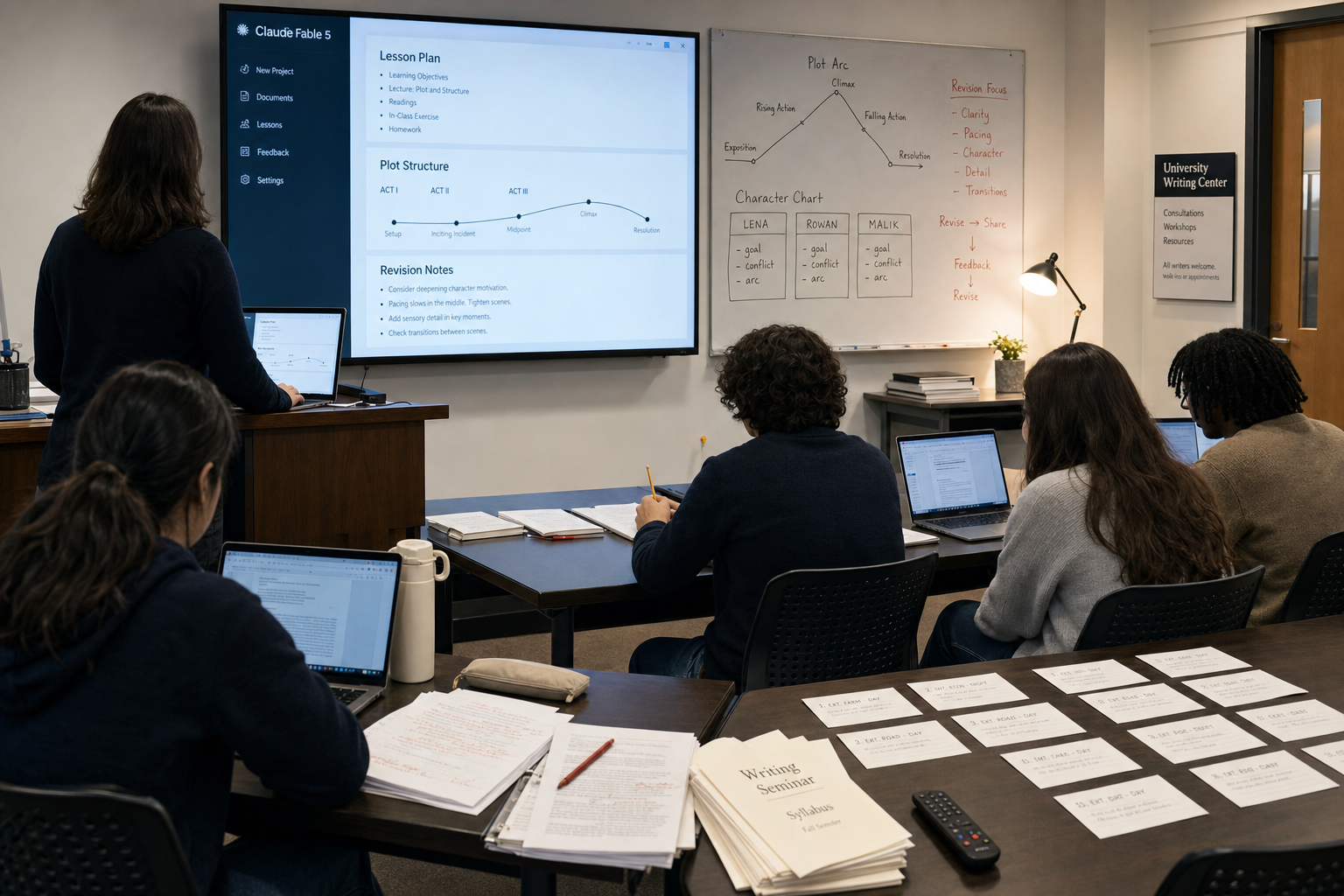
Claude Fable 5 has drawn interest online as a storytelling-focused AI model, or at least as a sign that model makers want to be seen as stronger at narrative work. Public details may still be limited, and early discussion around new models often gets ahead of verified performance. But even that is part of the story. The attention is shifting from raw utility toward something more culturally sensitive: plot, voice, structure, and style.
That matters because storytelling is not a niche use case. It sits inside classrooms, writing workshops, publishing, journalism, marketing, and everyday communication. The main debate is straightforward. Better storytelling models could help more people write, revise, and participate in culture. They could also make writing more formulaic, blur authorship, and weaken the slow human work that good teaching and good literature both depend on.
Why a storytelling model matters more than another benchmark
Most model launches are covered like hardware releases. Faster, larger, cheaper, better at tests. That framing misses what changes when a model improves at narrative tasks.
Storytelling is not just entertainment. It is how students learn to organize ideas. It is how teachers explain complexity. It is how writers build careers and how communities preserve experience. A model that gets better at scene-building, pacing, tone, and character consistency moves closer to work that people treat as personal, skilled, and meaningful.
That is why this kind of release is a cultural signal, even before anyone settles the technical rankings. It suggests that AI companies see creative language as a growth area, not just a side feature. Once that happens, the effects spread well beyond hobbyist fiction.
What writers may gain
For many writers, the biggest benefit is not that a model can produce a finished story. It is that it can support the middle of the process, where most work actually happens.
- Idea testing: A writer can compare different openings, points of view, or endings in minutes.
- Structural help: A model can summarize a draft and reveal where the plot drifts or repeats.
- Revision support: It can suggest cleaner transitions, sharper dialogue, or tighter scenes.
- Access support: Non-native English writers can use it to improve clarity while keeping the core idea their own.
These are real gains. They can lower the cost of experimentation. They can help beginners start. They can also help experienced writers move past routine friction and focus on judgment.
That last point is important. Good writers do not just generate sentences. They choose what to keep, what to cut, and what to resist. A useful storytelling model may speed up options, but it does not remove the need for taste, memory, ethics, and context.
What writers may lose
The risk is not simply that AI will write bad stories. Bad stories are easy to ignore. The deeper risk is that it will write acceptable ones quickly and at scale.
When a system is trained on large bodies of familiar narrative, it tends to produce patterns that feel competent because they already feel familiar. That can push writers toward safe arcs, predictable emotional beats, and a polished but generic rhythm. The result is not always failure. Sometimes it is something harder to spot: sameness.
There is also the issue of voice. A storytelling model can help a writer find language, but it can also become a shortcut that slowly replaces the harder work of developing an individual style. For new writers especially, that trade-off matters. Fluency is not the same as authorship.
Another concern is fairness. If a model has learned from large volumes of published writing, then its usefulness raises questions about consent, compensation, and stylistic imitation. Those questions do not disappear just because the output sounds smooth.
Teachers are not just facing a cheating problem
In education, the public conversation often collapses into one question: will students use AI to cheat? That is too narrow.
Better storytelling models change the writing environment itself. A student can now ask for a character sketch, a persuasive opening, a cleaner conclusion, or a full rewrite in a different tone. That affects how assignments are designed, how feedback works, and what teachers should actually measure.
There is real promise here. Teachers can use storytelling models to create examples at different reading levels, generate revision exercises, show weak and strong versions of the same passage, or help multilingual students express ideas more clearly. In the best cases, the model becomes a practice partner, not a ghostwriter.
But the risks are obvious too. Students may hand over the hardest parts of writing before they have learned them. They may receive language that sounds mature without understanding why it works. Teachers may also struggle to tell whether a polished paragraph reflects learning, assistance, or substitution.
The right response is not panic and not blind acceptance. It is better assignment design.
- Ask for process: notes, outlines, drafts, and revision comments.
- Use in-class writing strategically: not for everything, but enough to establish a baseline.
- Require reflection: students should explain choices, sources, and any AI assistance.
- Teach critique: students should learn to evaluate model output for cliché, error, bias, and false confidence.
If storytelling models are going to be present anyway, then students need literacy about them, not just rules about them.
What we know, and what we should not assume
It is worth being careful here. Online excitement is not proof of durable quality. A model can look impressive in a short demo and still fall apart over a long narrative. Many systems remain weak at deep coherence. They may handle style better than plot, and tone better than truth.
So the claim is not that Claude Fable 5, specifically, has solved storytelling. That would be too strong, especially if public evidence is still thin. The more defensible point is broader: when a model is discussed as a storytelling advance, it signals where the industry wants to go and where users may soon follow.
That signal deserves attention because cultural tools spread differently from technical ones. People do not only use them to save time. They use them to express themselves, teach others, and shape public language.
The counterargument deserves respect
Some writers and teachers will say this is overblown. They have a point.
Most people still value human-made work. Many teachers already know that strong instruction depends on relationships, not just outputs. And many current models, even the good ones, still produce thin characters, inflated dialogue, and borrowed-feeling prose. A flashy story demo does not equal literary depth.
There is also a practical counterpoint. Plenty of writers do not want machine help in their creative process at all. They value struggle, waiting, and uncertainty because those things are part of how original work emerges. That view should not be dismissed as nostalgia. Sometimes friction is productive.
But none of that weakens the larger argument. Tools do not need to replace experts to reshape expectations. Spellcheck changed writing without replacing writers. Search changed teaching without replacing teachers. Storytelling models may do something similar, but closer to the core of expression.
What a healthy response looks like
Writers, educators, and publishers should treat better storytelling models as tools that need norms, not as miracles or monsters.
- For writers: use them for options and feedback, not for borrowed identity.
- For teachers: redesign assignments around thinking, revision, and explanation.
- For schools and publishers: set clear disclosure rules about when AI use must be acknowledged.
- For the industry: answer harder questions about training data, stylistic imitation, and consent.
My view is simple. Better storytelling models do matter, but not because they are about to outwrite novelists or replace teachers. They matter because they are moving into one of the most human parts of language: the way people shape experience into meaning.
That is why Claude Fable 5 is worth watching as a cultural signal, even if the hype runs ahead of the evidence. The real question is not whether a model can tell a story. It is whether we will let convenience narrow our language, or use these systems carefully enough to expand who gets to write, learn, and be heard.