The Classroom Co-Pilot Agreement: A Simple AI Use Charter for Teachers and Students
Schools and universities have moved past the question of whether students will use AI. They are now dealing with the harder question: how to let students use it without weakening the work that education is supposed to develop. In many classrooms, the answer is still unclear. One teacher allows AI for brainstorming. Another treats any use as misconduct. A third says nothing and hopes for the best.
That confusion matters. It creates unfairness between classes, encourages hidden use, and puts teachers in a policing role they do not want. The central tension is straightforward: AI can help students learn, revise, and practice, but it can also replace the reading, reasoning, and drafting that assignments are designed to test. My view is simple: every course should have a short AI use charter, agreed early, written in plain language, and specific enough to protect both learning and trust.
Why the current approach is not working
Right now, many institutions have broad AI policies but weak classroom guidance. Students often hear phrases like “use responsibly” or “do not misuse AI,” which sound serious but do not answer the questions students actually have. Can they use AI to summarize a reading before class? To check grammar? To generate practice quiz questions? To debug code? To outline an essay? To rewrite a paragraph?
When the rules stay vague, students fill in the gaps themselves. Some become overly cautious and avoid useful tools. Others use AI heavily and assume that if no one objected, it must be acceptable. Teachers then face a second problem: they are asked to judge work without a clear shared standard. That weakens confidence on both sides.
Blanket bans do not solve this well. They are hard to enforce, especially outside supervised settings. They can also block legitimate support, including help with language, structure, study planning, and practice. On the other hand, open-ended permission is not a serious policy either. If anything goes, then authorship, effort, and independent judgment stop meaning much.
What AI can do well in school
A sensible charter starts by admitting a basic fact: some uses of AI are genuinely helpful. A student can use it to turn lecture notes into study questions, explain a difficult concept in simpler language, compare two interpretations of a historical event, or spot grammar problems in a draft. A programming student can use it to identify why code fails and then test the explanation. A non-native English speaker can use it to improve clarity without changing the substance of their argument.
Those are not trivial benefits. They can save time, lower frustration, and make students more willing to keep working. For some learners, especially those studying in a second language or returning to education after a long gap, AI can function as an always-available support tool.
But support is not the same as substitution. That distinction should be the center of any classroom policy.
Where the line should be
If the goal of an assignment is to show what a student can think, argue, solve, or create, then the student must still do that core work. A reflective essay should reflect the student. A close reading should show the student’s reading. A take-home proof should show the student’s reasoning. A lab report should not contain analysis the student cannot explain. AI can assist around the edges, but it should not quietly become the author, analyst, or problem-solver.
This is also where the risks become concrete. AI systems can produce false claims, invented citations, shallow paraphrases, and polished but empty prose. Students under pressure may submit work that sounds competent but collapses under basic questioning. Teachers then spend more time verifying than teaching. That is bad for everyone.
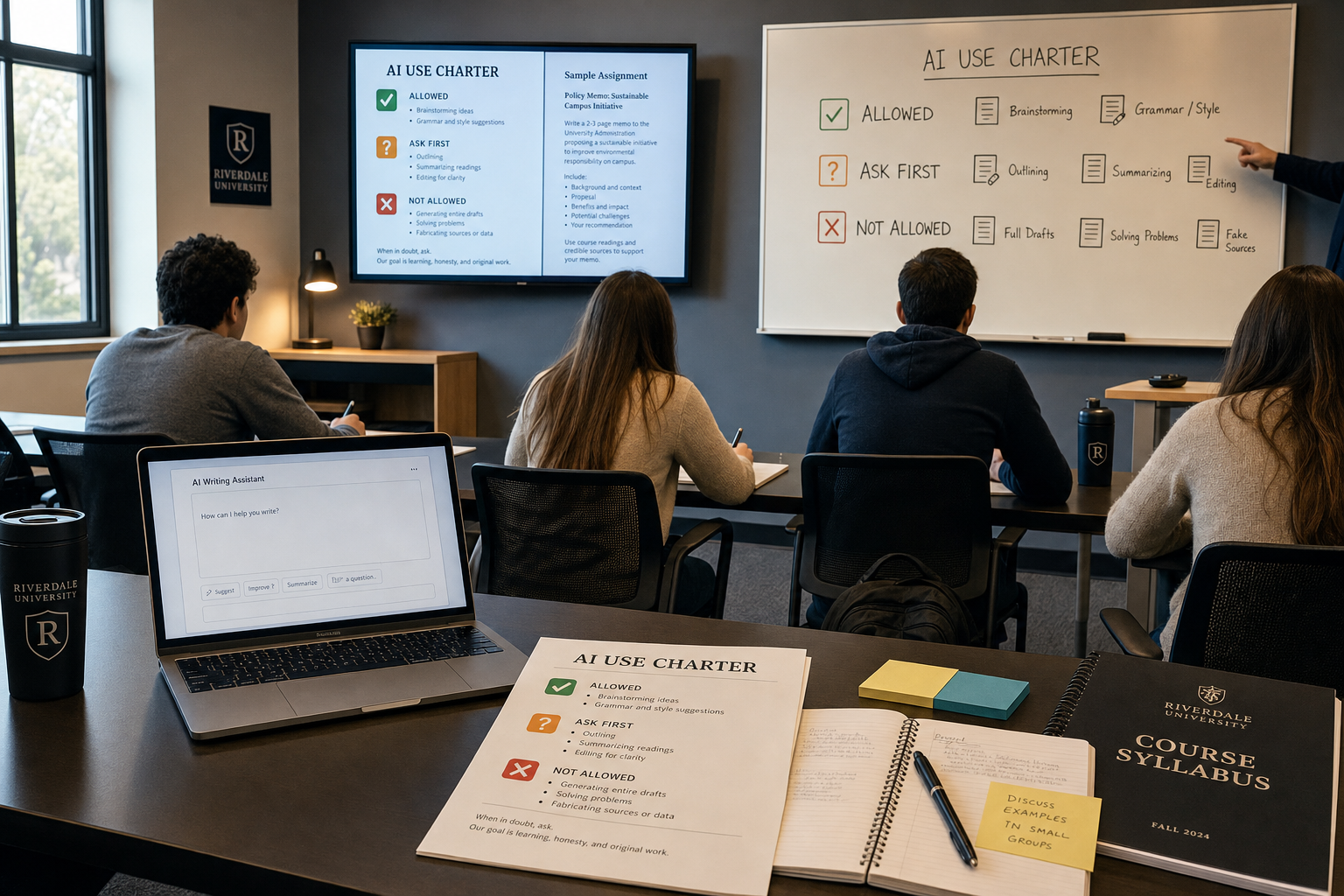
- Green light: study aids, practice questions, grammar help, translation of instructions, concept explanations, and feedback on clarity.
- Yellow light: outlining, code scaffolding, literature-search help, or idea generation for assessed work. These uses may be allowed, but only if the teacher says so.
- Red light: submitting AI-generated work as one’s own, using AI to bypass required reading or problem-solving, fabricating citations, or hiding substantial AI use.
That kind of traffic-light approach will not answer every edge case, but it is far better than silence. Students can understand it quickly, and teachers can apply it consistently.
A simple classroom charter schools can adapt
The best AI policy for a course is usually not a long legal document. It is a short agreement that fits on one page and is discussed at the start of the term. It should be specific about both permission and responsibility.
- Purpose: AI tools may support learning, but they may not replace the student’s own judgment, reading, reasoning, or authorship.
- Course-specific rules: The teacher will clearly mark which assignments are AI-allowed, AI-limited, or AI-free.
- Allowed uses: Students may use AI for tasks such as brainstorming, study support, grammar checking, translation of instructions, practice exercises, and feedback on structure, unless the assignment says otherwise.
- Restricted uses: Students must ask first before using AI for outlines, thesis development, coding solutions, data analysis, or draft generation on assessed work.
- Prohibited uses: Students may not submit AI-generated text, code, images, or analysis as their own work; may not paste in a question and submit the answer with minor edits; and may not include any citation, quotation, or factual claim they have not checked themselves.
- Disclosure: If AI was used in any meaningful way, students must say how it was used. Short disclosure is better than hidden use.
- Process evidence: For major assignments, students should keep notes, drafts, version history, or prompt records if the teacher requests them.
- Responsibility: The student remains responsible for the final submission, including errors, citations, and originality.
- Teacher commitment: Teachers should not change AI rules after work is submitted and should explain the reason for any AI-free assignment.
Simple disclosure line: “I used AI to help with [brainstorming / grammar / study questions / debugging / outlining]. I reviewed the output, checked facts and citations, and take responsibility for the final work.”
That disclosure line does two useful things. It normalizes honesty, and it reminds students that using a tool does not transfer accountability.
Counterpoints worth taking seriously
There are fair objections to this approach. Some educators argue that allowing any AI use weakens writing and critical thinking, especially in early-stage learning. That concern is real. In a first-year writing course, for example, a teacher may reasonably decide that certain assignments must be drafted without AI so students build sentence-level skill and confidence directly.
Others say these policies are impossible to enforce. They are partly right. No charter can prevent every misuse. Detection tools are not reliable enough to serve as the main answer, and teachers should be careful about false accusations. But imperfect enforcement is not a reason to have no rules. It is a reason to design better ones.
A good charter works best when paired with sensible assessment choices: in-class writing, oral follow-up questions, draft checkpoints, annotated bibliographies, version histories, and assignments that ask students to explain their decisions. These methods do not eliminate misuse, but they make substitution harder and genuine learning easier to see.
Trust needs rules on both sides
Too much of the AI debate in education frames students as the only people who need guidance. That is a mistake. Teachers also need to state expectations clearly and use AI rules consistently. If an assignment bans AI, students should know why. If a task allows AI for editing but not drafting, that line should be stated upfront. If disclosure is required, the format should be simple.
Schools should also think about equity. Not every student has the same access to paid tools, the same level of digital skill, or the same home environment for experimenting with them. If AI use becomes quietly expected without training or equal access, the classroom advantage will go to the students who already have more resources. Any serious policy should include basic AI literacy, not just punishment for misuse.
The wider goal is not to make every student use AI. It is to make expectations legible. Some assignments should remain fully human and unaided. Some should allow limited assistance. Some should actively teach students how to evaluate AI output, challenge it, and improve on it. That mix is healthier than either panic or surrender.
The practical bottom line
Education does not need another abstract argument about whether AI is good or bad. It needs workable classroom rules. A short co-pilot agreement gives teachers a way to protect academic standards without pretending AI does not exist. It gives students a fair answer to a fair question: what kind of help is allowed here?
The best version is plain, course-specific, and honest about both promise and risk. It tells students where AI can help, where they must think for themselves, and how to be transparent about the difference. That will not solve every dispute. But it is a strong place to start, and right now, clarity is more valuable than slogans.