The Classroom AI Policy Students Can Actually Understand
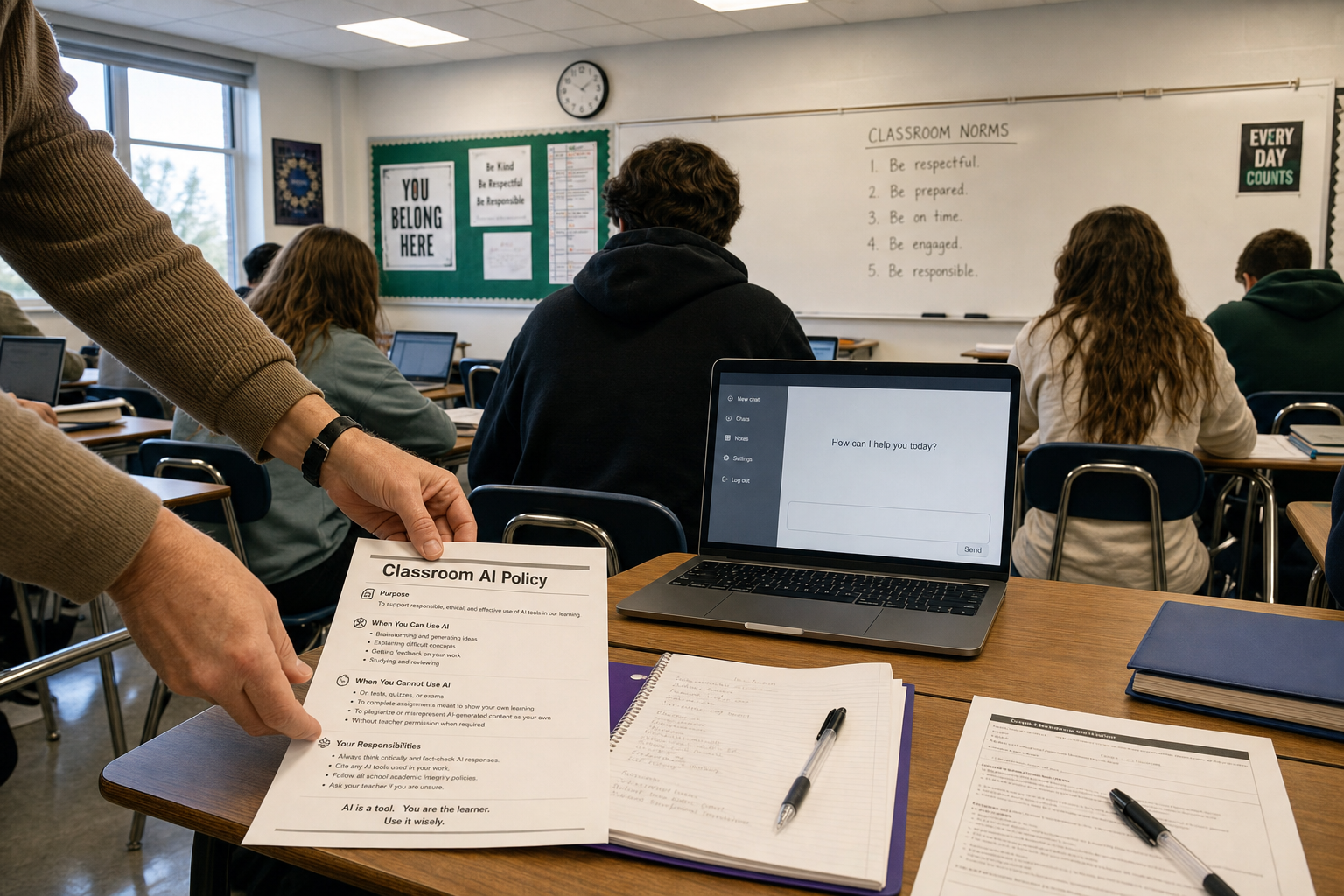
AI tools are already in classrooms, whether schools feel ready or not. Students use them to explain difficult readings, clean up grammar, generate quiz questions, and sometimes write work they should be doing themselves. The problem now is not access. It is the lack of clear rules. Many schools have responded with broad warnings, improvised teacher-by-teacher rules, or simple bans that do not match daily reality.
That matters because confusion is not a neutral policy. It leaves honest students unsure where the line is, gives rule-breakers room to hide, and turns normal schoolwork into a guessing game. The real debate is not whether AI exists. It is whether schools can protect learning, fairness, and trust without turning AI into a forbidden mystery that students will use anyway.
The real problem is not AI. It is unclear expectations.
Students can understand limits when adults explain them plainly. They struggle when policies sound like legal disclaimers. A rule such as “unauthorized use of generative systems may constitute academic dishonesty” may satisfy an administrator, but it does not help a 15-year-old decide whether using a chatbot to make flashcards is allowed.
A good classroom policy should answer four simple questions:
- Can I use AI for this assignment?
- If yes, what kind of use is allowed?
- Do I need to say how I used it?
- What happens if I cross the line?
If a student cannot answer those questions in under a minute, the policy is too vague.
A better rule: distinguish support from substitution
The strongest school policies do not treat every use of AI as the same. That is the mistake behind both panic and permissiveness. There is a real difference between using a tool to check understanding and using it to avoid thinking.
That difference should be the backbone of policy. AI can support learning. It should not substitute for the learning the assignment is meant to measure.
That sounds obvious, but it becomes useful when schools apply it to real cases. If the goal is to practice forming an argument, students should not submit AI-written paragraphs. If the goal is to review a topic before a test, using AI to generate practice questions may be fine. If the goal is a personal reflection, students should write it themselves. If the goal is to improve clarity in a draft, grammar help may be reasonable with disclosure.
Students understand this logic when adults say it directly: use AI to help you learn, not to replace the part of the work you are supposed to do.
The simplest policy is a three-label system
Schools do not need a perfect universal rule for every subject. They need a framework students can recognize across classes. One practical approach is to label assignments in three categories.
- AI-free: No AI use allowed. This fits in-class writing, tests, early skill-building, personal reflection, and assessments meant to show independent thinking.
- AI-assisted: Limited AI use allowed for specific tasks, such as brainstorming, study support, translation, or grammar help. Students must disclose what they used.
- AI-open: AI use is part of the assignment or broadly allowed, but students still remain responsible for accuracy, sources, and final judgment.
This does two useful things. First, it removes guesswork. Second, it puts the burden where it belongs: on adults to define the learning goal before students submit the work.
A short policy could say it like this:
Use AI to support your work, not replace it. Check each assignment label. If an assignment is AI-free, do it without AI. If it is AI-assisted or AI-open, say how you used the tool. You are responsible for errors, made-up facts, and copied language, even if a system produced them.
That is clearer than most current policies, and students can actually remember it.
What students should be allowed to do
Schools should not make ordinary support tools feel suspicious. There are many reasonable uses of AI that do not undermine learning when teachers allow them openly.
- Ask for a simpler explanation of a difficult concept
- Generate practice questions for revision
- Turn notes into a study guide
- Check grammar or sentence clarity in a draft
- Translate instructions or vocabulary for language support
- Brainstorm possible essay angles before writing independently
These uses can be especially helpful for students with dyslexia, executive function challenges, or limited confidence in academic English. That is one reason blanket bans are too blunt. They can remove a real support tool without offering a better alternative.
But permission should not become a loophole. Students should not be allowed to submit generated writing, invented citations, or AI-produced analysis as if it were their own work. That is not assistance. It is outsourcing.
Disclosure matters more than detection
Many schools still act as if the main challenge is catching hidden AI use after the fact. That leads to overreliance on detectors, and that is a weak foundation. Detection tools are not reliable enough to be the main judge of misconduct. False accusations are possible, and trust is easy to damage.
A better approach is to normalize disclosure. If AI use is allowed, students should state what they used it for in one or two lines. For example:
I used an AI tool to suggest three outline ideas and to check grammar in my final draft. I did not use it to write paragraphs or choose sources.
This is simple, teachable, and far more useful than a hidden policing game. It also helps teachers see patterns. If a student repeatedly depends on AI for tasks they should be learning to do alone, that is a teaching issue as much as a discipline issue.
Schools also need rules about privacy and fairness
An AI policy is not only about cheating. It is also about data, safety, and unequal access. Students should be told not to paste private personal information, confidential school records, or sensitive family details into public AI systems. That warning should be explicit, not buried in a digital safety document nobody reads.
Fairness matters too. If a school expects students to use AI, it should provide approved tools or clear alternatives. Otherwise, students with better devices, faster internet, or paid subscriptions gain an advantage. That is not innovation. It is a quiet expansion of inequality.
There is also a basic accuracy problem. AI systems can produce wrong answers, fake references, and confident nonsense. Students need a plain rule here as well: if you use AI, you must verify important facts and sources before submitting work. The tool does not carry responsibility. The student does.
Teachers need support, not just pressure
It is easy to tell teachers to “adapt.” It is harder to give them the time and guidance to do it well. A workable AI policy should reduce teacher burden, not add to it.
That means schools should provide shared language, model assignment labels, and examples of acceptable disclosure statements. It also means accepting that not every teacher needs to use AI in the same way. A chemistry teacher, a history teacher, and a first-grade teacher may set different limits. The school-wide framework should create consistency without pretending all assignments are the same.
One sensible expectation is this: if teachers assign work, they should state the AI rule at the point of assignment, not after submission. Students should not have to infer the rule from mood, rumor, or classroom culture.
The counterargument is real, but incomplete
There are fair objections to looser AI rules. Some educators worry that normalizing AI will weaken writing, reading, and persistence. Others fear students will stop wrestling with hard problems and let tools do too much. Those concerns should not be brushed aside. In some cases, they are already visible.
The evidence on long-term effects is still developing, and schools should be honest about that uncertainty. It would be reckless to assume AI always improves learning. It does not. Used badly, it can flatten effort, reduce original thinking, and make shallow work look polished.
But the answer to those risks is not confusion. It is design. Schools can preserve AI-free spaces for foundational skills. They can require drafts written in class. They can ask students to explain their process, defend their choices, and show source notes. They can build assignments that reward judgment rather than polished phrasing alone.
In other words, schools do not need to choose between old rules and no rules. They need better rules.
A policy students can follow is more likely to protect learning
The best classroom AI policy is not the toughest one. It is the clearest one. Students are more likely to respect limits they understand, and teachers are more likely to enforce rules they can explain without a speech.
A good policy should be short, direct, and visible on every assignment. It should separate allowed support from dishonest substitution. It should require disclosure instead of relying on unreliable detection. It should protect privacy. And it should keep room for AI-free learning where independent practice matters most.
The practical test is simple: if students need a lawyer to interpret the rule, the rule has already failed. Schools should write policies that sound like they were written for the people who actually have to use them.