The Classroom AI Disclosure Ladder: A Simple Way to Talk About Help, Credit, and Learning
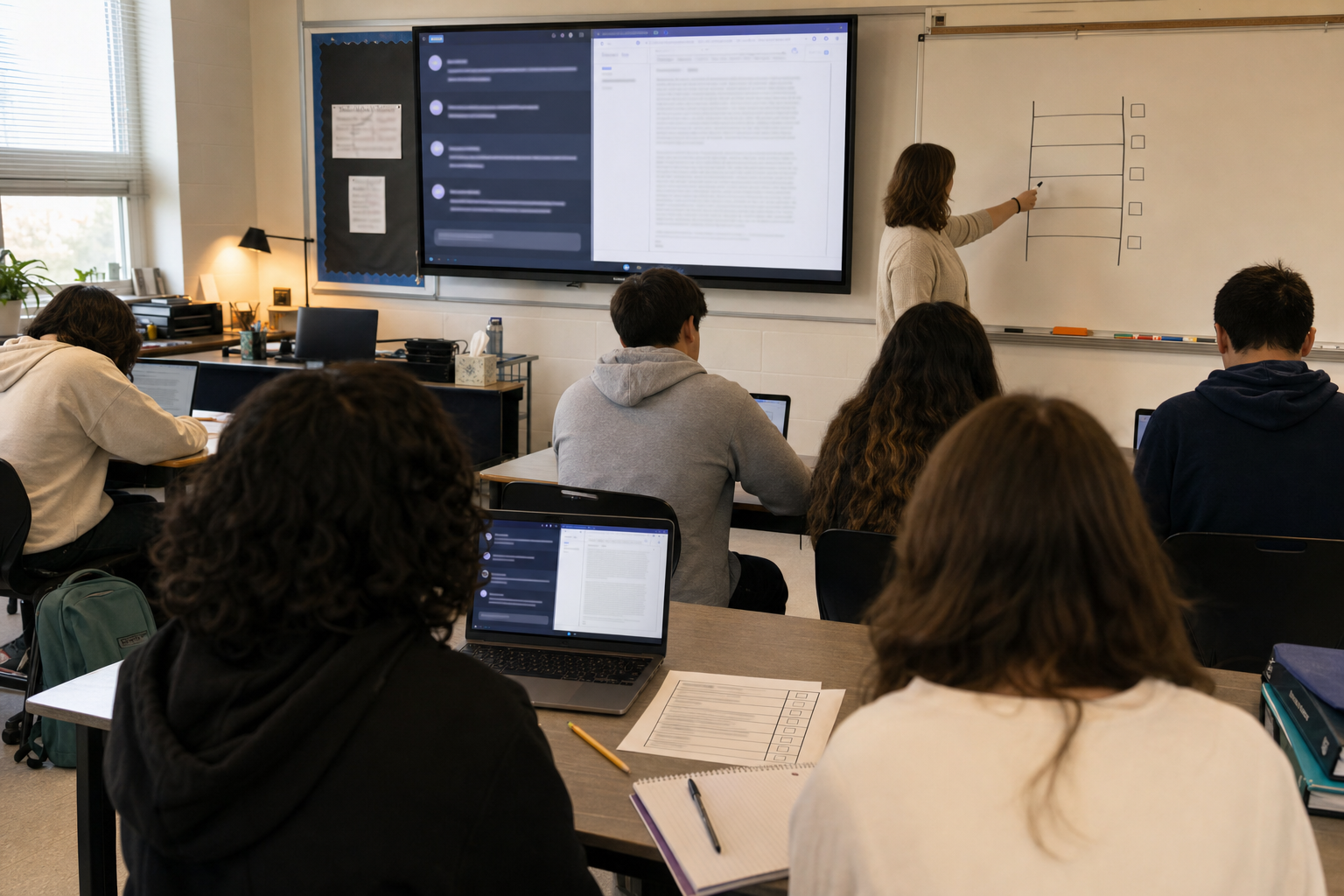
Students are already using AI for schoolwork. Some use it to test topic ideas. Some use it to clean up grammar. Some use it to produce sections of an essay. Teachers know this, but many classrooms still lack a shared way to describe the difference. A disclosure ladder would give students and educators a plain, workable language for what kind of help was used.
That matters because the current debate is stuck between two bad habits: punishment first, or blind acceptance. Blanket bans are hard to enforce and often ignore legitimate support needs. Anything-goes policies send the opposite message, as if all AI use were equal. It is not. The real question is how close AI came to the thinking, writing, and judgment the student was meant to practice, and how that should affect credit.
Why the current argument is failing
Right now, many schools have rules that are either too vague or too absolute. Students hear “do your own work,” but they also see classmates using AI for brainstorming, paraphrasing, and editing. Teachers hear “I only used it for help,” but that phrase can mean five very different things. The result is confusion, suspicion, and uneven enforcement.
That confusion hurts everyone. Honest students are unsure what is allowed. Teachers waste time investigating cases that could have been prevented by clearer expectations. And when the only language available is “allowed” or “cheating,” students have a strong incentive to hide use that might have been acceptable if disclosed.
My position is simple: schools should adopt a short AI disclosure ladder and attach it to assignments. Not because it solves every problem, but because it gives classrooms a middle ground. It replaces guessing with categories. It also separates three questions that are often mixed together: Was AI used? How much did it shape the final work? Was that level of use appropriate for this assignment?
A simple ladder that schools can actually use
This should not be a long policy document. It should be a short scale that students can understand on first reading. It should also be clear that the ladder is not a moral ranking. It is a disclosure tool. As the level rises, AI moves closer to doing the core work of the assignment, so the need for disclosure, limits, and reduced originality claims becomes stronger.
- Level 0: No AI use. The student did not use AI for ideas, drafting, editing, translation, or study support. For some exams, in-class writing tasks, and skill checks, this should remain the default.
- Level 1: Brainstorming and planning. The student used AI to generate topic ideas, possible thesis questions, counterarguments, or an early plan. This is often the lowest-risk use, but it should still be disclosed when the assignment asks for it.
- Level 2: Understanding and study support. The student used AI to explain a concept in simpler language, create practice questions, or help review material. This can support learning, but it should not be treated as a reliable source of facts or evidence unless the teacher says otherwise.
- Level 3: Language and revision support. The student wrote the work but used AI to improve grammar, transitions, clarity, or tone. This may be appropriate in many settings, especially for accessibility or non-native English support, but it should be disclosed if the wording changed in a meaningful way.
- Level 4: Structural rewriting or partial drafting. The student used AI to produce an outline, rewrite a section, suggest topic sentences, or draft part of the response. At this point, AI is shaping the substance of the submission. This should require explicit permission and clear disclosure.
- Level 5: Full drafting or analysis generation. The student used AI to write large portions of the final work or generate the main argument, explanation, or solution. For most learning-focused assignments, this should count as unacceptable unless the task is specifically about evaluating, editing, or comparing AI output.
The advantage of this ladder is that it does not pretend every assignment has the same goal. A timed history essay, a take-home lab reflection, and an AI literacy project should not all have the same rules. The ladder creates a shared vocabulary. The teacher still sets the ceiling.
What good disclosure looks like
Disclosure should be simple. If schools make it heavy and legalistic, students will avoid it. A short note at the end of the assignment is usually enough for lower levels.
AI disclosure: Level 3. I wrote my own draft, then used an AI tool to suggest clearer transitions and fix grammar. I did not use it to generate my argument or evidence.
That one sentence tells the teacher much more than a vague claim like “I used AI a little.” It also gives the student a way to be honest without turning the process into a confession.
Different assignments need different limits
A disclosure ladder only works if it is tied to assignment design. Teachers should not announce one rule for the entire course and hope it covers everything. The allowed level should appear on the assignment sheet, just as expectations for citation, collaboration, and formatting already do.
- Timed essays and exams: Often Level 0 only, or no outside tools at all.
- Take-home writing assignments: Level 1 to Level 3 may be acceptable, depending on the goal.
- Language-learning or writing-support contexts: Level 3 may be reasonable when the focus is ideas rather than sentence mechanics.
- AI literacy assignments: Level 4 or Level 5 may be allowed if the purpose is to critique, verify, edit, or improve AI-generated material.
This matters for fairness. A student should not be punished for using AI to polish grammar on an assignment that is grading historical analysis. But that same use may be inappropriate in a course exercise designed to assess the student’s own writing fluency. The rule has to match the learning goal.
Why this is better than bans or silence
The promise of a disclosure ladder is not that it makes AI harmless. It does not. AI tools can still produce false information, weak arguments, biased suggestions, and generic prose. They can still reduce struggle in ways that reduce learning. They can also widen inequality when some students have access to paid tools and others do not.
But silence does not solve any of that. It usually makes it worse. When schools refuse to distinguish between brainstorming, editing, and ghostwriting, they push all use into the same shadow zone. Students learn to hide. Teachers learn to distrust. The educational question gets replaced by a policing question.
A ladder does something modest but important: it keeps the focus on learning. It asks whether AI helped around the edges of the task or replaced the task itself. That is a much better question than whether the tool was opened at all.
The objections are real
There are fair criticisms of this approach. Some teachers will say it adds one more layer of paperwork. Some will say students who want to cheat will simply lie about their level. Others will worry that once schools formalize a ladder, higher-risk uses will slowly become normalized.
Those concerns should be taken seriously. A disclosure ladder is not a lie detector. It is not a universal permission slip. It will not fix weak assignments, and it will not replace in-class writing, oral follow-up, version history, draft checkpoints, or direct knowledge checks. Schools also should not require students to use commercial AI tools, especially when privacy, access, and cost are uneven.
Still, those objections are arguments for guardrails, not for confusion. A one-line disclosure is not excessive bureaucracy. It is basic transparency. And while dishonest students may still hide use, a clearer system makes enforcement less arbitrary and honest use easier to report. That is an improvement.
Make disclosure the norm, not the trap
If schools adopt this idea, they should keep it practical. Put the ladder on the syllabus. Put the allowed level on each assignment. Ask for a short disclosure note. Require more documentation only when the level of AI involvement is high. Most important, explain why the limits exist. Students are more likely to respect rules that clearly connect to learning goals.
The classroom does not need a perfect theory of AI before it can speak plainly about it. It needs a shared language. A disclosure ladder will not end every dispute, but it can make expectations clearer, credit fairer, and learning easier to protect. If schools cannot name the difference between help and substitution, they will keep arguing past each other. This is a simple way to stop doing that.