Can Your Phone Understand Your Accent? Apple SpeechAnalyzer and the Human Stakes of Voice AI
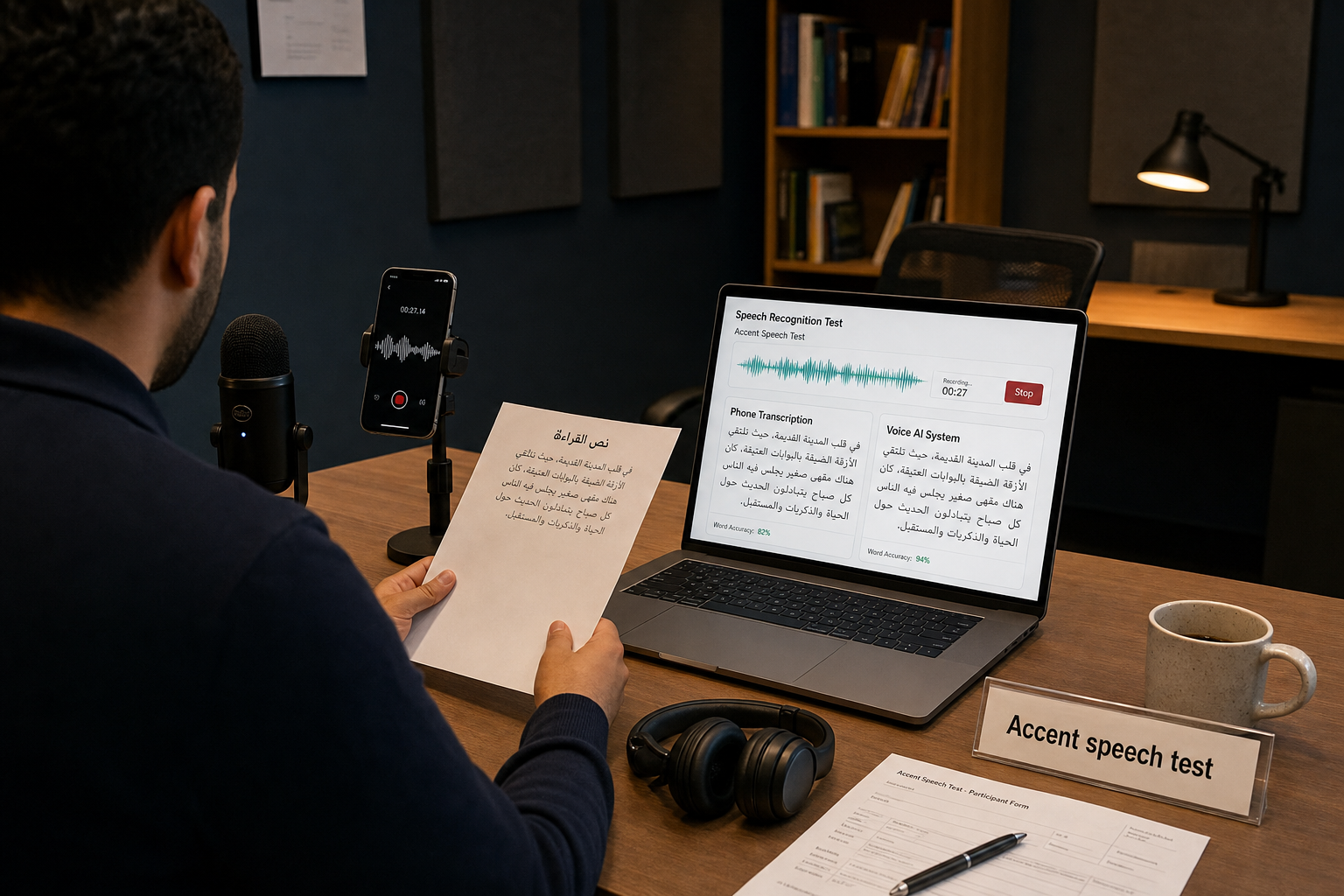
Apple’s new SpeechAnalyzer API is now being tested by developers, and early online comparisons are already placing it next to OpenAI’s Whisper to see which one transcribes speech better. That is a timely test. Speech recognition is no longer a niche feature. It now sits inside lecture tools, meeting apps, captions, voice notes, accessibility features, and hands-free controls.
But the real issue is not who wins an early benchmark. It is whether voice AI works for people who do not speak in slow, clean, standard English in a silent room. For Arabic-speaking users in particular, the question is not simply whether a tool “supports Arabic.” It is which Arabic, spoken by whom, in what setting. That is where the promise of voice AI meets its biggest credibility test.
Early benchmarks matter, but they do not settle the case
The public discussion so far is driven largely by early developer testing and online commentary, including comparisons with Whisper. That is useful, but it is not a final verdict. Benchmarks can show speed, rough accuracy, and practical strengths. They can also hide the conditions that matter most in daily life.
A speech system may look strong on short clips and still struggle in a crowded lecture hall. It may perform well on carefully read sentences and fail when people interrupt each other in a meeting. It may handle standard pronunciation but slip when a speaker mixes Arabic and English, shortens words, or uses local names. These are not edge cases. They are normal speech.
Whisper has become a common reference point because many developers know it well. That makes the comparison understandable. But a benchmark race can turn the story into a narrow contest over scores. Apple should not be judged only on whether it beats a rival model on a chart. It should be judged on whether it makes speech tools more useful, more private, and more inclusive in the real world.
Why Apple’s entry matters
When Apple adds a new API, it usually does more than launch a feature. It creates a path for thousands of app developers to build on top of it. If speech analysis becomes easier to use across Apple devices, it could improve note-taking apps, live captions, study tools, customer support software, and accessibility services for people who are deaf, hard of hearing, or have mobility limitations.
That scale is the opportunity. A student recording a lecture could get a usable transcript within minutes. A journalist could search an interview by keyword instead of replaying the whole file. A multilingual team could leave a meeting with cleaner notes. If more of that work can happen on-device or with tighter privacy controls, that is also a meaningful gain.
But scale also raises the stakes. When a company with Apple’s reach makes design choices, those choices spread quickly. If the underlying speech system works best for some voices and worse for others, that bias does not stay hidden in a lab. It becomes daily friction.
Accent is not a footnote. It is the test.
Voice AI often fails in predictable ways. It does better with speakers who sound like the people most represented in its training data. It does worse with strong regional accents, casual speech, overlapping voices, code-switching, and domain-specific words. That pattern has been visible for years across the industry.
For Arabic-speaking users, the challenge is even sharper. Arabic is not one speech pattern. Modern Standard Arabic is only part of the picture. People speak Egyptian, Levantine, Gulf, Iraqi, Sudanese, and Maghrebi dialects, often mixed with English or French, and often in the same conversation. A tool that handles a formal news clip but fails on a student from Amman, a manager from Dubai, or a family voice note from Cairo is not ready for broad claims about understanding Arabic.
The same is true for English spoken with an Arab accent. Many speech systems still treat accented English as a lower-priority case, even though it is common in universities, workplaces, and international teams. If a meeting assistant drops key points because one participant’s pronunciation does not fit its strongest patterns, that is not a minor technical miss. It changes whose speech gets captured and whose does not.
Concrete errors matter more than abstract fairness language. A missed medication name in a clinic, a garbled deadline in a meeting, a wrong term in a lecture transcript, or a badly transcribed name in a legal document can all create downstream problems. Some are inconvenient. Some are costly. Some exclude people from the record.
Accessibility gains are real, but they depend on trust
It would be a mistake to talk only about failure. Better speech recognition can be genuinely helpful. Live transcription can open classrooms to more students. Captions can reduce the strain of following fast speech. Voice interfaces can help users who cannot type easily. Searchable transcripts can save time for everyone.
That is why this technology deserves careful scrutiny rather than cynical dismissal. The upside is real. A phone that can reliably capture a professor’s lecture, transcribe a workplace briefing, or turn a voice memo into clean text is useful in a straightforward way.
Still, accessibility is not just about adding the feature. It is about whether people can trust it enough to rely on it. If the transcript is accurate for some users and consistently weak for others, the feature may widen gaps rather than close them. Convenience for the majority is not the same as access for all.
Privacy is part of the product, not an extra
Speech data is unusually sensitive. A recording may contain health details, financial information, student discussions, private arguments, or confidential work material. Even when users mainly care about accuracy, privacy shapes whether a tool can be used at all.
This is one area where Apple has a chance to set a higher bar, especially if speech features can be handled locally or with clear limits on what leaves the device. But “private” should not be treated as a marketing shortcut. Users need to know what is recorded, what is transcribed, where that text is stored, who can access it, and how it can be deleted.
Developers also need rules that are easy to understand. A speech API that enables strong transcription but encourages quiet data collection through third-party apps would create a new problem while solving another. In voice AI, technical performance and privacy policy cannot be separated for long.
Apple deserves a fair standard, not an easy one
There is a reasonable counterpoint here. No speech system can perfectly understand every accent, every dialect, and every noisy environment. Smaller models and device limits force tradeoffs. Microphone quality matters. Speaker overlap is hard. Anyone expecting flawless transcription in all conditions will be disappointed.
That is true. It is also exactly why companies should be modest in their claims and precise about their limits. A realistic standard is not perfection. It is transparency, measurable improvement, and honest support for the people most often left out of polished demos.
Apple’s SpeechAnalyzer should be judged on practical questions like these:
- How well does it handle accented English, Arabic dialects, and mixed-language speech?
- How does it perform in classrooms, meetings, cars, and other noisy settings?
- Does it preserve important details such as names, dates, technical terms, and numbers?
- What privacy protections are built in by default, not just promised in general terms?
- Can developers test language coverage and error patterns clearly, rather than guessing from marketing claims?
- Are users told when the system is likely to be less reliable?
Those questions are less glamorous than benchmark headlines. They are also closer to what people actually need.
The right question is simple
The most important question is not whether Apple can produce an impressive demo or even beat a strong competitor on selected tests. It is whether the company can help make voice AI normal, useful, and fair in ordinary life.
If your phone can transcribe a keynote but not your professor, your colleague from Beirut, your uncle from Alexandria, or your own English spoken with an accent, then the product is still unfinished. Apple’s SpeechAnalyzer may become a strong step forward. But the standard should be clear from the start: a speech tool is only as good as the range of people it can serve, and the trust it can earn while doing it.