Arabic Prompting Is Not Just Translation: What Bilingual Users Need From AI Assistants
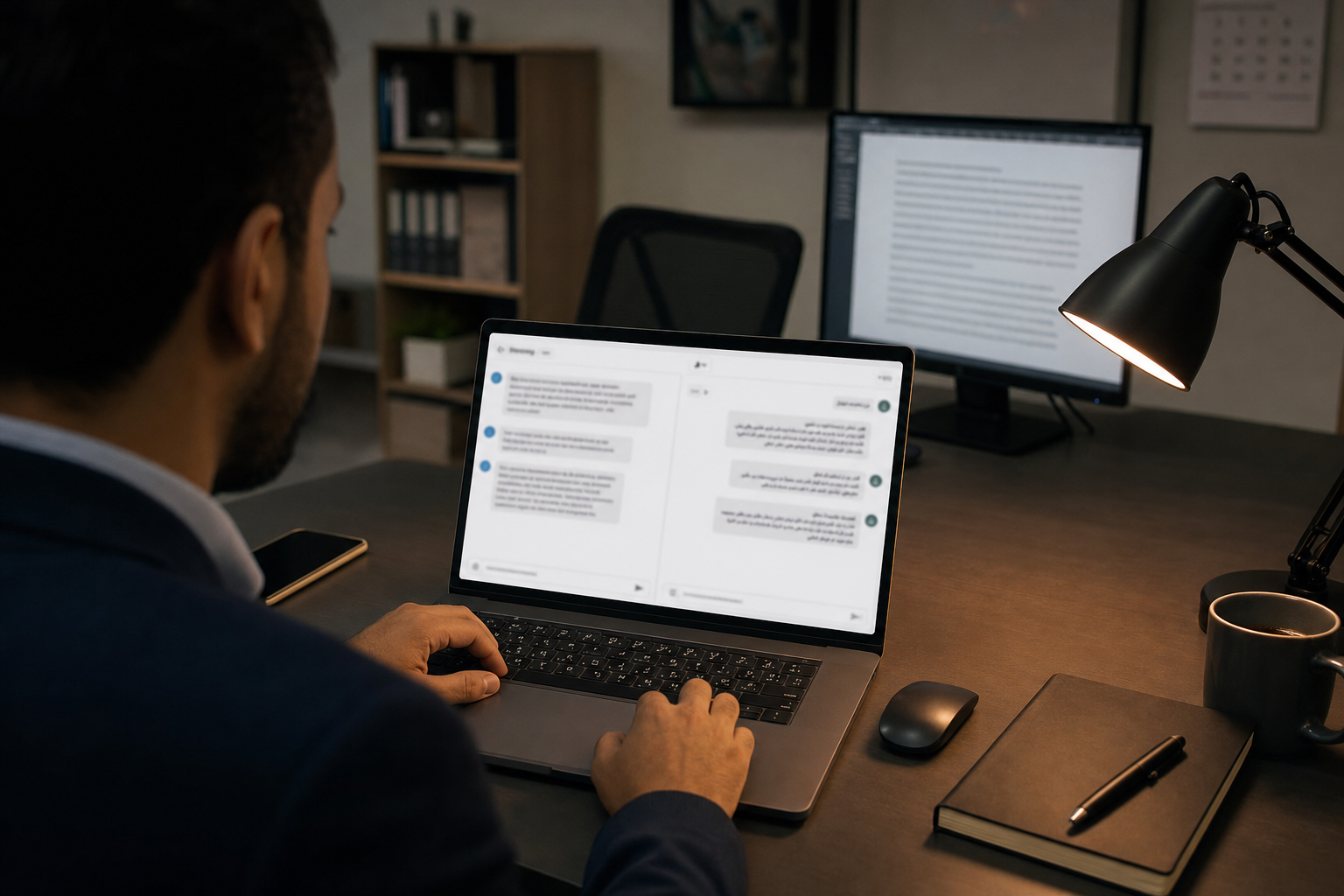
AI assistants are moving into everyday work and study, but many still treat Arabic as a translation layer on top of an English-first system. That is the wrong frame. For Arabic-speaking and bilingual users, the issue is not simply how to convert words from one language into another. It is how to preserve meaning, tone, dialect, context, and mixed-language habits that are normal in real life.
This matters because a bad prompt does not just produce awkward language. It can produce the wrong summary, the wrong tone, the wrong audience fit, or the wrong advice. The central debate is simple: should bilingual users adapt themselves to English-centric tools, or should AI assistants adapt to the way bilingual people actually speak, write, study, and work? The better answer is the second one.
Translation and prompting are not the same task
Translation tries to carry meaning across languages. Prompting is broader. It includes instruction, context, preference, audience, and intent. When a user writes in Arabic, they are not only choosing words. They are often signaling who the message is for, how formal it should sound, what cultural references matter, and whether some terms should stay in English.
Take a common student request: a summary of a science chapter in simple Arabic, while keeping technical terms in English because that is how they appear in class. A translation-only approach may turn everything into formal Arabic or translate terms the student actually needs to memorize in English. The result looks polished but becomes less useful.
The same problem appears at work. A user may ask for an email in Arabic that sounds professional but warm, or a report that uses Modern Standard Arabic for the main text and English for product names. That is not a translation puzzle. It is a communication task with local expectations.
Arabic is not one thing
Any serious discussion of Arabic prompting has to start here: Arabic is not a single uniform writing environment. There is Modern Standard Arabic, there are many dialects, and there is constant movement between Arabic and English. Users may switch language mid-sentence. They may write in Arabic script or in Latin letters. They may want a formal response, a Gulf-style phrasing, a Levantine tone, or something neutral that works across countries.
When systems ignore this, they flatten the user’s intent. A prompt in Egyptian Arabic may come back in stiff formal prose. A Gulf user may receive phrasing that sounds imported from another region. A bilingual office worker may ask for a mixed Arabic-English output because that is how their team communicates, only to get a forced monolingual answer.
That does not mean every assistant must perfectly master every dialect. It does mean the assistant should recognize the difference, avoid false confidence, and ask a clarifying question when the dialect or audience matters.
Code-switching is normal, not a user error
Many bilingual users do not separate Arabic and English neatly. They mix them because their education, software, workplace, and social environment are mixed. A business analyst may ask for a “brief بالعربي” with key terms kept in English. A university student may want a concept explained in Arabic but the definitions preserved in English for exam use. This is not sloppy language. It is efficient language.
Too many AI assistants still treat code-switching as a problem to clean up. They either translate too much or too little. They ignore which terms should remain untouched. They also fail to notice when the user is switching language for a reason, such as keeping legal terminology precise or using English words that are standard in a local industry.
A better assistant should be able to follow instructions like these:
- Explain the concept in simple Arabic, but keep technical terms in English.
- Write in Modern Standard Arabic, not dialect.
- Keep the tone suitable for a message to a professor in Jordan.
- Draft the email in Arabic, then provide an English version with the same tone.
- Do not translate product names, course titles, or software commands.
These are not edge cases. They are everyday requests.
Cultural context also shapes meaning
Language support is not just about vocabulary. It is also about context. A useful assistant should handle references to local customs, work styles, schooling systems, and social expectations without forcing everything into an Anglo-American frame.
For example, “make it polite” can mean different things depending on the audience. So can “brief,” “formal,” or “direct.” A reminder sent to a colleague, a parent, or a public official may need different levels of courtesy. Timing references can also vary. A user may refer to Ramadan, Eid, school exams, or a local workweek pattern. These are basic context signals, not decorative details.
There is also a safety issue here. In sensitive areas such as health, law, or finance, poor handling of language and context can create false reassurance. If an assistant misunderstands a dialect word, smooths over uncertainty, or translates a specific term into a broader one, the output may sound confident while missing the point. The polished tone can hide the mistake.
Why English still often performs better
There is a real counterpoint, and it should be acknowledged. In many domains, especially technical ones, English prompts still produce better results. That is not just habit. It often reflects how current systems are trained, evaluated, and optimized. Large volumes of online data, documentation, and benchmark testing still favor English.
Some users therefore choose English on purpose. They may get more consistent formatting, better coding help, or stronger access to niche technical knowledge. In some cases, using English first and then asking for an Arabic explanation is a practical workaround.
That is a reasonable short-term strategy. It is not a good long-term standard. If the market tells Arabic-speaking users that serious work should happen in English and Arabic is only for the final rewrite, then the tool is not meeting users where they are. It is asking them to compress their thinking into the language the system prefers.
What bilingual users should reasonably expect
If AI assistants are going to be useful for Arabic-speaking audiences, the bar should be higher than “it can translate.” At minimum, users should expect five things.
- Clear handling of dialect and register. The assistant should understand whether the user wants formal Arabic, a specific dialect, or a neutral middle ground.
- Comfort with code-switching. It should preserve English terms when asked and avoid rewriting mixed-language prompts into unnatural text.
- Clarifying questions when needed. If the audience, country, or tone matters, the assistant should ask instead of guessing.
- Cultural and professional context. It should adapt to real communication settings, from university assignments to regional business etiquette.
- Honesty about uncertainty. If a phrase could mean different things across dialects, the system should say so.
These expectations are not luxury features. They are basic requirements for reliable use.
What developers and product teams often miss
Many teams evaluate language support with narrow tests: can the system translate a sentence, answer a factual question, or summarize a paragraph? Those tests matter, but they miss the daily reality of bilingual use. Real prompts are messy. They contain dialect, abbreviations, English course terms, company jargon, partial instructions, and audience cues.
That means evaluation should change too. Instead of only testing clean Modern Standard Arabic, teams should test mixed prompts from real settings: a student asking for a simpler explanation, a recruiter asking for a professional message in Arabic with English job titles, or a parent asking for a school note in plain language. The point is not to celebrate linguistic complexity for its own sake. The point is to measure whether the assistant helps people communicate as they already do.
There is also a design choice here. Some systems behave as if every ambiguous prompt must produce an answer immediately. For Arabic prompting, that can be a mistake. Sometimes the most useful response is a short question: which dialect, which country, which audience, which terms should stay in English? A small delay can prevent a large misunderstanding.
What users can do right now
While tools improve, bilingual users can get better results by being explicit. A few small habits make a difference.
- State the language format you want: Arabic only, English only, or mixed.
- Name the register: Modern Standard Arabic, simple Arabic, or a specific dialect.
- Say which words should remain in English, such as technical terms or product names.
- Define the audience: professor, client, manager, parent, student, or general reader.
- Ask the assistant to list any assumptions if the request could vary by country or dialect.
A prompt like this is usually stronger than a direct translation of an English prompt:
Explain this chapter in simple Arabic for a first-year student. Keep biology terms in English because they appear that way in the exam. Use short paragraphs and give one example after each point.
This works because it describes the real task, not just the language.
The bigger point
Arabic prompting is not a side issue. It is a test of whether AI assistants are being built for actual users or for a narrow idea of the “default” user. Bilingual people do not think, work, and learn in one clean language box. Their tools should not force them to.
The promise here is real. Better Arabic prompting support could make AI more useful in classrooms, offices, small businesses, and daily communication across the region and diaspora. The risk is also real. If the tools stay English-first, they will widen a quiet gap: people who can reshape their requests for the machine will benefit more than those who should not have to.
The practical conclusion is simple: treat Arabic as a working language, not a translated afterthought. Once AI assistants do that, bilingual users will not just get nicer wording. They will get better help.