When AI Enters the Research Room, Science Still Needs Human Judgment
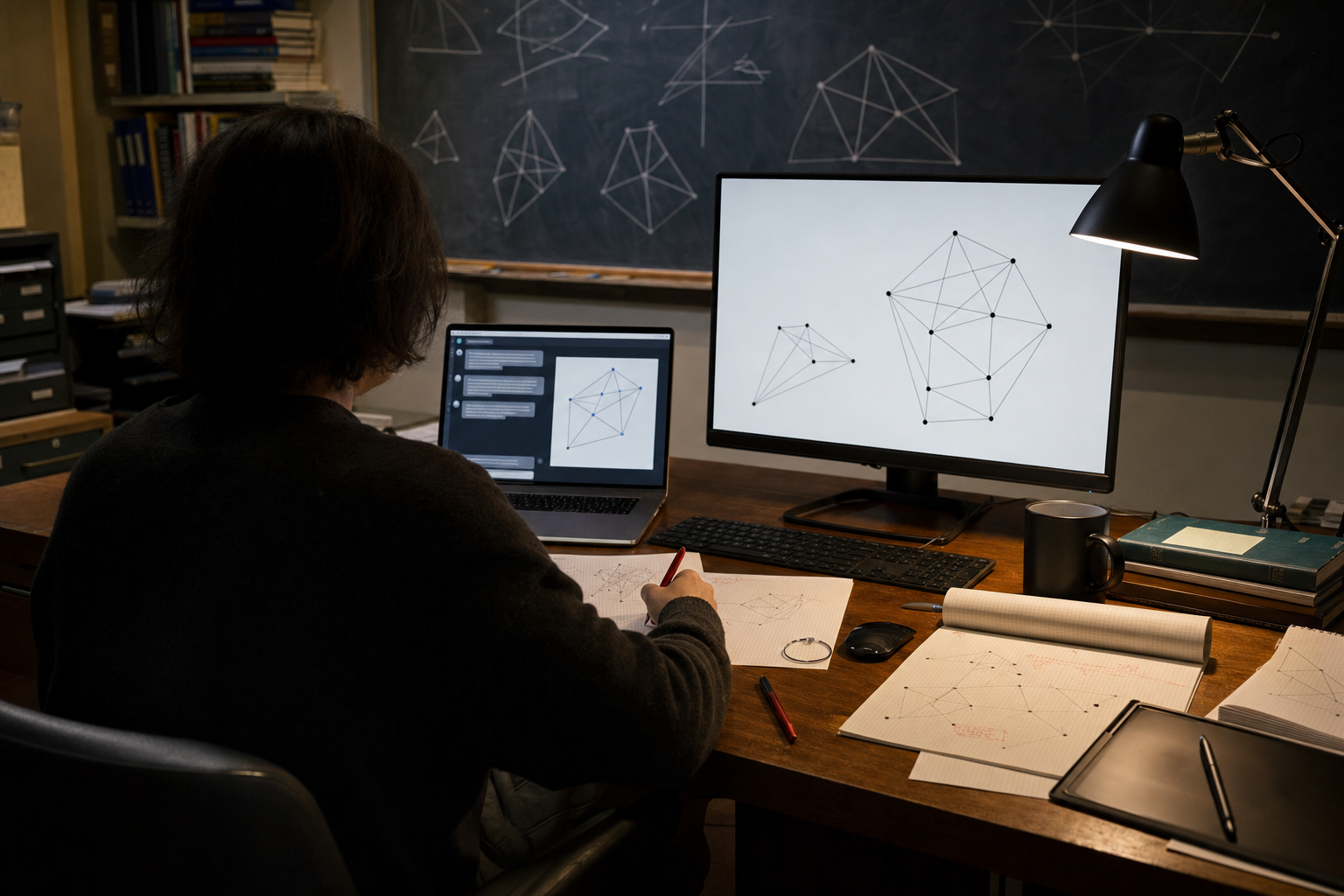
Reports and online discussions have recently pointed to an OpenAI model helping researchers find a result in discrete geometry that challenged a major conjecture. Because this story has had limited formal news coverage, it should be treated carefully: the broad claim is that an AI system contributed to a genuine mathematical advance, not that it finished science on its own. If that account is accurate, it matters for a simple reason. It suggests AI is moving beyond writing assistance and code generation into the earlier, more uncertain stage of discovery itself.
The real debate is not whether AI can produce something useful. It clearly can. The harder question is what scientific discovery still requires from humans once a model starts generating promising leads, examples, or even proofs. My view is straightforward: AI may speed up the search, but humans still carry the burden of turning outputs into knowledge. That means checking validity, explaining why a result matters, and earning trust from the research community.
A result is not the same as understanding
In mathematics, a counterexample can be enough to disprove a conjecture. But even there, the work does not end when one is found. Someone has to verify that the object really has the claimed properties, that no assumption was misread, and that the statement being disproved was understood correctly. Then comes the deeper task: explaining why this counterexample exists and what it changes.
This is where human expertise still matters most. A model may help search through a large space of possibilities much faster than a person can. It may notice patterns that human researchers did not test. But science does not only reward novelty. It rewards reliable, interpretable novelty. A strange object or candidate solution becomes knowledge only when experts can inspect it, reproduce it, and fit it into a larger body of work.
The difference is important. Producing an answer is one thing. Making that answer legible to a field is another.
Peer review becomes more important when AI helps
Some people talk as if AI assistance reduces the need for gatekeeping. In practice, it does the opposite. The easier it becomes to generate plausible claims, the more valuable strong review becomes. Researchers, referees, and editors will need to ask sharper questions, not fewer of them.
In a case like discrete geometry, that means checking the formal argument, the construction, and the computational method used to find it. It also means asking whether the result is robust or fragile. Did the system uncover a meaningful structural insight, or did it simply stumble onto a rare exception? Both outcomes matter, but they are not the same.
Peer review also serves a social function. A field needs a shared process for deciding what is credible. That process is imperfect and sometimes slow, but it is still how a private output becomes a public result. If AI systems become common in research, the scientific community will need clearer norms around disclosure, reproducibility, and attribution.
What AI is genuinely good at in research
There is no need to downplay the promise. AI systems are already useful at several parts of the research workflow.
- Search: exploring large spaces of examples, parameters, or possible constructions.
- Pattern detection: spotting regularities that may suggest a conjecture or a test case.
- Drafting and formalization: helping researchers organize ideas, code experiments, or translate between informal and more structured reasoning.
- Acceleration: reducing the time between a question and the first serious lead.
In mathematics, this can mean surfacing an unexpected counterexample. In chemistry or materials science, it can mean proposing candidate compounds worth testing. In biology, it can help rank hypotheses or identify patterns in messy data. In each case, AI can widen the search and reduce routine effort.
That is not a small contribution. Scientific progress often depends on exploring many dead ends before finding one useful path. Tools that make that search cheaper can change what researchers choose to attempt.
What AI still cannot supply on its own
But faster search is not the same as scientific judgment. Researchers still decide which questions matter, which assumptions are reasonable, and which results deserve confidence. They also decide when a formal success hides a practical weakness.
Take a mathematical example. Suppose a model helps identify a construction that disproves a long-standing conjecture. That is a real achievement. But humans still have to answer the next questions: Was the conjecture almost right in a narrower form? Does the counterexample suggest a better theorem? What new line of inquiry does it open? Those are not administrative details. They are the work of science.
The same is true outside mathematics. A model may generate a promising result from training data, but domain experts must ask whether the data were biased, whether the method overfit, or whether the output captures a real mechanism rather than a coincidence. A result that cannot survive those checks may still be interesting, but it is not solid knowledge.
The trust problem will grow
The strongest argument for human centrality is trust. Science is not only a system for generating claims. It is a system for deciding which claims deserve to be used by others. That requires transparency about methods, confidence about provenance, and enough understanding to let other people build on the result.
AI complicates each of those steps. If a model proposes an idea through a process that researchers cannot easily explain, the field may accept the result but remain cautious about the method. If a proof is long, technical, or partly machine-assisted, verification standards may need to change. If models are trained on private data or accessed through proprietary systems, reproducibility becomes harder.
These are not reasons to reject AI in research. They are reasons to insist on better scientific hygiene around it. The more powerful the tool, the more carefully the field has to document how it was used.
The counterpoint: science has always used tools
There is a fair objection here. Telescopes changed astronomy. Statistical software changed social science. Computer-assisted proofs changed mathematics. In that sense, AI is just another tool, and every major tool has triggered anxiety before becoming normal.
That point is partly right. Science has always been shaped by instruments that extend human ability. The mistake is thinking that this makes the current shift trivial. AI is not just measuring, storing, or calculating. It can generate candidate ideas and non-obvious paths. That moves it closer to parts of the workflow that researchers often treat as distinctly intellectual.
So the challenge is not to protect a romantic image of the lone scientist. It is to update scientific norms without lowering scientific standards.
A better division of labor
The most productive view is neither panic nor hype. AI should be treated as a high-powered research instrument with uneven reliability. It can be excellent at exploring, suggesting, and narrowing. Humans remain responsible for framing, validating, interpreting, and communicating.
That division of labor is not a temporary compromise. It is likely the durable model. Even if AI systems become much better at formal reasoning, scientific communities will still need human researchers to set priorities, connect findings across fields, resolve ambiguity, and decide what level of evidence is enough for acceptance.
There is also a practical reason to keep humans in the center. Research is a communal activity. Careers, funding, teaching, and public trust all depend on shared understanding, not just isolated outputs. A result people cannot explain, review, or extend has limited value, no matter how impressive its origin story sounds.
What scientific discovery still needs from humans
If the reported discrete geometry result holds up, it should be seen as a milestone. Not because it proves AI can replace scientists, but because it shows where the frontier is moving. AI can now help produce leads that matter at the research level. That is significant.
Still, discovery is more than finding. It is also checking, explaining, debating, and teaching. Humans do that work. They turn an output into an argument, an argument into a paper, and a paper into accepted knowledge.
That is the practical conclusion. As AI enters the research room, the human role becomes less about doing every step by hand and more about protecting the meaning of the work. In science, that is not the leftover task. It is the essential one.