AI in Education: Students and Teachers Should Adapt Together, Not Against Each Other
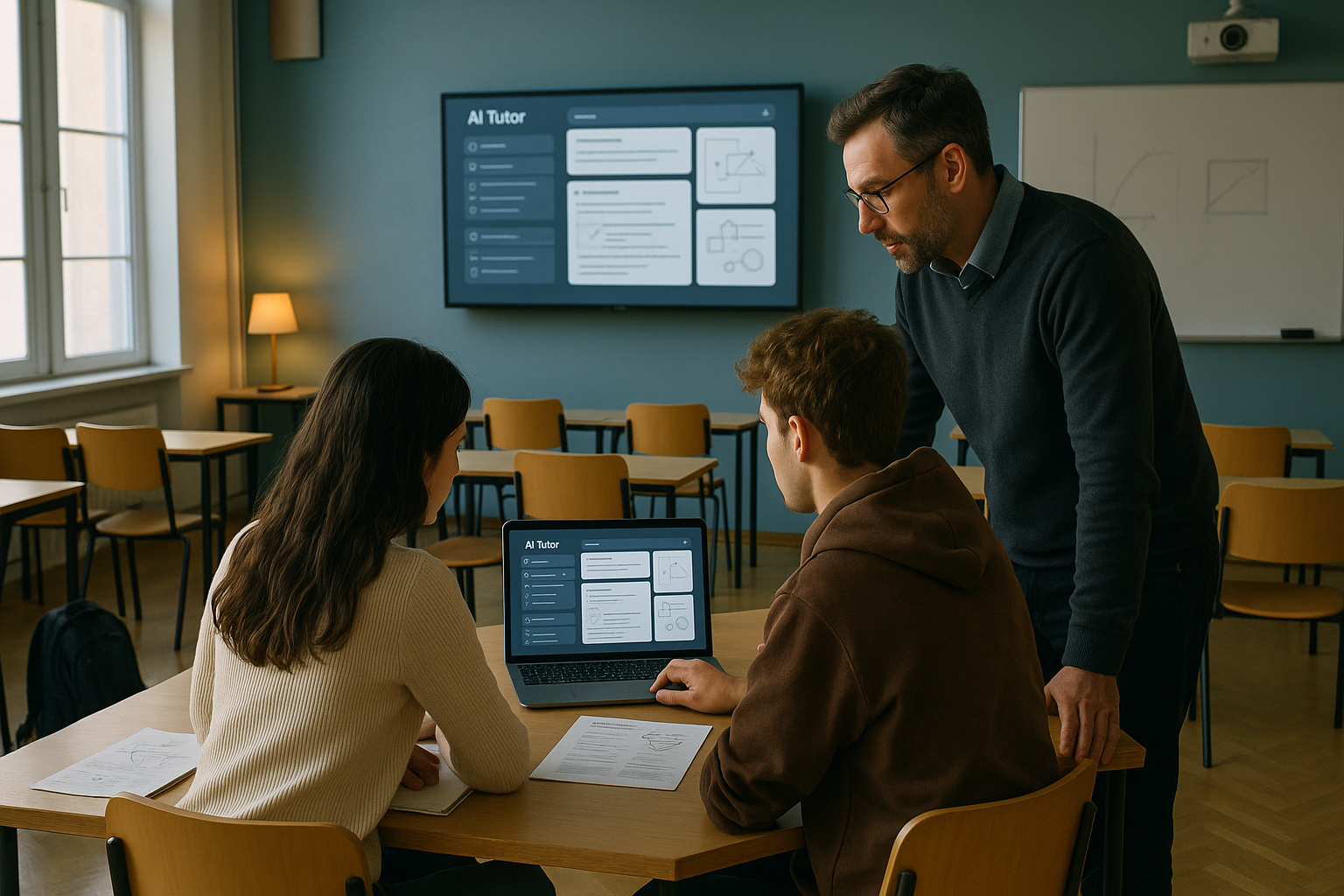
AI in education has moved from a side topic to a daily reality. Students now use AI tools to summarize readings, explain difficult concepts, translate material, draft outlines, and prepare for exams. Teachers use them to plan lessons, generate quizzes, adjust reading levels, and save time on routine tasks. This is already happening in schools and universities, whether policies are ready or not.
That matters because the real debate is no longer whether AI will enter education. It already has. The harder question is how it should be used. The tension is clear: AI can support learning, but it can also weaken it if students use it to avoid thinking and if schools respond with either panic or blind enthusiasm. My view is simple: AI should be treated as a tool for guided learning, not as a shortcut and not as a threat to be banned on sight.
The classroom has changed faster than the rulebook
One reason this debate feels messy is that adoption has been faster than policy. In many classrooms, students started using AI before teachers had training, and teachers started experimenting before institutions had clear standards. That gap has created confusion.
Some students see AI as a private tutor that is always available. They ask it to explain algebra step by step, simplify a dense article, or help organize a research paper. For students who study in a second language, including many Arabic-speaking learners working with English material, this can be especially useful. AI for students can reduce the time spent decoding language and increase the time spent understanding ideas.
Teachers, meanwhile, are under pressure to do more with limited time. AI can help create practice questions, suggest classroom activities, and produce different versions of the same lesson for mixed ability groups. In large classes, that kind of support is not trivial.
But faster access to help is not the same as better education. If students submit AI-written work they do not understand, or if teachers rely on auto-generated material without checking quality, the result is not progress. It is just speed without learning.
What AI does well for students
The strongest case for AI in education is practical, not magical. Used well, it can make learning more accessible and more responsive.
- It gives immediate support. A student stuck on a math problem or a grammar rule does not need to wait for office hours.
- It can personalize explanations. The same topic can be explained in simpler language, with examples, or in another language.
- It helps with structure. Many students do not fail because they lack ideas. They fail because they cannot organize them. AI can help build outlines, study plans, and revision checklists.
- It can reduce fear. Some students are embarrassed to ask basic questions in class. A private tool lowers that barrier.
These are real advantages. They should not be dismissed just because academic misconduct also exists.
There is another reason this matters. Education is supposed to prepare students for work, and AI in jobs is becoming more common across sectors. Employers increasingly expect people to know how to search well, verify outputs, edit drafts, and use digital tools responsibly. Schools that ignore AI entirely may protect old assessment habits, but they may also leave students less prepared for the workplace they are entering.
What AI does badly, and why that matters
The risks are also concrete. AI systems can produce false information, weak reasoning, fake citations, and confident nonsense. That is not a minor flaw in education. It goes to the heart of trust.
A student who uses AI to understand a concept may benefit. A student who uses it to generate an essay and submits it without checking facts may learn very little. The same tool can support study or replace it. The difference is not in the software. It is in the rules, the habits, and the expectations around it.
There are at least four serious concerns schools should take seriously.
- Skill erosion. If students outsource brainstorming, drafting, and revision too early, they may not build core writing and thinking skills.
- Assessment problems. Homework and take-home essays are harder to evaluate if teachers cannot tell what work reflects the student’s own understanding.
- Accuracy and bias. AI outputs can reflect errors, limited context, or bias in training data.
- Inequality. Some students have better devices, paid tools, faster internet, and more guidance at home. Others do not.
These concerns do not prove that AI should be removed from education. They do prove that lazy adoption is risky.
Bans are understandable, but they are not a full solution
Some educators argue that the safest response is to restrict or ban AI use, especially in writing-heavy courses. This view deserves respect. Teachers are right to worry about plagiarism, weaker reading habits, and the loss of authentic student work. In some settings, especially where students are still building foundational literacy, strong limits may be appropriate.
But blanket bans have clear weaknesses. First, they are difficult to enforce outside the classroom. Second, they can push use underground rather than stop it. Third, they may deny responsible students a tool that could genuinely help them learn. And finally, they do not solve the larger issue: students will still meet AI in higher education, at work, and in everyday life.
A better approach is selective permission with clear boundaries. Not every task should allow AI. Not every task should ban it. Schools need to decide which assignments measure thinking that must be done independently, and which assignments can include AI as part of the process.
The goal should not be “AI everywhere” or “AI nowhere.” The goal should be “AI where it improves learning, and limits where it weakens it.”
Teachers need support, not just pressure
Public discussion often focuses on what students are doing wrong. Less attention goes to the fact that many teachers are being asked to manage a major shift with little training and little time. That is unfair and unrealistic.
If institutions want responsible AI in education, they need to give educators practical support. That includes training on how AI tools work, what their limits are, how to redesign assessments, and how to talk to students about acceptable use.
For example, a teacher can ask students to submit:
- an outline before the final essay
- a short reflection on how they used AI, if at all
- drafts showing their revision process
- an in-class writing sample to compare with take-home work
These methods do more than catch cheating. They move attention back to the learning process.
Teachers can also redesign assignments so that simple AI copying is less useful. Asking students to connect theory to a local case, compare two class discussions, analyze a personal observation, or defend a position orally makes it harder to outsource the whole task. Good assessment has always evolved. This is another moment that requires adaptation.
Students also need a new kind of honesty
Students should not be told only what not to do. They should be taught how to use AI well.
That means learning to ask better questions, check sources, spot weak answers, and revise poor drafts. It means understanding that convenience is not competence. A polished paragraph is not proof of learning if the student cannot explain it, defend it, or build it again without help.
In practice, students need clear rules such as:
- Use AI to explain, not to impersonate you.
- Check every factual claim.
- Do not submit AI-generated citations unless you verify them.
- Disclose use when required.
- Keep building your own voice and judgment.
This is not just about discipline. It is about maturity. In a world full of generated content, the ability to verify and improve information will matter as much as the ability to produce first drafts.
The long-term effects are still not fully clear
It is important to be honest about uncertainty. AI adoption is moving quickly, but research on long-term effects is still developing. We do not yet know the full impact on writing ability, attention, memory, or deep reading when students use these tools heavily over many years.
That uncertainty is a reason for caution, not paralysis. Schools do not need perfect evidence before setting norms. But they should monitor outcomes closely. If students become faster but weaker, something is wrong. If teachers save time but lower academic standards, something is wrong. Efficiency should support education, not replace it.
What sensible adaptation looks like
The best path is cooperative adaptation. Students and teachers should not be treated as opponents in a surveillance contest. They should be partners in building new habits around a tool that is now part of educational life.
A sensible model would include:
- clear institutional policies written in plain language
- different rules for different kinds of assignments
- teacher training, not just teacher warnings
- student guidance on ethical use
- more emphasis on oral defense, drafts, and process
- regular review of what is working and what is not
This approach accepts reality without surrendering standards. It recognizes the promise of AI for students while protecting the core purpose of education: building understanding, judgment, and independent skill.
The real test is not access to AI, but what schools value
Every new tool exposes an old question: what are schools really trying to teach? If education is reduced to producing neat answers on demand, then AI will fit in easily and may even outperform many students at the surface level. But if education is about reasoning, interpretation, discussion, memory, discipline, and original judgment, then schools must protect those habits more deliberately.
That is why this moment should be taken seriously. AI in education is not just a technology story. It is a standards story. It forces schools to decide what must remain human work, what can be assisted, and how students can prepare for a labor market where AI in jobs will be normal but not sufficient on its own.
The right response is neither fear nor surrender. It is structure. Let students use AI to learn, not to hide. Let teachers use AI to support teaching, not replace professional judgment. And let schools stop pretending this change can be avoided. It cannot. The real choice is whether adaptation will be thoughtful or chaotic.