AI Images in Student Projects: A Fair Credit Guide for Teachers, Parents, and Young Creators
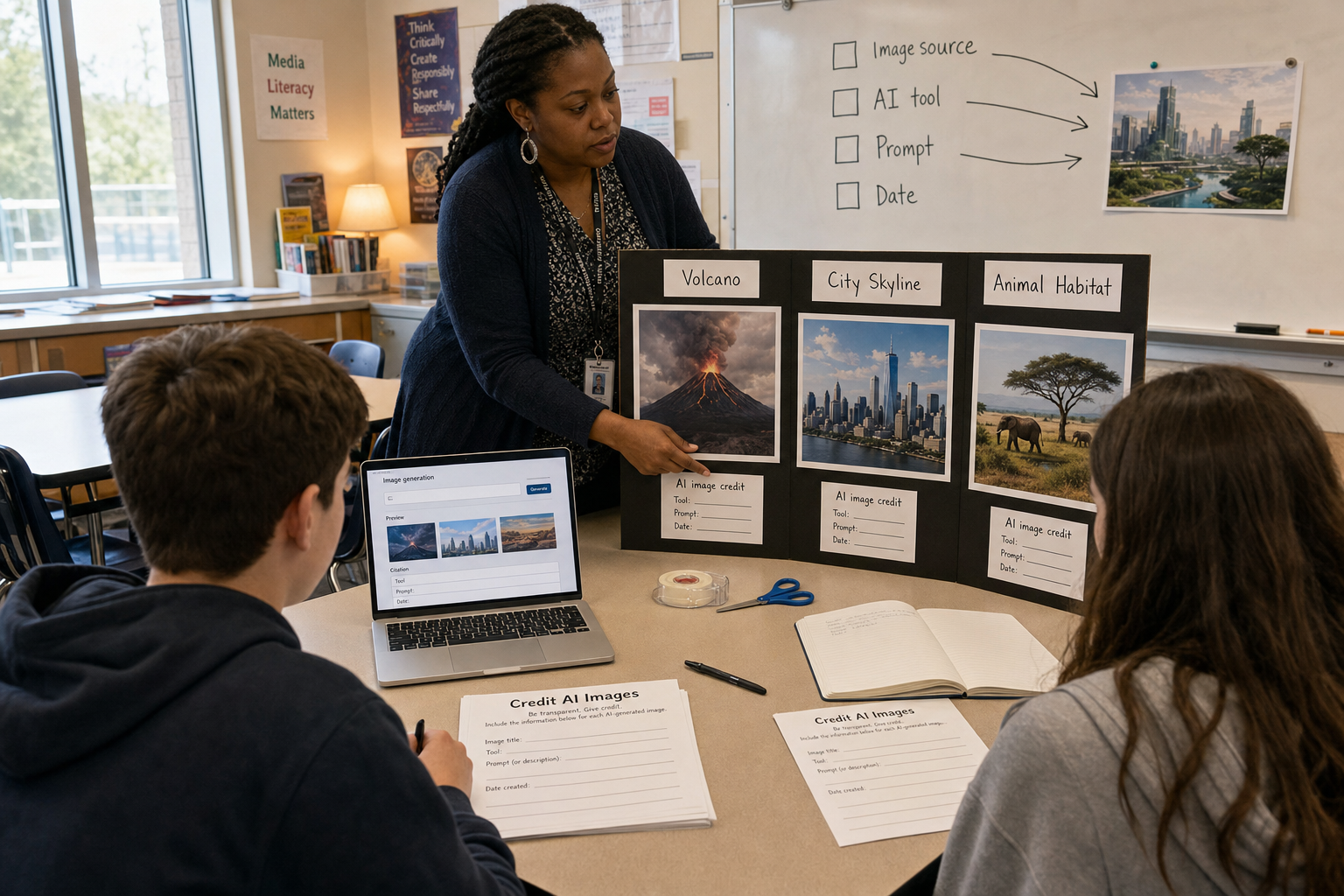
AI-generated images are now common in student life. They show up in class slides, science fair boards, club posters, and social graphics made by teens. What has not caught up is the norm around credit. Many young creators still treat these images like free decoration, even when the result came from prompts, borrowed references, or a look closely tied to a real artist.
That matters for three reasons. First, school is where people learn habits around honesty and authorship. Second, it affects fairness when one student presents machine-made polish as personal craft. Third, it sits inside a real debate: some adults want to ban AI visuals entirely, while others treat them as no different from clip art. Neither approach is good enough.
The better standard is simple. In many assignments, AI visuals can be allowed. But students should credit the tool, explain their own role, and avoid uses that hide human sources or replace work the assignment was designed to measure.
Credit is about honesty, not shame
Credit is not a punishment. It is a basic record of how something was made. Students already learn to cite books, articles, photos, and music. AI visuals belong in that same conversation, not because the software deserves praise, but because the audience deserves context.
A fair credit note answers three questions: what tool helped make the image, what the student added or changed, and whether another person’s work was directly used as a source.
The simplest rule: if AI helped make the image, say so; if a human source shaped it, name that source when you can; and if the assignment was meant to test your own art skill, do not let AI do that job for you.
This is also about fairness to classmates. If one student spends hours drawing a diagram and another generates a polished image in seconds, the teacher needs enough context to judge the work properly. Credit makes that possible.
Crediting the tool is not enough
A one-line note saying made with AI is better than nothing, but it does not solve the harder issue. A student can credit the tool and still rely on someone else’s creative labor in ways that are unfair. That happens when a prompt asks for the style of a living artist, when a student uploads another person’s work as input, or when the final image closely copies copyrighted characters or distinctive visual identities.
The legal picture here is still unsettled. Courts and policymakers are still working through questions about training data, style imitation, and copyright in generated outputs. Schools do not need to wait for perfect legal clarity before teaching better habits. A practical standard is enough: do not use living artists’ names as shortcuts for school work, and do not feed other people’s art into a generator unless you clearly have permission or a right to use it.
There is a better alternative. Students can describe the look they want without borrowing a real person’s name. Vintage travel poster, flat vector infographic, charcoal sketch, and watercolor landscape are all useful directions. They teach observation and design language instead of imitation.
The assignment decides what is fair
Some people argue that AI images are just the new clip art. There is a small truth in that. Students have always used templates, stock icons, and ready-made visuals. But AI generation is different in one important way: it can create something that looks original while hiding how little of the visible result came from the student. That makes honest credit more necessary, not less.
Others take the opposite view and call any AI visual cheating. That also goes too far. In a geography report, business pitch, or debate presentation, the main goal may be clear explanation, not hand illustration. AI visuals can also help students with limited drawing skills, tight schedules, language barriers, or some disabilities take part more fully. The right question is not whether AI was used at all. The right question is what the assignment was meant to measure.
The difference is easy to see in practice. An AI-generated background for a science slideshow may be acceptable if the student’s real work is the research, writing, and labeling. An AI-generated portrait submitted in a drawing unit is different. One supports the project. The other replaces the skill being assessed.
What fair credit looks like in practice
Good credit should be short enough that students will actually use it. In most cases, a single line on the slide, poster, caption, or reference page is enough. It does not need to read like a legal warning.
- For a presentation image: “Header image generated with Adobe Firefly from prompts written by Lina; final slide design and labels by Lina.”
- For a club poster: “Background visual generated with DALL·E; layout, text, and photo editing by the media team.”
- For brainstorming only: “AI concept images used for early ideas; final illustration drawn by the student.”
- When references matter: “Generated with Midjourney using the student’s own campus photos as reference; final collage assembled in Canva.”
- When no AI was used in the final image: “AI used for concept exploration only; final visual created without generated elements.”
What should not appear is a false claim such as Artwork by me when the student mainly wrote prompts and lightly edited the result. Prompting involves judgment, but it is not the same as drawing, painting, or photographing from scratch. Students should not erase that distinction.
There are also cases where credit is not enough. If competition rules ban AI, if the image depends on copyrighted characters, or if the teacher clearly assigned original manual work, then the student should use a different method. A truthful credit line does not turn a disallowed submission into an acceptable one.
What teachers should require
- Say the rule early. Do not wait until grading day. State whether AI visuals are allowed, limited, or banned for each assignment.
- Separate support from core skill. If the task is research or presentation, AI images may be a support tool. If the task is drawing, photography, or design technique, limits should be tighter.
- Require a simple credit format. Tell students where the credit belongs and what it should include.
- Ask for process evidence when needed. A draft sheet, prompt log, screenshots, or rough sketches can show what the student actually did.
- Model the standard. If teachers use generated visuals in class materials, they should credit them too.
- Grade judgment, not just polish. A flashy image should not earn more credit than careful sourcing, clear thinking, and honest attribution.
Teachers do not need a fifty-page policy. They need a clear one. Students usually follow the path adults make visible.
What parents can reinforce
- Ask how the image was made. That question matters more than whether it looks impressive.
- Help children keep simple notes. A saved prompt, draft, or screenshot can prevent confusion later.
- Explain the difference between influence and imitation. Learning from art is normal. Using a living artist’s name as a shortcut for instant output is different.
- Read assignment and contest rules together. Many problems begin because nobody checked what was allowed.
- Reward honesty. If a child says, “I used AI for the background but did the rest myself,” that should be treated as responsible behavior, not as a confession.
Most students are not trying to deceive anyone. They are using the fastest tool available. Adults still need to teach where speed stops being fair.
What young creators can do today
- Be clear about your role. Did you prompt, edit, crop, label, combine, or redraw? Say what you actually did.
- Keep a short record. Save the tool name, the main prompt idea, and a few work-in-progress images.
- Use your own material when possible. Your own photos, sketches, and notes make your project stronger and easier to credit honestly.
- Avoid living artists’ names and copyrighted characters. If you would feel awkward saying it out loud to a teacher or the artist, do not put it in the prompt.
- Ask before you submit. If the rules are unclear, check first. It is easier than fixing a problem later.
The point of credit is not to make student work heavy or joyless. It is to build a habit that will matter long after school: show your process honestly, respect other people’s labor, and be clear about what is yours. AI images are now part of student culture. The fair response is neither panic nor denial. It is a workable standard that young creators can actually follow: name the tool, name your contribution, and do not borrow someone else’s art as if it were your own.