When AI Helps Find Lost History: What the Maya Pyramid Story Teaches Us About Human Discovery
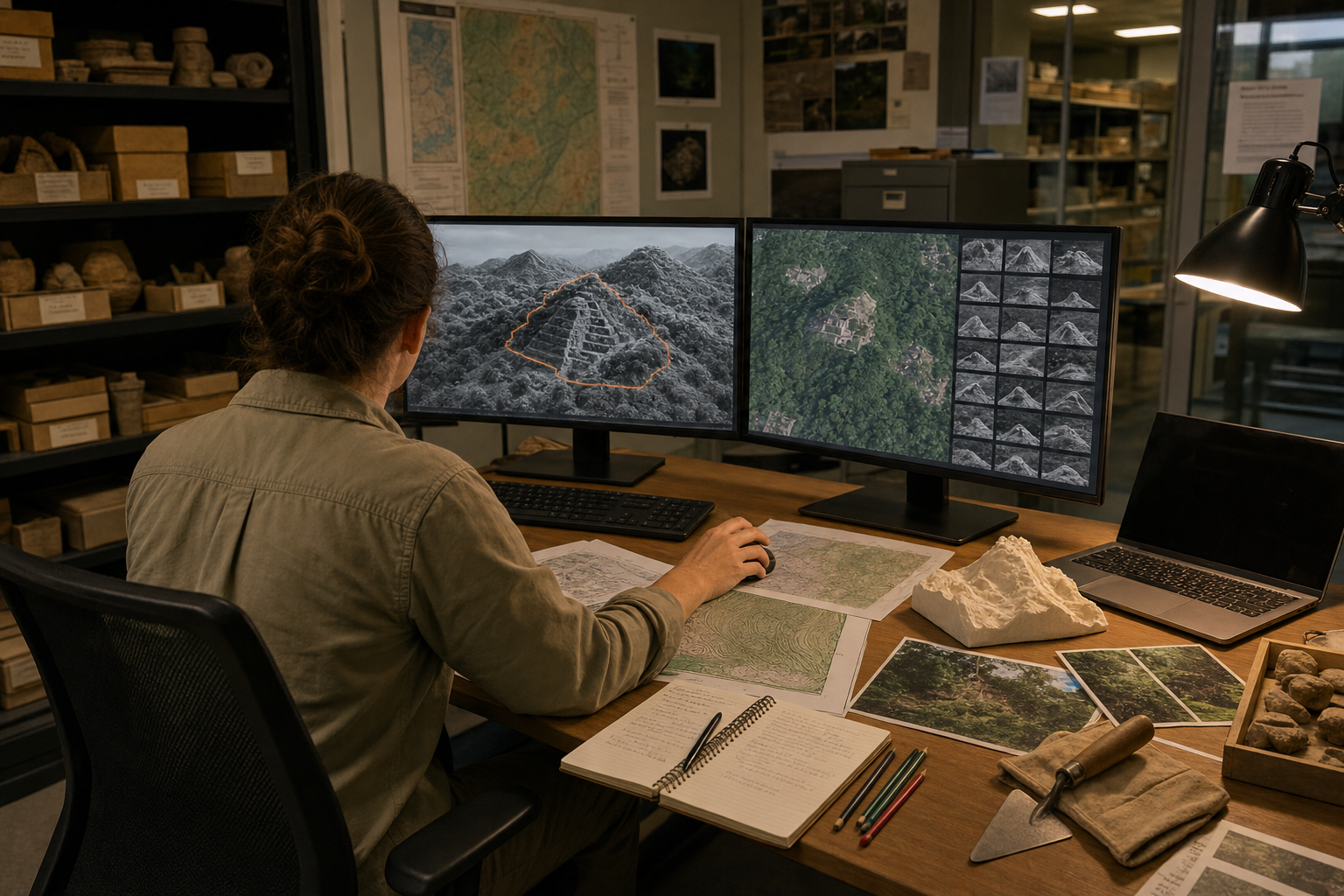
A widely shared report claims that a Google software engineer used 48 AI agents to analyze NASA lidar data and identify what may be an unmapped Maya pyramid in about 72 hours. If the claim holds up, that is a striking example of AI being used for search and pattern detection in a field where the data is often massive and the human labor is slow.
It matters because the story captures a real shift. AI is no longer discussed only as a chatbot or writing tool. It is increasingly being framed as a research assistant that can scan scientific data, surface overlooked patterns, and help experts decide where to look next. But that is also where the debate begins. A fast AI-generated lead is not the same as an archaeological discovery, and the excitement around speed can easily blur the role of expert judgment, field verification, and local knowledge.
What we know, and what we do not
Some parts of this story fit well with established practice. Archaeologists have used lidar for years to reveal ground features hidden by dense vegetation. In Maya studies especially, lidar has transformed mapping by exposing platforms, causeways, terraces, walls, and settlement patterns that are difficult to see from the ground.
The new claim is about method. Instead of one researcher or one software pipeline reviewing the data, multiple AI agents reportedly worked through the dataset quickly and flagged a possible pyramid. That is plausible as a technical workflow. What is not yet the same thing is confirmation. A reported detection in remote-sensing data is a candidate finding. It becomes a stronger archaeological claim only after expert review, comparison with known records, and ideally field validation.
AI can help identify a candidate site. It cannot, by itself, confirm an archaeological discovery or explain its meaning.
That distinction may sound fussy, but it is the whole issue. In science and archaeology, a result is not strong because it is exciting. It is strong because other people can examine the method, test the claim, and check the evidence.
Why this story caught attention so fast
The appeal is easy to understand. Lidar datasets are huge. A forested region can contain countless shapes that look promising from above. Some are cultural features. Some are natural landforms. Some are modern disturbances. Reviewing that terrain carefully takes time, and time is exactly what many research teams do not have enough of.
AI systems are well suited to one part of that problem: scanning large volumes of visual or spatial data for repeatable patterns. In archaeology, that could mean ranking anomalies that resemble platforms, pyramidal forms, plazas, or aligned structures. Instead of replacing archaeologists, a good system can act as a triage tool. It can reduce the search space.
That is a real benefit. A graduate student, a small lab, or an underfunded heritage team may never be able to inspect every promising area manually. If AI helps them move from ten thousand possible features to fifty serious candidates, that is not a gimmick. It is useful work.
The real contribution is speed, not magic
The “48 agents in 72 hours” framing sounds dramatic, but the deeper lesson is simpler. AI is valuable here because it can compress the early search phase, not because it has suddenly solved archaeology.
Every AI-assisted discovery still depends on human choices. Someone has to decide which data to use, how to clean it, what patterns matter, how to define a “pyramid-like” structure, and how to separate weak leads from strong ones. Domain experts also know what the model does not know: regional building styles, earlier surveys, geological look-alikes, seasonal distortions, and the limits of the underlying scan.
That is why the best way to describe AI in stories like this is as an instrument. Lidar is an instrument. GIS software is an instrument. Image segmentation tools are instruments. Multi-agent AI can be another instrument. Useful, potentially powerful, but still part of a wider research process.
Where the hype can mislead people
The first risk is overclaiming. A likely candidate can quickly become “AI found a lost city” once the story moves online. That is bad for public understanding and bad for the field. Archaeology already struggles with sensational headlines that outrun evidence. AI can make that habit worse by adding the appeal of novelty.
The second risk is false confidence. Pattern recognition systems are good at finding shapes that match a prompt. They are not good at knowing whether those shapes matter historically. A mound can be natural. A straight line can be a road, an erosion pattern, or a modern boundary. Remote sensing is powerful, but it does not remove uncertainty.
The third risk is that credit gets distorted. When a story focuses on the AI or the engineer, it can sideline the people whose expertise made the result meaningful: archaeologists, lidar specialists, local institutions, and often the communities connected to the landscape itself. Heritage research is not just a technical puzzle. It involves stewardship, permissions, interpretation, and responsibility.
There is also a practical concern. If universities, funders, or the public start believing that AI can “do the discovery part,” they may undervalue the slow human work that follows: site visits, archival checks, conservation planning, excavation design, and long-term interpretation. That would be a serious mistake.
What archaeologists, researchers, and students should ask next
When an AI-assisted finding makes headlines, the right response is neither automatic belief nor automatic dismissal. It is structured scrutiny. A few questions matter more than the buzz:
- Is this a confirmed finding or a reported candidate? Those are different claims.
- What data was used? Was it public lidar, proprietary scans, or a mixed source?
- How was the system evaluated? Did it detect known sites accurately, or only produce one striking new example?
- Can the method be checked? Are the workflow, assumptions, and error limits clear enough for others to review?
- Who interpreted the result? Were archaeologists and regional experts involved, or only technical operators?
- What follow-up happened? Was the candidate compared with existing maps, prior surveys, and on-the-ground evidence?
- Who is included in the credit and governance? Were local researchers, institutions, and heritage authorities part of the process?
These questions are not barriers to innovation. They are how serious research protects itself from self-deception.
A fair case for moving faster
There is a reasonable counterargument here. Archaeology has more data than experts can fully process. Forests are disappearing, sites are threatened, and field seasons are expensive. If AI can surface overlooked locations quickly, then demanding perfect certainty before public discussion may slow down useful work.
That is true up to a point. Speed has value. Early leads have value. Experimentation has value. The field should not treat every new computational method with suspicion just because it sounds unfamiliar or arrives from outside traditional archaeology.
But speed is only a virtue if it improves the next decision. A faster list of possible sites is helpful. A faster cycle of hype is not. The standard should be simple: does the tool help experts ask better questions, allocate attention better, and test claims more effectively? If yes, it deserves serious use. If not, it is mainly a story.
The better lesson from the Maya pyramid claim
The best lesson is not that AI is replacing archaeologists. It is that discovery is becoming more layered. First comes data collection. Then pattern detection. Then expert review. Then field verification. Then interpretation. AI can improve one or more of those steps, especially the early filtering of large datasets. But it does not collapse them into one.
That is good news for students and researchers. The future is not a choice between coding and fieldwork, or between technical systems and humanistic interpretation. The real opportunity is combination. People who understand both computational tools and domain evidence will be in a stronger position than people who romanticize either side.
It is also a useful correction to the way AI is often discussed in public. The most interesting use of AI may not be flashy imitation of human conversation. It may be disciplined assistance in places where humans face scale problems: archives, climate models, medical imaging, biodiversity records, and, yes, archaeological landscapes.
Discovery still needs human responsibility
If the Maya pyramid report is eventually confirmed, it will deserve attention. Not because AI somehow uncovered history on its own, but because a smart technical workflow helped direct human expertise toward something worth checking. If the claim weakens under review, that will also teach an important lesson about caution, standards, and the difference between a signal and a result.
The practical takeaway is clear. Treat AI-assisted findings as leads, not verdicts. Welcome tools that help experts search faster. Demand evidence before celebrating breakthroughs. And keep the credit where it belongs: with the full chain of people who collect the data, build the tools, interpret the landscape, verify the site, and protect the history.
That is the human side of AI in discovery. It can help us notice more. It does not remove the need to prove, explain, and care for what we find.