When AI Helps Disprove a Math Conjecture, the Real Work Starts After the Headline
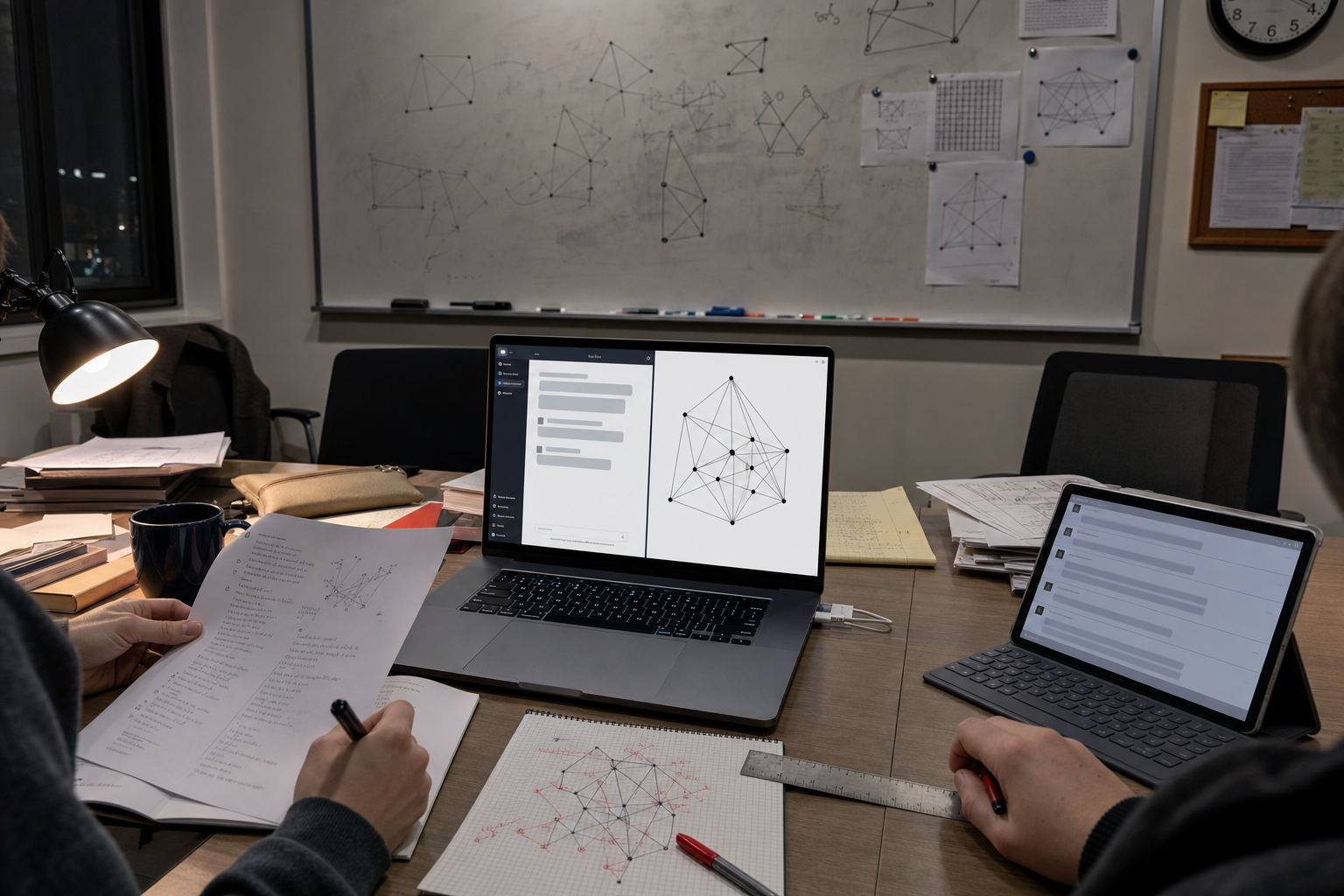
Reports circulating online, including discussion on Hacker News, say an OpenAI model helped disprove a major conjecture in discrete geometry. Public details still appear limited, so this should be treated as a reported claim, not a settled fact, until the proof, the model’s exact role, and the review status are clear. If the claim holds up, it matters. A conjecture is a statement believed to be true but not yet proven, and disproving one can reset a field.
The deeper issue is not whether a model can produce a surprising mathematical lead. It is what researchers must do next. In mathematics, a result is not finished when software suggests a counterexample or sketches an argument. It becomes part of science only when people can verify it, understand why it works, explain it to others, and build on it. That is the real tension here: fast machine-assisted discovery on one side, and slow human validation and interpretation on the other.
First, separate the claim from the conclusion
Before anyone treats this as a milestone, the basic facts need to be pinned down. Did the model generate a counterexample? Did it suggest a promising path that human researchers then developed into a proof? Was the decisive step found by search, by symbolic computation, by a language model, or by a mix of tools? Those are not minor details. They determine what the result actually shows about AI and what it does not.
Discrete geometry studies arrangements of points, lines, shapes, and related combinatorial structure. In that kind of work, a disproof can arrive in different forms. Sometimes one explicit construction is enough. Sometimes the real contribution is not the object itself, but the way of finding it. If the current reports are accurate, researchers will need to show which of those happened here.
That is why the first responsible response is caution. Until the argument is public and others can inspect it, this is an interesting report, not yet a finished chapter in mathematics.
Verification is not a formality
If an AI system helped produce a disproof, human researchers still have to do the hardest kind of checking. In math, there is no room for “mostly right.” A single hidden assumption, a wrongly copied constraint, or a gap in a lemma can undo the entire claim.
If the result depends on a concrete counterexample, researchers must verify every condition. Does the object really satisfy the setup of the conjecture? Does it truly violate the claimed conclusion? In geometry, even a small mistake in dimension, symmetry, or boundary conditions can make a dramatic claim collapse.
If the result is a longer proof, the burden is even heavier. Mathematicians will want to rebuild the argument step by step, reduce it to clear lemmas, and check whether the proof relies on any unstated computational assumptions. Independent teams may try to reproduce the result from scratch. In some cases, proof assistants or formal verification tools may help. But even then, people still have to decide what exactly should be formalized and how to translate the informal argument into something rigorous.
This is where the current excitement around AI needs discipline. Language models can produce plausible mathematical text. Plausible is not the same as correct. Fluency is useful in drafting and exploration, but in a proof it can also hide weakness. That is why verification becomes more important, not less, when AI enters the picture.
Correctness is only the first question
Even when a disproof is valid, the next job is interpretation. Researchers will ask a more interesting question than “Is the conjecture false?” They will ask “Why was it false?”
That matters because a failed conjecture often contains a useful idea that was stated too broadly. A counterexample can reveal where the original intuition breaks. Maybe the claim is wrong in high dimensions but still right in low ones. Maybe it fails only for rare constructions. Maybe the conjecture needs one extra condition. A strong research community does not stop at the first demolition. It studies the rubble and figures out what should be rebuilt.
This is one reason human expertise stays central. A model may help search a vast space of possibilities. It does not remove the need for mathematical judgment about which repaired statement is interesting, which special cases matter, and which new questions are worth asking. Those choices shape the future of the field.
A result the field cannot teach is a weak result
There is another task that headlines usually miss: explanation. A mathematical result is much more valuable when other people can learn it. That means seminars, lecture notes, textbook revisions, diagrams, examples, and simpler proofs if possible.
If a machine-assisted disproof comes wrapped in a complicated search process or an opaque chain of generated arguments, the community may accept that it is correct and still struggle to absorb it. That is not a trivial problem. Mathematics advances through shared understanding, not just through isolated true statements.
Good researchers will therefore try to compress the result into human-sized ideas. They will ask whether the key mechanism can be explained with a small example. They will look for a cleaner proof. They will identify the general principle behind the counterexample. That work may look less glamorous than the original breakthrough, but it is what turns a one-off result into knowledge others can use.
Credit should be honest, precise, and boring
One of the worst ways to discuss stories like this is to turn them into a contest between “AI” and “humans.” Research does not work that way. Tools contribute in different ways, and people remain responsible for choosing problems, setting standards, checking results, and explaining them.
The right question is not whether a model should get credit in a human sense. The right question is whether papers and institutions describe the workflow accurately. Readers should be told:
- who posed the problem and framed the conjecture,
- what kind of system was used,
- whether the system generated a candidate counterexample, a proof sketch, or a search strategy,
- who verified the result,
- and which parts were computational, formal, or purely human-written.
That level of clarity is not just about fairness. It is about reproducibility and trust. If the key step depends on a private model that outside researchers cannot inspect or rerun, the field has a real problem. A theorem can still be true in that situation. But mathematics as a public discipline should be careful about accepting black-box authority as a normal standard.
The counterpoint is real
There is a fair objection here. Mathematics has long used computer assistance. Researchers already rely on symbolic algebra systems, search algorithms, exhaustive case checks, and proof assistants. From that perspective, AI is just another tool. If the result is correct, why should the origin story matter so much?
That argument has force. A valid proof does not become invalid because software helped produce it. And it would be a mistake to act as if “pure” human mathematics has always been untouched by machines. It has not.
But the current debate is still different in one important respect. Large AI models can generate persuasive language and partial reasoning without stable guarantees of correctness. That makes them useful for exploration and dangerous for trust at the same time. The issue is not that AI is unnatural. The issue is that some forms of AI assistance are much easier to overestimate.
What good human-AI collaboration should look like
If AI is going to play a larger role in mathematical discovery, the standards should be clear from the start.
- Public claims should come with public arguments as quickly as possible.
- Important results should be independently checked by researchers who were not part of the original workflow.
- When feasible, crucial steps should be formalized or computationally reproduced.
- Authors should describe tool use plainly, without hype and without vagueness.
- Follow-up work should aim to simplify, teach, and generalize the result, not just celebrate it.
- Students should be trained to test machine output, not to treat it as authority.
This is the right way to think about scientific AI. Not as a replacement story, and not as a marketing story, but as a workflow question. What matters is whether the collaboration leaves the field with knowledge that is stronger, clearer, and easier to build on.
The real measure of success
If this reported discrete geometry result proves genuine, the achievement will not simply be that a model helped disprove a conjecture. The bigger achievement will be what human researchers do afterward: verify every step, explain the mechanism, repair the theory where needed, teach the result clearly, and set better standards for the next case.
And if the claim does not survive scrutiny, that would also teach an important lesson. In mathematics, the standard is not who produced the most exciting first draft. The standard is whether the community can check it, understand it, and rely on it.
That is the practical conclusion. When AI enters discovery, the machine-generated lead is only the beginning. The real work, and the work that makes science public, still belongs to researchers.