When AI Helps Discover Biology: What Claude’s Enzyme Finding Means for Human Scientists
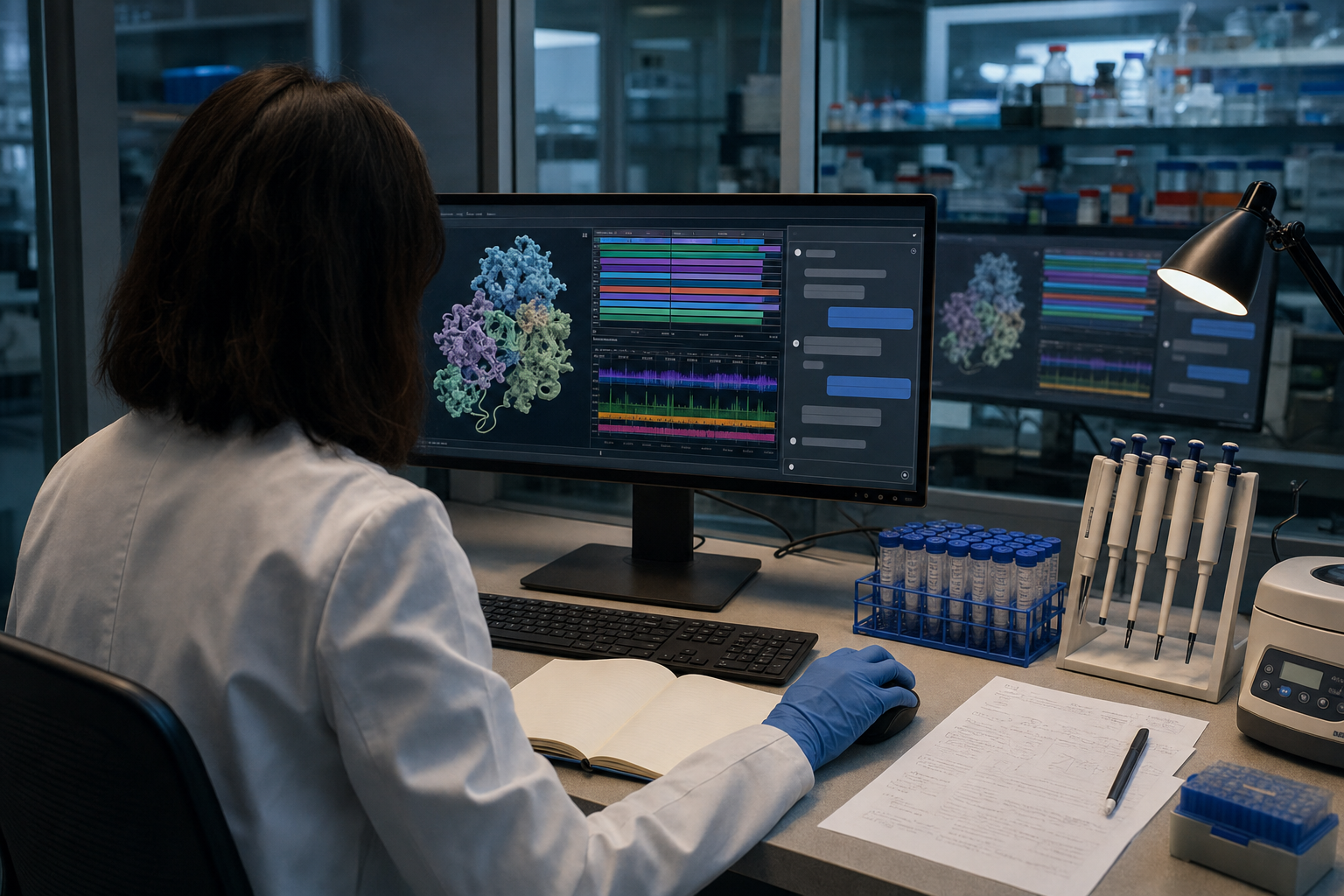
Recent reports say scientists using Anthropic’s Claude helped identify a previously overlooked enzyme system linked to CRISPR-like repeats. If that account is accurate, and if the finding holds up through peer review and independent replication, it is an important result. It would show that a general-purpose AI model can help researchers spot biologically useful patterns inside massive amounts of sequence data and literature.
Why does that matter? Because modern biology has a search problem as much as a theory problem. There is too much data for any team to read, compare, and test by hand. The main debate is not whether AI can replace biologists; it cannot. The real question is how to treat AI when it helps generate a lead: as a breakthrough scientific tool, as a collaborator in a limited sense, or as a piece of corporate marketing. That debate matters for verification, credit, safety, and public trust.
What happened, and what remains uncertain
At the moment, the public story is still based largely on reports, discussion, and company-linked descriptions rather than a settled scientific record that everyone has inspected. That distinction matters. Readers should separate three different claims.
- A model may have helped researchers notice or prioritize a candidate enzyme system.
- Human scientists then had to test whether that candidate actually worked as claimed.
- Some people are already treating this as proof that AI now “discovers biology” on its own.
Those are not the same thing. In biology, a plausible lead is valuable, but it is not the same as a validated mechanism. A pattern in genomic data still has to survive controls, assays, replication, and scrutiny from other labs. If this enzyme finding is real, the lab work is not a footnote. It is the whole reason the claim matters.
Why this could still be a real turning point
Even with those caveats, this kind of result could mark a real shift in how science gets done. Much of research is not a dramatic “eureka” moment. It is slow filtering. Scientists scan papers, compare gene neighborhoods, inspect odd sequence motifs, and decide which ideas deserve scarce lab time. That early-stage judgment is where good AI systems may become useful.
A model does not need to “understand life” to help with that job. It may be enough for it to connect clues across databases, flag unusual repeats near certain genes, surface related papers from distant subfields, and help produce a short list of testable candidates. In areas like microbial genomics, that kind of narrowing can save months of work.
That is why this case matters beyond one enzyme system. If verified, it suggests AI may become part of the front end of discovery: not proving results, but improving the odds that scientists spend their time on the right questions.
Discovery is not the same as explanation
This is where the public conversation often goes wrong. People hear that AI helped find an enzyme and jump straight to the idea that the model “did science.” That is too loose to be useful.
Finding a candidate is one stage. Explaining what it does is another. Scientists still need to show how the enzyme behaves, what it acts on, how reliable the effect is, whether it appears across organisms, and whether the finding can be reproduced by others. A smooth output from a model is not evidence. At best, it is a lead.
That may sound obvious, but it is exactly the distinction that hype tends to erase. And once that line gets blurred, public trust gets weaker. If people feel they are being sold a story about machine genius instead of a documented research process, they will become more skeptical not only of AI claims, but of the science itself.
Human scientists are still the authors of the work
The strongest lesson from a Claude-assisted finding is not that human researchers matter less. It is that their role becomes more visible where it counts most: framing the question, judging the model’s suggestions, designing experiments, rejecting false leads, and deciding what counts as proof.
AI systems should not be listed as scientific authors. They cannot explain their own methods in the way reviewers require. They cannot accept responsibility for an error. They cannot stand behind a conclusion when another lab challenges it. Authorship belongs to the humans who designed, tested, and defended the work.
But that does not mean AI use should be hidden. Quite the opposite. If a model helped search the literature, cluster candidate systems, interpret patterns, or suggest next steps, that should be disclosed clearly. The right comparison is not a brilliant colleague. It is a powerful, partly opaque research tool. We do not give authorship to a microscope, but we do describe the microscope, its settings, and its limits. AI deserves the same procedural honesty.
Verification is where this story succeeds or fails
The biggest question is not whether one team got a useful result with one model. The bigger question is whether other scientists can reproduce the process and the outcome.
That means asking practical questions. What exactly was the model asked to do? Was it given raw data, curated inputs, or heavy expert steering? How many candidate ideas did it produce before one looked promising? How many were dead ends? Did standard bioinformatics tools already point in the same direction? Without that context, it is hard to know whether the model added true scientific value or simply sped up a literature and ranking task.
This is not a hostile standard. It is the standard science already uses. A claim becomes stronger when others can inspect it, test it, and repeat it. For AI-assisted biology, that means keeping records of prompts, model versions, filtering steps, and validation methods. If those details stay private, the result may remain impressive but difficult to trust.
Skeptics are right about some things
Critics of large language models have solid reasons for caution. These systems can produce fluent nonsense. They can hide weak logic behind confident language. In scientific settings, that is not a cosmetic flaw. It can waste money, lab time, and attention.
It is also fair to ask how novel the model’s role really was. Did it identify something that standard tools and expert review had truly missed? Or did it mainly help compress a lot of reading and candidate sorting into a shorter time window? Both would be useful. They are just different kinds of usefulness.
Still, skepticism should not become denial. If a tool helps a research team find one meaningful lead inside a search space that humans struggle to navigate, that is scientifically important. Many valuable tools in science do exactly that. They do not replace judgment. They improve where judgment is applied.
Biology makes the safety question unavoidable
There is also a harder issue here. A system that helps identify new biological mechanisms may, in the wrong context, make it easier to explore harmful ones. That does not mean such work should stop. It means AI-assisted biology needs stronger safety practices than a normal software rollout.
Model providers and research labs should think seriously about controlled access, logging, red-team testing, and limits around requests involving pathogens or risky experimental design. The fact that a model can help surface useful enzyme systems is exciting. It is also a reminder that capability and governance have to grow together.
This matters for public trust as much as for safety. People are more likely to accept AI in science if they can see that someone is taking responsibility for misuse risk, not just celebrating performance gains.
The public needs less mythology and more process
If this reported enzyme finding proves robust, it should be presented in the most boring honest way possible: a model helped humans search; humans decided what looked plausible; humans tested it; evidence determined the result. That story is strong enough. It does not need grand claims about autonomous discovery.
In fact, the mythology is the dangerous part. It encourages companies to overstate what happened. It encourages institutions to chase headlines instead of methods. And it encourages the public to see every success as magic and every failure as fraud. Science works better when the middle ground is visible.
What should happen next
- Journals should require clear disclosure of which model was used, which version, and for what tasks.
- Labs should document prompts, intermediate outputs, and decision points just as they document protocols.
- Funders should support replication and benchmarking, not only first claims.
- Companies should avoid presenting AI-assisted findings as proof of independent machine discovery unless outside scientists can inspect the evidence.
- Research institutions should build safety review into AI-enabled biology workflows early, not after a public controversy.
These are not glamorous reforms. They are exactly the kind that make a new tool credible.
A better way to understand AI in science
The reported Claude-assisted enzyme discovery, if confirmed, should not make human scientists feel obsolete. It should make them more demanding. AI can help search, connect, summarize, and suggest. Humans still decide what counts as a good question, what counts as proof, what risks are acceptable, and what deserves trust.
That is not a disappointing conclusion. It is the right one. The best future for AI in biology is not a lab without scientists. It is a lab where scientists waste less time, test better ideas, disclose more of their process, and remain fully accountable for the results.