Who Gets Credit When AI Helps? A Guide for Writers, Students, and Editors
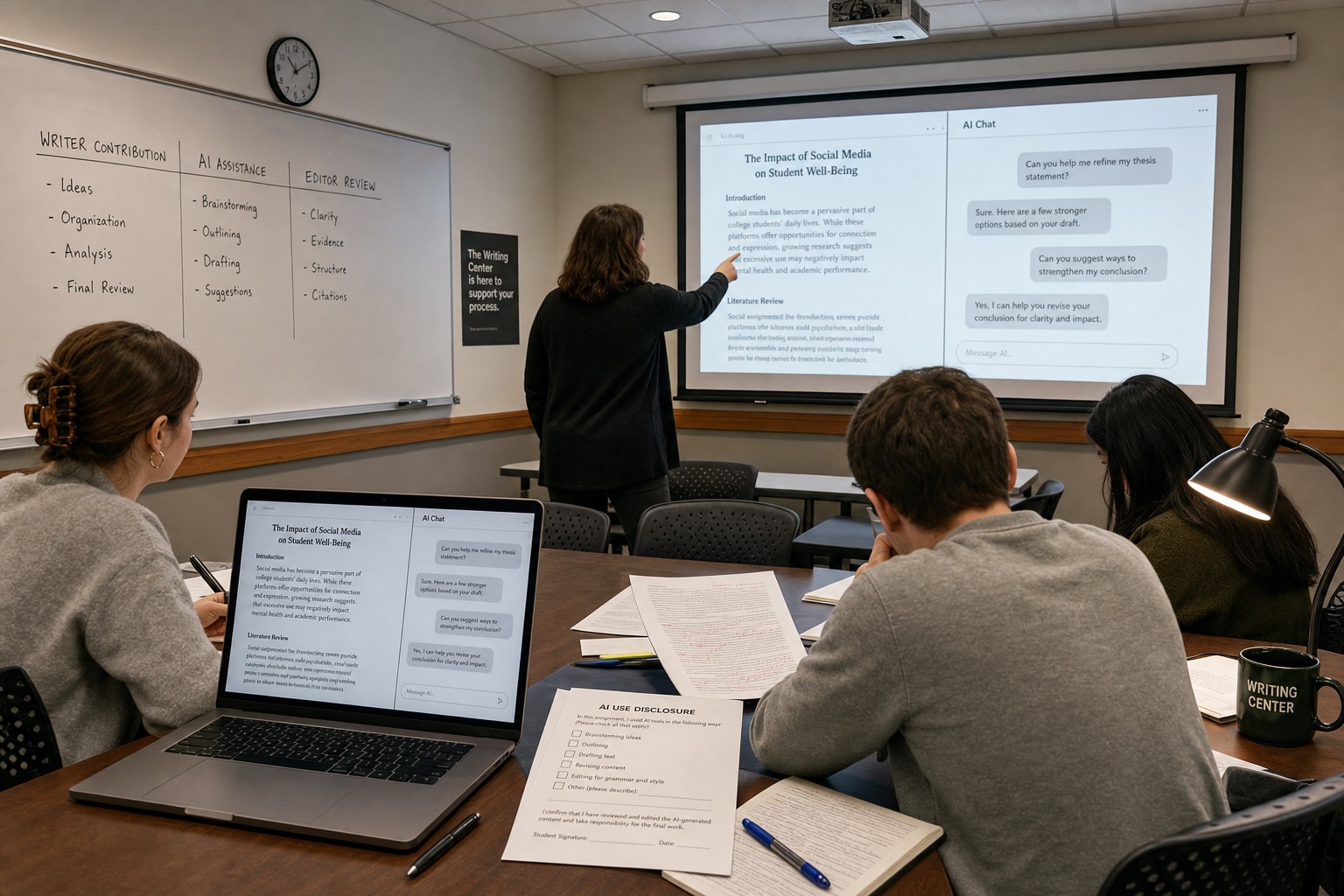
AI has moved from the margins of writing into the daily routine. People now use it to brainstorm ideas, rewrite rough sentences, summarize research, generate outlines, and sometimes draft full sections. That shift has created a practical problem that schools, publishers, and workplaces are still trying to answer: when AI helps with a piece of writing, who gets credit, and what should be disclosed?
The question matters because writing depends on trust. Readers want to know who is responsible for the facts, the judgment, and the final argument. Teachers need to know what a student actually learned. Editors need standards that allow reasonable assistance without hiding major outsourcing. The core debate is not whether AI can help. It can. The debate is where to draw the line between acceptable assistance, meaningful collaboration, and misleading presentation.
The basic rule: credit follows responsibility
The clearest standard is also the most useful one: the person who makes the key decisions and stands behind the final work is the author. AI can assist, but it should not be treated as an author in the human sense. It does not take responsibility, cannot defend a claim, and cannot be accountable for errors, bias, plagiarism, or misrepresentation. A human can.
That does not mean AI use is irrelevant. It means authorship and acknowledgment are different things. A writer may remain the sole author while still disclosing that AI was used for certain tasks. This is already normal in other forms of work. Editors get thanked. Researchers cite software. Designers use tools. The tool matters, but it does not become the accountable creator.
That should be the starting point for policy: authorship stays with the human responsible for the work, and disclosure depends on how much the tool shaped the result.
Not every use needs a confession
One reason this debate gets messy is that “using AI” can mean very different things. Asking a tool to suggest five headline options is not the same as submitting an AI-written essay under your own name. Running a draft through grammar suggestions is not the same as letting a system produce the core analysis.
That is why blanket rules often fail. If institutions require disclosure for every minor use, the rule becomes hard to follow and easy to ignore. Many digital tools already include machine assistance in spelling, autocomplete, translation, and search. Treating all of that as suspicious will not create honesty. It will create paperwork and confusion.
A better norm is this: disclose material assistance, not trivial assistance.
- Minor assistance: spelling, grammar, formatting, basic transcription, simple brainstorming. Usually no formal credit is needed unless a specific policy says otherwise.
- Moderate assistance: generating an outline, rewriting passages, summarizing long documents, proposing structures or examples. This often deserves disclosure in academic, journalistic, or professional settings.
- Major assistance: drafting large portions of the text, generating analysis, producing arguments, or substantially shaping the final content. This should be disclosed clearly, and in some settings it may violate the rules altogether.
This kind of scale is more realistic than an all-or-nothing standard.
For writers: disclosure should match the role AI played
Writers do not need a ritual apology every time they use a tool. But they do need to be honest when the tool materially shaped the work. If AI helped generate the structure of an article, rewrite key passages, or suggest core examples, readers and editors should know that. If it only cleaned up punctuation, that usually does not change the meaning of authorship.
The practical test is simple: if a reasonable reader or editor would think the AI contribution matters to how the piece was made, disclose it.
A short acknowledgment is often enough. For example:
- Light disclosure: “AI tools were used for grammar and formatting assistance.”
- Moderate disclosure: “The author used AI tools to help organize notes and test alternative phrasing. All claims and final wording were reviewed and approved by the author.”
- Strong disclosure: “AI tools were used to generate an initial draft structure and summarize source material. The author substantially revised the text and takes responsibility for the final version.”
These statements are not perfect, but they do two important things. They tell the truth, and they keep responsibility with the human author.
For students: the real issue is learning, not just credit
In education, the question is slightly different. A student paper is not only a product. It is also evidence of learning. That means schools are right to care more about AI use than many workplaces do.
If a student uses AI to explain a concept, check grammar, or generate practice questions, that may support learning. If the student asks AI to write the essay, solve the problem set, or produce analysis they cannot explain, the system is no longer supporting learning. It is replacing it.
That is why students need rules that are specific, not vague warnings about “misuse.” Teachers should tell students what is allowed in each assignment. Students, in turn, should assume that hidden substantive use is risky even when the policy is unclear.
A fair baseline for schools would look like this:
- Using AI for proofreading or basic language support may be allowed.
- Using AI for idea generation or outlining may be allowed if disclosed.
- Using AI to produce final answers, analysis, or large sections of text should require explicit permission.
- If a student cannot explain or defend what was submitted, they should not claim full ownership of it.
This approach is especially important for non-native English speakers. Some rely on language tools to communicate clearly, not to avoid thinking. Schools should not confuse language support with academic dishonesty. At the same time, students should not use that reality as cover for outsourcing the real intellectual work.
For editors: make the rule usable
Editors often sit in the hardest position. They need to protect trust without creating rules so strict that writers hide what they are doing. The answer is not to ban everything or accept everything. It is to define what kinds of assistance are acceptable and what must be disclosed.
A useful editorial policy should answer four questions:
- What kinds of AI use are allowed?
- What kinds require disclosure?
- What kinds are prohibited?
- Who is responsible for checking facts, permissions, and originality?
In most editorial settings, the last answer should remain simple: the human writer and editor are responsible. AI output should be treated like unverified material. It may be useful. It may also be wrong, derivative, or misleading. Nothing generated by a tool should bypass normal editorial checks.
Editors should also avoid a false sense of precision. AI detection tools are unreliable, especially for edited text and for non-native English writing. A good policy should rely more on transparent disclosure and process than on weak technical policing.
What about creative work?
Creative fields make the issue more sensitive because style, voice, and originality are central to the value of the work. If a novelist uses AI to brainstorm character names, many readers will not care. If a publisher markets a book as the singular voice of an author when large sections were machine-generated, some readers will feel misled.
The same principle still applies: the more AI shaped the expressive core of the work, the stronger the case for disclosure. This is not because AI use automatically ruins creativity. It is because readers often care how a work was made, especially when the selling point is personal craft.
There is also a labor issue here. Illustrators, translators, copywriters, and ghostwriters may lose credit or compensation when AI is used to replace hidden parts of their work. Clear disclosure is not only about reader trust. It is also about fair professional standards.
The strongest counterarguments, and where they fall short
One camp argues that any undisclosed AI use is deceptive. That view has force, especially where trust is central. If a writer presents heavily AI-shaped work as entirely personal labor, the audience may be misled. But the strict version of this argument goes too far. It collapses basic assistance into authorship and treats every digital aid as ethically equal. That is not practical, and it does not reflect how writing tools already work.
The opposite camp argues that AI is just another tool, so no special disclosure is needed. That is also too simple. A spellchecker does not usually generate arguments, summarize books, or draft entire paragraphs. Some AI systems do. Once a tool starts contributing to the substance of the work, not just its surface, the case for disclosure becomes much stronger.
The sensible middle position is not evasive. It is precise. Minor assistance can remain invisible. Material assistance should be visible. Responsibility should always remain human.
A simple framework people can actually use
When deciding whether to disclose AI help, ask three questions:
- Did AI shape the meaning, argument, structure, or wording in a significant way?
- Would the audience, teacher, or editor reasonably want to know that?
- Can the named author explain, defend, and take responsibility for every important part of the final work?
If the answer to the first two questions is yes, disclose it. If the answer to the third is no, do not claim full authorship.
This framework will not solve every edge case. Some assignments will ban AI entirely. Some publications will allow limited use. Some professions will develop stricter norms than others. That variation is normal. What matters is having a principle that can travel across settings.
The standard worth keeping
AI is not going away, and neither is the need for clear credit. The right norm is not purity. It is honesty. People should be able to use helpful tools without pretending they did everything alone. They should also not hide major machine-generated work behind a human byline.
The best rule is easy to remember: use AI if the setting allows it, disclose it when it materially shapes the work, and keep authorship tied to the person who takes responsibility. That standard is fair to writers, fair to students, useful for editors, and clear enough to build trust.