The AI Co-Author Agreement: Five Questions Before You Publish With a Machine Helper
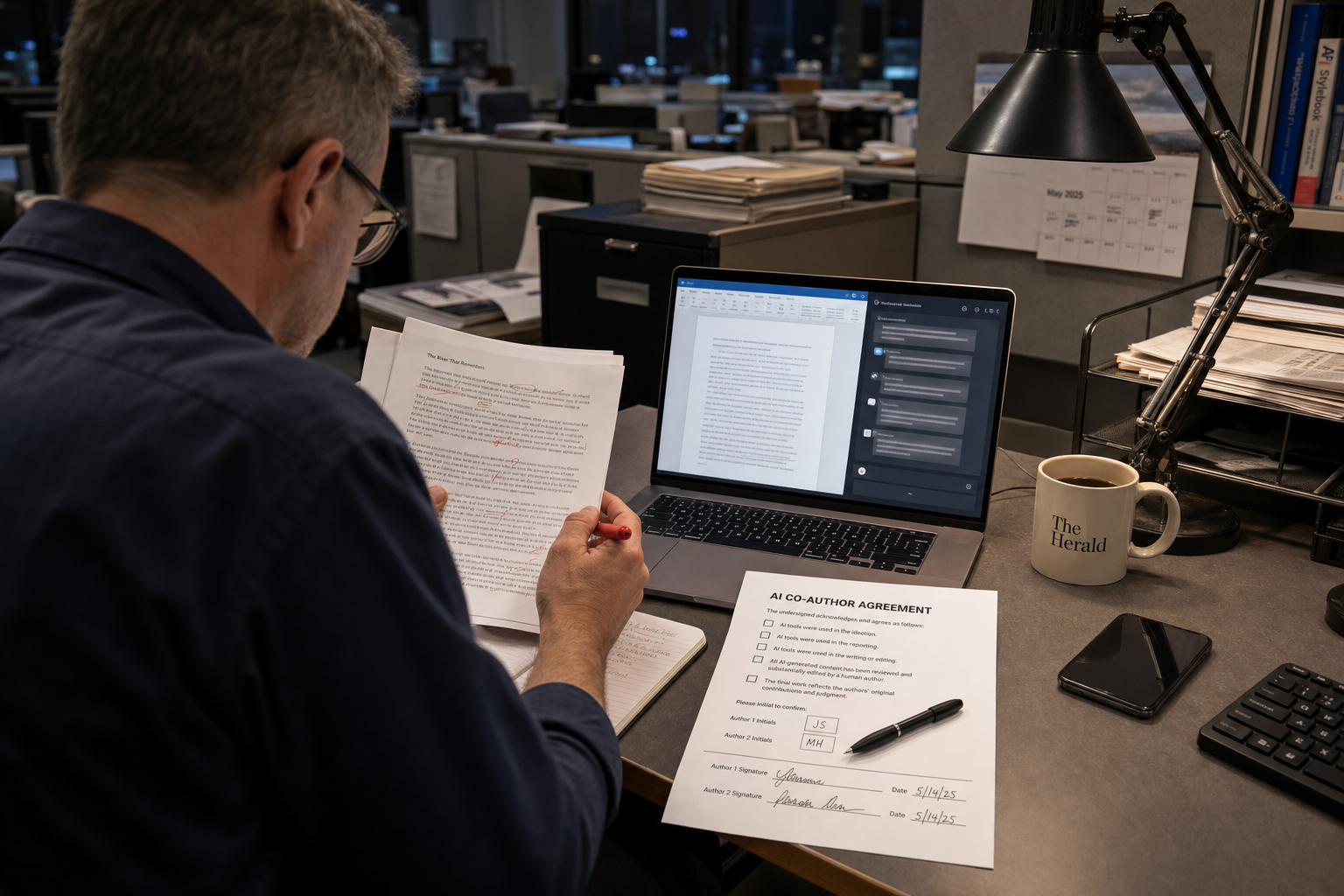
AI-assisted writing has moved from novelty to routine. Newsletter editors use it to draft intros, student magazines use it to clean up copy, community pages use it to translate updates, and independent writers use it to test structure or headlines. That shift matters because publishing habits have moved faster than publishing rules. When a machine helper shapes a piece, readers still need to know who wrote it, who checked it, and who will answer for errors.
The debate is not whether these tools can be useful. They can save time, widen access, and help people who work across languages or with small budgets. The tension is about trust. Some writers see AI as just another editing aid and think disclosure rules will smother experimentation. Others see hidden machine writing as a direct threat to authorship and credibility. My view is simpler: before you publish AI-assisted work, agree on five basic points. That protects creativity by giving it clear boundaries.
This agreement is really for people, not machines
The phrase “AI co-author” is catchy, but it can mislead. A text generator can produce sentences. It cannot verify a quote, accept legal risk, correct a factual error, or explain why a judgment call was made. The agreement, then, is not with the system. It is among the humans around it: the writer, the editor, the publication, and the reader.
That matters even more because the legal picture is still uneven in some places, especially around copyright, ownership, and training data. But even where the law is uncertain, the editorial principle is not. Human publication requires human responsibility.
1. What exactly did the system do?
Start with a plain description. Did the tool suggest headlines? Rewrite a clumsy paragraph? Summarize notes? Draft whole sections? Translate text? Generate captions? These are not the same thing, and they should not be treated as the same thing.
A community newsletter that uses AI to shorten meeting minutes is taking a different editorial risk from a magazine that asks a system to write a first draft of reported analysis. One use is light assistance. The other shapes the substance of the piece.
If you cannot describe the tool’s role in one sentence, you probably do not understand the workflow well enough to publish from it. A simple internal note can solve this: “Used for outline and headline options,” or “Used to generate a rough draft from author notes, then fully rewritten by staff.”
2. What source material went into the system, and were you allowed to use it?
This question is often missed. Writers may paste in interview transcripts, class assignments, internal documents, customer emails, or unpublished drafts without thinking about privacy, consent, or ownership. That is a problem.
If the material contains personal information, confidential reporting, or copyrighted text you do not control, do not assume a tool is a safe workspace. Check the platform’s terms and your publication’s rules. Some systems may store or process data in ways your source did not agree to. In other cases, the legal status is still unclear.
For student publications and community projects, this can be the difference between a useful shortcut and a preventable breach of trust. A good rule is simple: do not feed private or sensitive material into a system unless you have clear permission and a clear reason.
3. Who gets the byline, and who can defend every line?
The byline should belong to the person or people who can explain the reporting, the argument, and the final wording. Not to the tool. If a writer cannot explain where a claim came from because “the system added that part,” the claim should be removed or checked from scratch.
This is where many arguments become clearer. AI can help produce language. It does not qualify for human credit in the way an actual collaborator does. A human co-writer can discuss choices, accept edits, and share accountability. A model cannot do that.
If no human can explain and defend a sentence, that sentence is not ready to publish.
This rule protects both writers and readers. It also keeps the byline meaningful, which still matters in a media environment full of recycled text.
4. What will you tell readers?
Disclosure should be proportional, not theatrical. Readers do not need a warning label for every grammar suggestion or spellcheck. But if a system materially helped draft, restructure, summarize, or translate a published piece, some level of disclosure is usually fair.
The goal is not confession. It is context. Readers deserve to know when machine assistance had a real role in shaping what they are reading. That is especially true for reported features, personal essays, opinion writing, and any piece that depends on voice or trust.
If a student paper uses AI to fix grammar in an events listing, a public note may be excessive. If it uses AI to draft the introduction to a profile of a local activist, readers should know. The line will vary by publication, but the principle should not.
Good disclosure is brief and specific:
This article was produced with AI assistance for outlining and copy editing. All reporting, verification, and final wording were completed by the author and editor.
That kind of note does not kill the piece. It tells the reader what matters.
5. Who revised the final draft, and who owns the consequences?
Before publication, someone must review the finished piece line by line. That means checking names, dates, figures, quotations, links, tone, and attribution. It also means watching for a common AI failure: confident wording built on weak or false claims.
The review should include style and fairness. Machine-generated phrasing can flatten a writer’s voice, introduce clichés, or reproduce bias from training data. A fast draft is not a finished draft.
Then comes the last part: responsibility after publication. If a reader challenges the piece, who answers the email? Who issues the correction? Who explains the sourcing? A publication should never be in the position of saying, in effect, “the tool wrote it.” That is not an editorial defense.
A light policy beats a confused one
Small publications do not need a 20-page handbook. They need a short rule set that people will actually use. A workable minimum could look like this:
- Record AI use in the draft notes.
- Do not input private or sensitive material without permission.
- Keep the human byline tied to human accountability.
- Disclose material AI assistance to readers.
- Require a human editor or author to verify the final text.
- Name one person responsible for corrections or complaints.
This is not anti-technology. It is basic publishing hygiene. It gives writers room to experiment while keeping standards visible.
The point is trust, not purity
There is a real case for AI assistance in writing. It can help non-native speakers organize ideas. It can help exhausted volunteer editors produce cleaner copy. It can help independent writers test structure, cut repetition, and work faster. Those are genuine benefits.
But the counterpoint is just as real. Hidden machine drafting can weaken voice, spread mistakes at scale, and blur the line between support and substitution. If the public starts to feel that no one truly stands behind published words, the damage will not be technical. It will be editorial.
That is why the AI co-author agreement matters. Before you publish, decide what the system did, what material went into it, who owns the byline, what readers should be told, and who will answer for the result. A machine can help make a draft. Only people can make it publishable.