When AI Becomes a Creative Partner: A Practical Workflow for Writers Who Want to Keep Their Voice
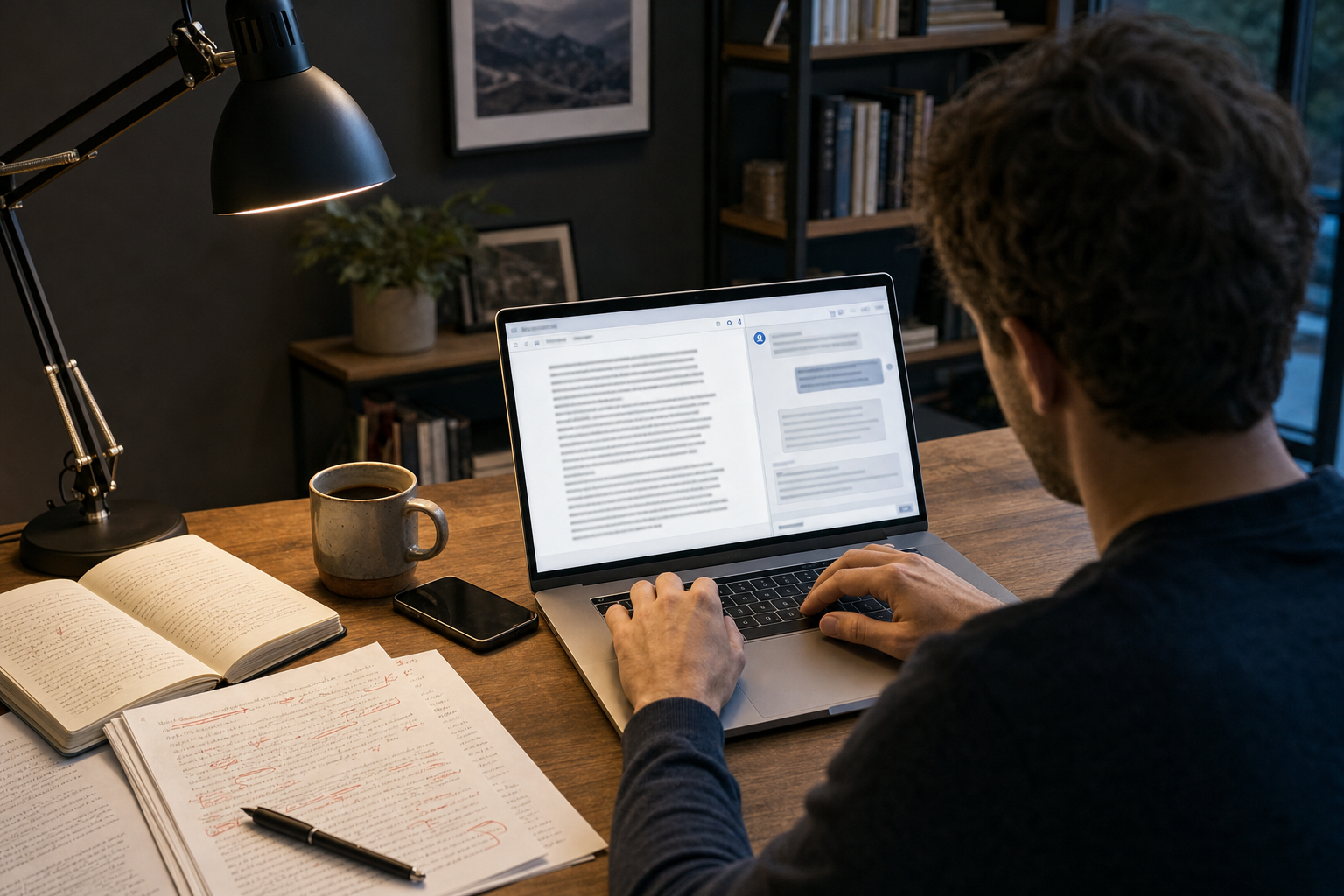
AI writing tools have moved from novelty to routine. Students use them to start drafts. Professionals use them to summarize reports, shape presentations, and clean up emails. Writers use them to get unstuck. That shift matters because the real question is no longer whether people will use AI in writing. It is how to use it without ending up with the same smooth, empty prose as everyone else.
That is the central tension. AI can save time, widen the range of ideas, and improve clarity. It can also flatten style, weaken judgment, and make writers hand over the hardest part of the job: deciding what they actually mean. My view is straightforward: writers should use AI as a creative partner for brainstorming, testing, and editing, but they should not let it become the source of their voice.
The real risk is not just error. It is sameness.
Most concerns about AI writing focus on accuracy, plagiarism, or academic integrity. Those risks are real. But for many everyday writers, a different problem shows up first: generic language.
AI systems are trained to predict plausible next words from large patterns in existing text. That makes them good at producing competent sentences. It also makes them prone to familiar rhythms, standard transitions, and safe conclusions. The result often sounds polished on first reading and forgettable on the second.
That matters because voice is not a luxury item added at the end. It is how a writer signals judgment, confidence, humor, restraint, and point of view. A grant proposal, a newsletter, an essay, and a product memo all need clarity. But they also need choices that sound like they came from a real person with a reason to write.
For non-native English speakers, the issue can be even more delicate. AI can help clean up grammar and make a draft easier to follow. That is a real benefit. But if every unusual phrasing is smoothed away, the writing may become correct and lifeless at the same time.
A human-first workflow that actually works
The best way to keep your voice is not to avoid AI entirely. It is to give it a narrow job at each stage. Here is a practical workflow that keeps authorship where it belongs: with the writer.
- 1. Start without the tool. Before you open an AI assistant, write a short private note to yourself. State the audience, the point, the tone, and the stakes in your own words. If you cannot explain what you want to say in six to eight lines, the system will end up making too many choices for you.
- 2. Use AI to expand options, not decide the argument. This is the right stage for brainstorming angles, examples, objections, headlines, or interview questions. It is the wrong stage to ask for a full article and then try to “make it yours” afterward. Once a machine-generated structure takes over, many writers start editing around it instead of thinking independently.
- 3. Build the outline yourself. You can ask for suggested structures, but make the final outline with your own priorities. Choose what comes first, what supports the claim, and what can be cut. Structure is where much of a writer’s judgment lives.
- 4. Draft the key passages in your own language. Write the opening, the thesis, the transitions, and the sections that carry your core reasoning. These are the parts readers remember. If those sections are outsourced, your name may be on the piece, but your voice will not be.
- 5. Bring AI in as a precise editor. Ask it to flag repetition, jargon, weak transitions, missing counterarguments, or paragraphs that assume too much background knowledge. Narrow tasks produce better results than broad requests like “improve this.”
- 6. Do a final voice check. Read the piece aloud. Compare it with something you wrote before AI entered your workflow. Cut any sentence that sounds impressive but not natural. Restore specific nouns, concrete examples, and turns of phrase you would actually use.
If you would be embarrassed to say a sentence out loud, do not publish it just because the wording sounds polished.
What this looks like in practice
Take a writer working on an opinion piece about remote work. A weak AI workflow would be simple: ask for an 800-word article, then trim it. The result will probably be clean, balanced, and dull.
A stronger workflow looks different. The writer first notes a clear position: remote work is good for focused tasks but bad for weak managers who rely on constant visibility. Then the writer asks AI for three counterarguments, two recent examples of policy reversals, and five questions skeptical readers might ask. After that, the writer builds an outline, drafts the argument alone, and uses AI at the end to spot repeated phrases and overlong sentences.
The tool helped. But it did not choose the point. It did not decide the emphasis. It did not flatten the writer’s angle into generic workplace commentary.
The same method works outside journalism. A consultant can use AI to test whether a client memo is clear to a non-expert reader. A student can use it to find weak transitions and unclear claims before submitting a draft written in their own words. A non-native English speaker can use it to simplify grammar while keeping the ideas and examples intact.
Where AI genuinely adds value
Used well, AI can improve writing in ways that are practical, not magical.
- It can speed up early exploration. A blank page is slower than a page full of options.
- It can surface gaps. A writer may know their position but miss the strongest objection to it.
- It can improve readability. Dense paragraphs, filler phrases, and buried conclusions are easier to spot with outside help.
- It can support language access. For people writing in a second language, AI can lower friction without removing ownership.
Those are meaningful gains. They are also easy to overstate. Better wording is not the same as better thinking. A polished paragraph can still carry a weak idea.
Where writers should be careful
Writers who rely on AI too early or too broadly tend to run into the same problems.
- They lose specificity. The system replaces exact details with familiar abstractions like “in today’s fast-paced world” or “it is important to consider.”
- They accept false confidence. The prose may sound authoritative even when the facts are thin or wrong.
- They weaken their own development. Early-career writers learn by wrestling with structure, evidence, and tone. If that struggle disappears completely, growth slows down.
- They risk privacy and policy problems. Drafts may contain client information, unpublished ideas, or internal data that should not be pasted into a third-party system. Employers, publishers, and schools may also have specific rules about AI use.
These are not reasons to reject the tools. They are reasons to use them with discipline.
The fair counterpoint
Some people will say this workflow is idealistic. Under deadline pressure, a full AI draft can be useful. That is true. There are moments when speed matters more than style, especially for routine documents, internal summaries, or first-pass background material.
But that argument has limits. The more public, personal, or consequential the writing is, the less wise it is to outsource the first draft entirely. An editorial, application essay, speech, pitch, or signed analysis carries your name and your judgment. In those cases, convenience is a weak trade for voice.
There is also a difference between using AI to help you write and using it to avoid writing. The first can strengthen your process. The second can quietly hollow it out.
Use AI to sharpen the work, not replace the writer
The strongest case for AI in writing is not that it can produce acceptable text quickly. It is that it can help a writer think wider, revise harder, and notice weak spots earlier. That is useful. But it only works if the writer keeps control over the claim, the structure, and the final tone.
A practical rule is simple: let AI widen the menu, but do not let it choose the meal. Use it to brainstorm, challenge, simplify, and edit. Keep the essential human tasks for yourself: deciding what matters, weighing what is true, and writing the sentences that sound like they came from you.
That is how AI becomes a creative partner instead of a ghostwriter. And for anyone who wants speed without losing identity, that distinction is the whole game.