AI Can Generate Art, but Creativity Still Needs a Human Center
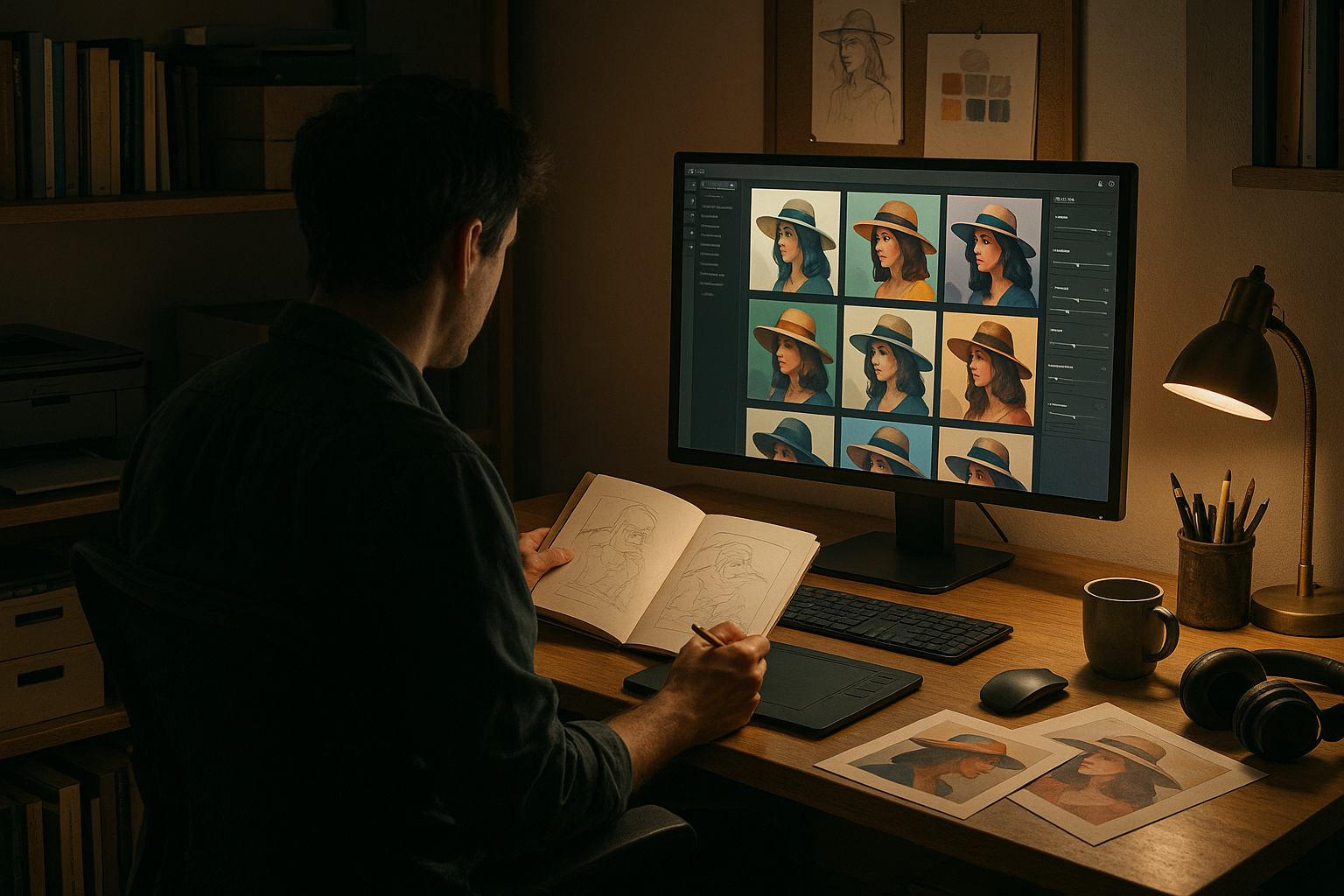
AI art, AI writing, AI poetry, and AI music are no longer side experiments. Image generators can produce polished visuals in seconds. Writing systems can draft stories, slogans, and sonnets on command. Music tools can assemble melodies, harmonies, and background tracks with very little technical skill from the user. This matters because creativity is not a niche issue. It shapes culture, education, media, and a large part of the modern economy.
The debate is now clear. If an AI system can produce something that looks like a painting, sounds like a song, or reads like a poem, should we call that creativity? My view is that AI can create useful and sometimes striking outputs, but it does not create in the full human sense. It generates from patterns. The deeper creative act still depends on human intent, taste, context, and responsibility. That distinction matters more than ever.
What AI systems are actually doing
First, the basic fact. Today’s creative AI systems are trained on large amounts of existing human-made material: images, text, audio, video, and code. They learn statistical relationships in that material. Then they generate new outputs based on prompts, probabilities, and constraints.
That process can produce results that feel fresh. A user can ask for a film poster in a 1970s style, a poem with spare language, or a piano track for a quiet documentary scene. The output may be original in the narrow sense that it is newly generated and not a direct copy. But it is still built from patterns learned from past work.
That is why AI creativity is both real and limited. Real, because the outputs can be surprising and useful. Limited, because the system is not drawing on lived experience, moral judgment, or personal stakes. It has no childhood, no grief, no political commitment, no memory of a place, no reason to choose one image over another except the goals set by its design and by the person using it.
That last point is not philosophical decoration. It changes how we should value the result.
Why many people still see this as creativity
The strongest argument on the other side is simple: audiences judge the work, not the tool. If a poem moves a reader, if a song creates atmosphere, if an image captures attention, why should the production process matter so much?
That is a fair challenge. In practice, people often respond to the finished piece first. A strong AI-generated illustration can solve a design problem. An AI writing tool can help a marketer find a cleaner line. An AI music generator can help a small studio produce a soundtrack on a tight budget. In these cases, the output does some of the work that we associate with creativity.
There is also a real democratic promise here. AI tools can lower barriers to entry. A person who cannot draw can sketch ideas through prompts. A founder with no agency budget can test ad concepts. A student can experiment with tone, rhyme, or story structure. A disabled creator may find new ways to make visual or musical work. Used well, AI can widen participation.
That is not a trivial benefit. For many people, creative industries have always had high gates: training, cost, software, connections, time. AI content generation can reduce some of that friction.
But output alone is not the whole story
Still, there is a reason many artists, writers, and musicians resist the idea that generated output should be treated as equal to human creativity. Art is not only an object. It is also an act of selection, intention, and meaning.
A poem about loss means something different when it comes from a person working through grief than when it is produced by a model imitating the language of grief. A song associated with a movement or a community carries context that goes beyond chords and lyrics. A painting often matters partly because of who made it, why they made it, and what conversation it enters.
This is where authorship still matters. Not because human creators are automatically superior, but because culture is relational. People care about source, not just surface. They want to know who is speaking, what experience shaped the work, and who stands behind it.
That is why AI writing can be useful for drafting but still feel empty as a finished piece. It can imitate tone without owning a point of view. AI poetry can reproduce rhythm and image patterns without having anything at stake. AI art can be visually impressive while saying very little once the first surprise fades.
Of course, human-made work can also be shallow. A human signature does not guarantee depth. But when strong work appears, the human creator can explain choices, revise with purpose, and accept responsibility for what the work does in public. That remains a major difference.
The hidden dependence on human labor
There is another issue that should stay in view: these systems do not emerge from nowhere. Much of their power comes from training on human-made archives. That includes paintings, photographs, articles, novels, songs, and performances produced over many years.
So when people say AI has become creative on its own, they often skip over the human source material that made the system useful in the first place. The machine-generated result may be new, but it is deeply dependent on prior human expression.
This is where the legal and ethical debate becomes more concrete. Many creators argue that their work was used to train commercial systems without clear permission, payment, or credit. Companies argue that training is transformative and that large-scale learning from data is what makes the technology effective. Courts and regulators are still sorting that out in many places.
The facts here are still developing. But the tension is obvious. AI creativity looks less magical when you remember how much hidden human labor sits underneath it.
The real risks are not only artistic
The excitement around AI creativity can make the risks sound secondary. They are not. Some are already visible.
- Creative jobs can be squeezed. Stock illustrators, background musicians, junior copywriters, and other entry-level workers are especially exposed when speed and low cost become the main buying criteria.
- The market can be flooded with cheap content. When producing images, articles, and music becomes nearly free, attention becomes harder to earn and quality becomes harder to signal.
- Style can be copied too easily. Even when output is not a direct duplicate, it may closely mimic living artists in ways that feel extractive.
- Average quality can rise while distinctiveness falls. AI is good at producing competent work. That can push culture toward the familiar and reduce appetite for slower, stranger, more personal expression.
- Trust can weaken. If songs, speeches, photos, and texts can be generated at scale, audiences need stronger ways to verify source and intent.
These are not arguments against the technology itself. They are arguments against using it carelessly and pretending the social effects are minor.
What AI is best at, and what it is not
In practical terms, AI is strongest as a creative assistant. It is good at variation, speed, and exploration. It can generate twenty rough concepts before a human would finish two. It can help a writer test different headlines, help a designer mock up styles, or help a composer try alternate textures.
That makes it powerful in early stages of work. It can reduce blank-page anxiety. It can help people move from idea to draft faster. It can support editing, brainstorming, translation, and adaptation across formats.
But the final mile still matters most. Deciding what deserves to exist, what should be cut, what is honest, what is derivative, what is harmful, what is worth signing your name to: those are not small finishing touches. They are the center of serious creative work.
That is why the most convincing future is not “AI replaces artists.” It is “artists, editors, musicians, and designers who use AI well may outperform those who ignore it.” Even then, the human role is not optional. It becomes more editorial, more curatorial, and in some cases more responsible than before.
A better question than “Can machines create?”
The headline question is useful, but it can also trap the discussion. “Can machines create art, poetry, and music?” Yes, in the sense that they can generate outputs that function as art-like or even art-worthy objects. No, in the sense that creativity in public life is about more than making artifacts. It is also about intention, relationship, accountability, and meaning.
So the better question is this: what kind of creative culture do we want these tools to support?
If the goal is speed alone, AI will push culture toward quantity. If the goal is imitation, it will reward pastiche. If the goal is access, experimentation, and collaboration, it can become a useful instrument. The outcome is not fixed by the software. It depends on standards, incentives, and choices.
Some practical principles would help:
- Be honest about process. If a work is heavily AI-generated, audiences, clients, and collaborators should know. Disclosure will not solve every problem, but it helps preserve trust.
- Protect consent and compensation. Creative tools should not depend on quietly absorbing the work of artists, writers, and musicians without serious rules around licensing, attribution, and payment.
- Keep a human accountable. Someone should be able to explain why a piece was made, what it is trying to do, and why it should stand in public. “The model produced it” is not enough.
- Use AI to expand options, not flatten them. The point should be to explore, test, and iterate, not to replace judgment with averages or fill every channel with interchangeable material.
- Preserve pathways for emerging creators. If every junior task is automated away, the next generation loses the space where craft is learned. A creative economy still needs apprenticeships, not only tools.
- Reward originality, not just efficiency. Institutions, publishers, studios, and platforms shape taste through what they commission, fund, and promote. If they reward only speed, they should expect thinner culture.
Why the human center matters even more now
It is tempting to hear all this and think the human role is simply shrinking. In one sense, some routine parts of creative work probably will shrink. But the more important truth may be the opposite: as generation gets cheaper, human judgment becomes more valuable.
When anyone can produce a plausible image, paragraph, or soundtrack in seconds, the scarce thing is no longer output. The scarce thing is direction. Who knows what is worth making? Who can tell the difference between competent and necessary? Who can connect a work to a real audience, moment, or moral context?
That is the work of editors, curators, teachers, designers, producers, and artists themselves. It is also the work of communities that decide what they want to preserve, celebrate, reject, or question. Creativity has never been only about making more things. It has also been about deciding what deserves attention.
AI does not remove that burden. It intensifies it.
This is especially important in education. Students will increasingly use AI to brainstorm, draft, remix, and visualize ideas. The goal should not be a panicked attempt to pretend the tools do not exist. The goal should be to teach discernment. What did the student actually choose? What did they understand? What can they defend? What part of the work reflects their own thought?
The same standard applies in professional life. AI can help produce options, but professionals still need a point of view. A publication still needs an editor. A brand still needs a voice. A filmmaker still needs a reason for this scene, this image, this silence. The tool may accelerate production, but it cannot supply conviction.
Creativity is not just generation
One reason the debate gets tangled is that we often use the word creativity for several different things at once. We may mean novelty, technical skill, expressive depth, cultural impact, or personal originality. AI scores well on some of these dimensions and poorly on others.
It can generate novelty at scale. It can simulate styles and combine forms in ways that feel inventive. It can help people with limited training produce material that would otherwise be out of reach. Those are meaningful capabilities.
But creativity in the richer human sense also involves risk, memory, desire, conflict, restraint, and consequence. It involves knowing why one version is truer than another. It involves choosing not only what can be made, but what should be said, what should be left unsaid, and what one is willing to stand behind after the applause or criticism arrives.
That is why the strongest human art often carries more than technique. It carries a center of gravity. It comes from somewhere. Even when it is playful or experimental, it is anchored in a life, a pressure, a question, or a commitment. AI can assist around that center. It cannot replace it.
The future is likely to be hybrid, but not neutral
Most creative fields will probably settle into a hybrid reality. Some works will be fully human-made. Some will be AI-assisted. Some will be generated mainly by machines and lightly edited by people. The boundaries will keep shifting, and different audiences will value those categories differently.
What matters is that we do not pretend all of those paths mean the same thing. A hand-drawn illustration, a licensed AI-assisted campaign, and an anonymous stream of generated images may all have uses, but they do not occupy the same cultural ground. Treating them as interchangeable would not be technological progress. It would be a failure of judgment.
The question, then, is not whether AI can produce art-like outputs. It plainly can. The real question is whether we will let convenience redefine creativity until meaning, credit, and responsibility disappear into the background.
We should resist that drift. Not because machines are useless, and not because every tradition must stay untouched, but because culture needs more than supply. It needs people who care what a work says, where it came from, and what it does to others.
AI can generate images, melodies, and language with remarkable speed. It can widen access and unlock new forms of experimentation. But a culture worth living in still needs human beings at the center of the creative act: to choose, to interpret, to answer for the work, and to make something that is not only impressive, but meant.