The AI Adoption Gap: Why “Everyone Uses AI Now” Leaves Real Learners Behind
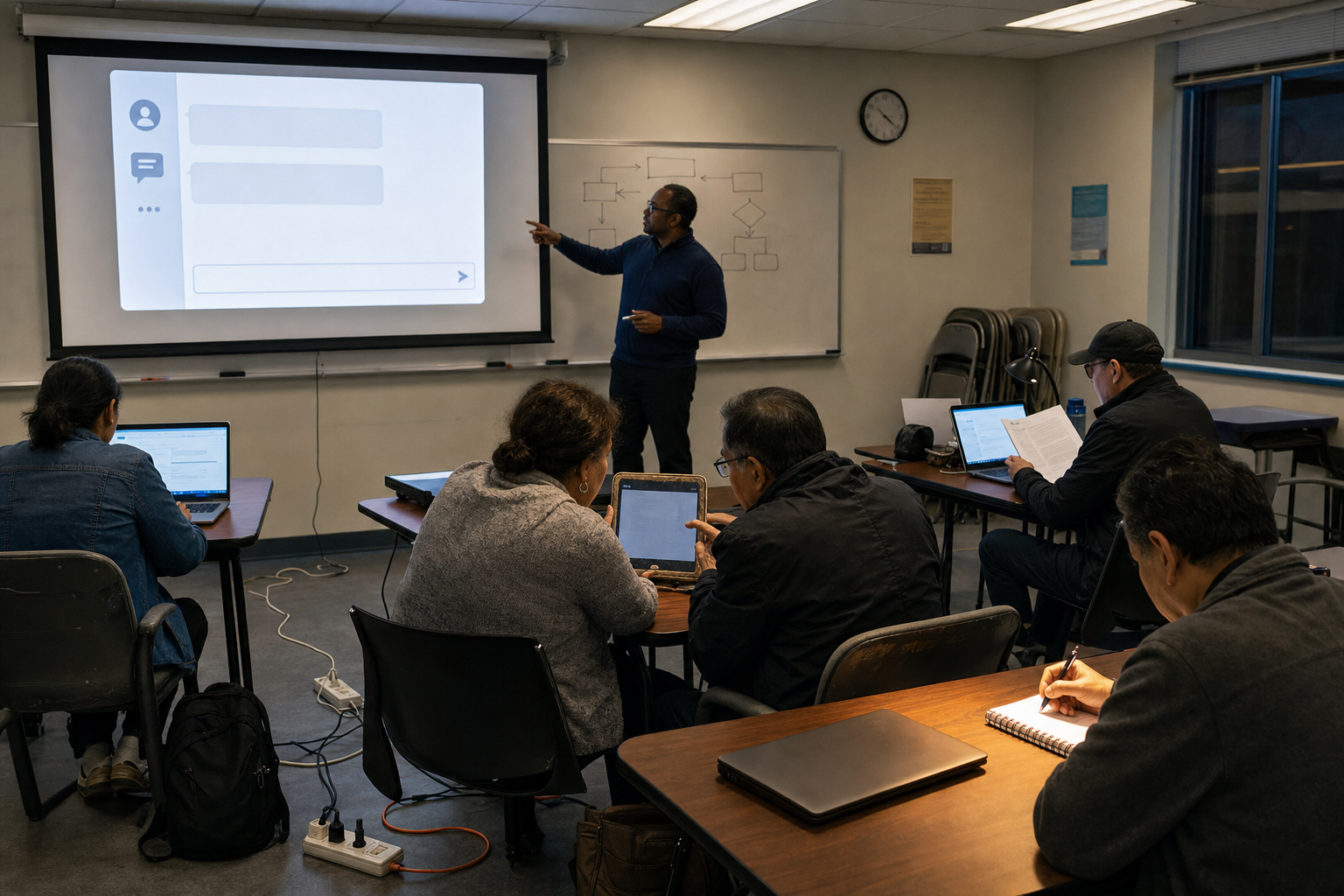
“Everyone uses AI now” has become a casual line in offices, classrooms, and online debates. It sounds plausible because AI tools have spread quickly, especially in writing, coding, search, and routine office work. But fast adoption is not the same as universal adoption. Treating it that way turns a real shift in technology into a false social fact.
That matters because assumptions become policy. Employers write job descriptions that quietly expect AI fluency. Schools redesign assignments around AI use or ban it as if all students face the same choices. Managers cut training because they think workers already learned these tools on their own. The tension is simple: AI is becoming common, and it can be genuinely useful, but access, confidence, language, disability, cost, and institutional rules still decide who benefits and who falls behind.
Widespread is not universal
It is fair to say AI use is growing quickly. Many students have tried chatbots. Many professionals use AI to draft emails, summarize documents, write code, translate text, or brainstorm ideas. In some industries, not using AI at all is already unusual.
But “common” and “universal” are not the same word. Use varies by job, country, income, age, language, and workplace policy. A software engineer with a paid subscription, a fast laptop, and a manager who encourages experimentation does not face the same reality as a retail worker using an old phone, a student sharing a family device, or a public employee blocked by strict data rules.
The loudest voices also distort the picture. Tech workers, active online users, and early adopters are overrepresented in public discussion. If your social feed is full of people comparing prompts and AI workflows, it is easy to mistake a visible subculture for the whole population.
This is not a minor wording issue. When leaders hear “everyone,” they stop asking who still needs support.
The real learners are not resisting. They are navigating constraints
The people left behind by the “everyone uses AI” story are often described as slow, skeptical, or unprepared. That description misses the point. Many are not refusing to learn. They are dealing with practical limits.
- Access and cost: Free tools are often limited. Paid versions are better for file uploads, longer context, speed, and reliability. For a student, job seeker, or lower-paid worker, a monthly subscription is not trivial.
- Language: AI tools often work best in English or other major languages. A user can technically access the system but still get weaker results, worse guidance, or lower confidence if the interface, examples, and community advice are not in their strongest language.
- Disability and usability: Some tools help with accessibility. Others create new barriers through poor keyboard support, cluttered interfaces, or inconsistent output. A tool is not truly available if it is hard to use with screen readers, voice input, or assistive software.
- Confidence and social risk: Not everyone feels safe experimenting. Some workers worry that using AI will look dishonest, lazy, or careless. Some students worry they will break rules they do not fully understand.
- Institutional rules: Many workplaces block public AI tools or ban them for sensitive tasks. Many schools allow some uses but do not explain where the line is. People are told to “use AI” and “be careful” at the same time, with little practical guidance.
These are ordinary barriers, not rare exceptions. That is exactly why they matter. A social transition is defined less by the most capable users than by the people trying to catch up under normal conditions.
How the false assumption shows up in education
Education is one of the clearest places to see the adoption gap. A teacher may say, “Use AI to generate ideas, then write your own draft,” assuming this is a neutral instruction. It is not neutral if one student has a paid tool, a private laptop, and strong English skills, while another relies on a phone, a weak connection, and free access that times out or limits uploads.
The same problem appears on the other side. A total AI ban can also widen inequality. Students with private access at home may still use it quietly. Students who follow the rules or lack access do not. The result is a hidden advantage for the already advantaged.
There is also a deeper problem: schools increasingly talk about “AI literacy” without always defining it. If AI literacy means knowing when to trust a summary, how to verify a claim, how to protect private data, and how to disclose assistance, then it should be taught. If it becomes a vague expectation that students somehow absorb on their own, it becomes a filter for privilege.
The practical question for educators is not whether students are aware of AI. Most are. The question is whether they have equal chances to learn how to use it well, safely, and honestly.
Hiring and work can punish people for a gap they did not create
The same pattern is spreading into hiring. Employers increasingly ask for “AI fluency,” “prompting skills,” or “experience with AI tools.” Sometimes that makes sense. In many roles, these tools now save time. But hiring language can become sloppy very quickly.
If a company says candidates should “already know how to use AI,” what does that mean? Does it mean they can draft a better email? Automate a spreadsheet? Review model output for errors? Understand confidentiality rules? The phrase often hides a real training failure. Employers want the productivity gains without paying for the learning curve.
That is especially unfair to job seekers changing careers, returning to work, or coming from institutions that restricted AI use. A candidate who has not spent the last year experimenting with premium tools is not necessarily less capable. They may simply have had less access, less permission, or more risk.
Inside workplaces, the adoption gap creates another distortion. Managers may assume staff already use AI in their personal lives, so formal training looks unnecessary. Then workers either avoid the tools or use them quietly without clear standards. That is a bad outcome for both productivity and governance. Hidden use increases errors, privacy risks, and uneven performance expectations.
Yes, rapid adoption is real, and ignoring it would also be a mistake
There is a valid counterpoint here. Institutions should not talk as if AI were a niche curiosity. That would also misread reality. Many people do use these tools regularly, and in some cases they are already part of normal work. Good AI systems can help users draft faster, translate across languages, summarize dense material, generate first-pass code, and support some accessibility needs.
It would be a mistake to protect learners by pretending nothing has changed. Students do need guidance. Workers do need training. Job seekers do need a fair chance to build relevant skills.
But that argument supports a stronger response, not a weaker one. The faster adoption moves, the more important it is to distinguish between awareness, occasional use, skilled use, and equitable access. A person who tried a chatbot twice is not in the same position as a person who has integrated several tools into daily work with paid access and company support.
The better question is not “Who uses AI?” but “Who can use it well?”
Before institutions assume AI readiness, they should check for real access, clear rules, and time to learn.
A better policy starts with a more honest sentence: AI use is rising, but support is uneven. That small change forces better decisions.
- Measure actual access: Do students or staff have approved tools, enough devices, and reliable connectivity? Or is “access” just an assumption?
- Pay for the tools you expect people to use: If a school or employer benefits from AI-assisted work, free-tier dependence is not a serious strategy.
- Teach the basics explicitly: Good prompting matters less than judgment. People need to know how to check facts, protect sensitive data, disclose assistance, and recognize weak output.
- Support multilingual and accessible use: Training, examples, and policy documents should not assume strong English or a standard interface experience.
- Keep alternative paths open: If someone cannot use AI for cost, disability, privacy, or policy reasons, they should not be locked out of learning or work by default.
- Stop treating AI literacy as a personality trait: It is a teachable skill set, not a sign that someone is naturally ahead or behind.
The phrase matters because people hear it as a verdict
When leaders say “everyone uses AI now,” they usually mean the technology has become too important to ignore. That part is fair. But many people hear something else: if you are not already fluent, you are late; if you are cautious, you are backward; if you need help, you are the problem.
That is the wrong message at the wrong time. AI adoption is not a single moment that everyone passed together. It is a messy transition, shaped by money, language, rules, design, trust, and training. The institutions that admit this will build better classrooms, fairer hiring, and safer workplaces.
The practical conclusion is simple. Do not plan around the most visible users. Plan around the real learners. They are the ones who will decide whether AI becomes a broad public benefit or just another tool that rewards people who were already ahead.